
Does Democracy Have a Future in Pakistan?
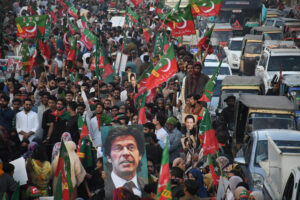
The break between the military and former prime minister Imran Khan marks a new era of instability. Is this the rise of an autocratic deep state or the fall of authoritarian populism? | Ayesha Jalal
1172 Results
The break between the military and former prime minister Imran Khan marks a new era of instability. Is this the rise of an autocratic deep state or the fall of authoritarian populism? | Ayesha Jalal
October 1998, Volume 9, Issue 4
Reports on elections in Belize, Cambodia, Colombia, the Czech Republic, Ecuador, Madagascar, the Philippines, and Togo.

April 2014, Volume 25, Issue 2
How do democracies emerge from monarchies? In an essay that eminent political scientist Juan J. Linz was working on when he passed away in October 2013, he and his coauthors draw lessons from the European experience about whether and how Arab monarchies might aid or resist democratic development.
July 2009, Volume 20, Issue 3
In the two decades since the Tiananmen massacre, China has enjoyed rapid economic growth and a measure of political stability. Recently, however, various forms of popular protest have been increasing. Do they represent a potentially serious threat to CCP rule?
October 2010, Volume 21, Issue 4
Religion in various forms is burgeoning in the PRC today, and the ruling Chinese Communist Party cannot decide what to make of it—or do about it.
April 2024, Volume 35, Issue 2
The belief we can “escape” remains a part of the liberal imagination. In truth, it is realized in the form of detachment from any community, an exodus without refuge.
April 2022, Volume 33, Issue 2
In 2021, autocrats’ efforts to reshape the global order enabled heavier repression and brazen power grabs, while democracies faltered. Is this a tipping point?
July 2020, Volume 31, Issue 3
The illiberal credo prominent in Russia’s foreign policy is more than just a clever political ploy. Rather, this outlook reflects the traumatic experience of the 1990s, and it is stoked by young political thinkers, the Russian Orthodox Church, and the Kremlin itself.
October 2019, Volume 30, Issue 4
To a degree that is still not widely appreciated, the BJP has replaced Congress as India’s party of welfarism. The carefully crafted political persona of Prime Minister Narendra Modi as the “leader of the poor” has been crucial to this shift.
October 2019, Volume 30, Issue 4
The first half of President Rodrigo Duterte’s single six-year term saw steady erosion of legal barriers against abuses of power, typified by a bloody and extralegal “drug war.” Yet in midterm Senate elections, Filipino voters gave him a decisive victory.
July 2016, Volume 27, Issue 3
As more and more African presidents attempt to remove or circumvent constitutional term limits, African populations increasingly are mobilizing en masse, at great risk, to defend their constitutions.
April 2016, Volume 27, Issue 2
Ten of the world’s twelve largest countries are “electoral democracies.” Yet a look at politics beneath the national level reveals patterns of illiberalism that mark out a new frontier for democratic research and activism.
January 2016, Volume 27, Issue 1
Ethiopia’s ruling party has long been tightening its grip, using antiterrorism laws and harsh restrictions on media and civil society to silence voices critical of the regime.
January 2014, Volume 25, Issue 1
Communism is gone, but while it was alive and in power it bred profound moral pathologies that still haunt the region.
April 2013, Volume 24, Issue 2
Latin America’s much-discussed political “left turn” has taken two very different forms. Why has the region’s commodities boom led some left-turn states to move toward “plebiscitarian superpresidentialism,” while others have resisted this temptation?
April 2013, Volume 24, Issue 2
Data from the latest wave of the Asian Barometer Survey show commonalities and variations in the sources of regime support in Southeast Asian countries. Most regimes—democracies and nondemocracies alike—draw political legitimacy from perceptions of effective and upright governance.
January 2013, Volume 24, Issue 1
In October 2012, Georgia’s government lost power in an election, and peacefully stepped aside. But can a country with Georgia’s troubled history capitalize on this surprising achievement?
July 2012, Volume 23, Issue 3
Although they have quieted down as quickly as they flared up, the clamorous protests that followed the dishonest Russian legislative elections in December 2011 have essentially destroyed Putin’s regime, the infamous “managed democracy.”
January 2011, Volume 22, Issue 1
Why are peacebuilding operations rarely able to establish postconflict democracies, and are there other strategies that would yield more successes?
October 2010, Volume 21, Issue 4
May 2010, Benigno Aquino III bested a crowded field to win the presidency. The election, which was remarkably clean and orderly, gave a clear victory to the reformist narrative that has long vied with populism in the Philippines.