April 2010, Volume 21, Issue 2
What Makes Legislatures Strong?
A review of The Handbook of National Legislatures: A Global Survey by M. Steven Fish and Matthew Kroenig, and Legislative Power in Emerging African Democracies edited by Joel D. Barkan.
April 2010, Volume 21, Issue 2
A review of The Handbook of National Legislatures: A Global Survey by M. Steven Fish and Matthew Kroenig, and Legislative Power in Emerging African Democracies edited by Joel D. Barkan.
July 2007, Volume 18, Issue 3
The Editors’ introduction to the first of two clusters on “The Democracy Barometers.”
April 2007, Volume 18, Issue 2
Although the overall state of democracy in the world differed little from that in 2005, a series of worrisome trends seem to be contributing to a stagnation of freedom.
April 2006, Volume 17, Issue 2
Contemporary liberal democracies, especially in Western Europe, face a major challenge in integrating Muslim immigrants as citizens of pluralistic societies.
July 2003, Volume 14, Issue 3
A review of Defending Democracy: A Global Survey of Foriegn Policy Trends 1992–2002, edited by Robert G. Herman and Theodore J. Piccone.
July 2003, Volume 14, Issue 3
A review of "Ending Civil Wars: The Implementation of Peace Agreements" Edited by Stephen John Stedman, Donald Rothchild, and Elizabeth M. Cousens.
April 2003, Volume 14, Issue 2
The claim that ethnic minorities have a moral and legal right to secede from states is a dangerous fiction with perilous implications for divided societies.
April 2003, Volume 14, Issue 2
A review of “Conversations with Gorbachev” by Mikhail Gorbachev and Zdenek Mlynár.
January 2003, Volume 14, Issue 1
A review of The Politics of Moral Capital by John Kane.
July 2002, Volume 13, Issue 3
Until now, globalization and democratization have been mutually reinforcing, but in the future globalization may pose serious challenges for democracy.
January 2002, Volume 13, Issue 1
The year 2001 saw modest gains in the strengthening and consolidation of democracy worldwide, but in predominantly Muslim countries—especially the Arab states—the status of freedom and democracy lags far behind the rest of the world.
October 1999, Volume 10, Issue 4
Read the full essay here.
October 1999, Volume 10, Issue 4
Read the full essay here.
October 1999, Volume 10, Issue 4
Read the full essay here.
October 1999, Volume 10, Issue 4
Read the full essay here.
October 1999, Volume 10, Issue 4
Read the full essay here.
October 1999, Volume 10, Issue 4
Review of The Lexus and the Olive Tree, by Thomas L. Friedman.
July 1999, Volume 10, Issue 3
The recognition of democracy as a universally relevant system is a major revolution in thinking, and one of the main contributions of the twentieth century. While not yet universally practiced, democracy is now being taken as generally right.
January 1999, Volume 10, Issue 1
Read the full essay here.
October 1998, Volume 9, Issue 4
Read the full essay here.
April 1998, Volume 9, Issue 2
Read the full essay here.
October 1995, Volume 6, Issue 4
Read the full essay here.
April 1995, Volume 6, Issue 2
Read the full essay here.
April 1995, Volume 6, Issue 2
A review of The Failure of Presidential Democracy, edited by Juan J. Linz and Arturo Valenzuela.
January 1995, Volume 6, Issue 1
The Editors’ introduction to “Democracy’s Future.”
January 1995, Volume 6, Issue 1
Democratic consolidation in the East will face the most difficulties in the cultural sphere. Democracy’s fate will depend on how the West handles its own sociocultural problems.
April 1994, Volume 5, Issue 2
A review of Capitalist Development and Democracy, by Dietrich Rueschemeyer, Evelyne Huber Stephens, and John D. Stephens.
October 1993, Volume 4, Issue 4
The Editors’ introduction to “The Challenge of Ethnic Conflict.”
July 1993, Volume 4, Issue 3
Read the full essay here.
July 1993, Volume 4, Issue 3
A review of Freedom House’s Freedom in the World: The Annual Survey of Political Rights and Civil Liberties, 1992-1993.
January 1992, Volume 3, Issue 1
A review of The Third Wave: Democratization in the Late Twentieth Century, by Samuel P. Huntington
Summer 1991, Volume 2, Issue 3
Read the full essay here. The Editors’ introduction to “The Unfinished Revolution.”
Winter 1990, Volume 1, Issue 1
The Journal of Democracy seeks to bridge some of these gaps. We hope that it will help to unify what is becoming a worldwide democratic movement. But like genuine democracy itself, the journal will be pluralistic. Its pages will be open to a wide variety of perspectives and shades of opinion, and it will seek…
Winter 1990, Volume 1, Issue 1
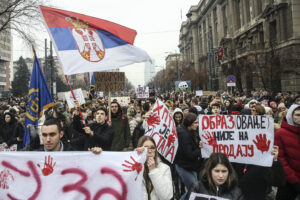
Read the full essay here. Image credit: Vuk Valcic/SOPA Images/LightRocket via Getty Images
How can we restore support for democracy in the world?” Journal of Democracy cofounder Larry Diamond sees three keys to reviving the drive for and commitment to democratic government: “Power, Performance, and Legitimacy.”
Cash is king, even if you are an activist leading a democratic movement against some of the world’s worst dictators. That’s why Bitcoin has quickly become the currency of choice for dissidents working everywhere.
Democracy is more resilient than many people realize, but that doesn’t mean there aren’t worrying signs on the horizon.
They are benefiting from a world that has grown more hostile for democracy and human rights. But it doesn’t need to be the case. Democracies need to double down on their own competitive advantage.
Moscow and China pose a great danger to the democratic world. But they pose threats that need to be managed, not won. Every great foreign-policy battle doesn’t end with a decisive victory.
The case for liberal democracy remains powerful. It may get its biggest boost in the near term from success on the battlefields of Ukraine.
Our struggle against the Soviet Union offers vital lessons for how to confront the aggressive totalitarian threat that Beijing now represents.
Many derided it as naïve idealism, but the vision undergirding the Freedom Agenda offers lessons for the biggest global tests of our time.
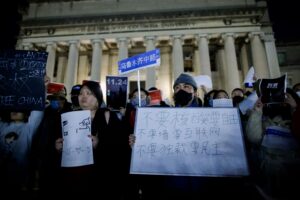
His military didn’t just fail. Ordinary Ukrainians, Russians, and people across the globe are creatively and nonviolently protesting Putin’s war on Ukraine, and they are making a difference.
China’s recent protests marked a crucial milestone: The mainstream Chinese public, at home and abroad, finally spoke up for the Uyghurs and their plight.
The government has spent billions preparing to host the 2022 World Cup. Never mind the abusive labor practices and human rights violations. It’s betting that your love of the “beautiful game” will make you more fond of this tiny Gulf state, too.
Across the globe, the people who run our elections are being undermined, targeted, and attacked. Here is how to shore them up—and protect democratic institutions, too.
National politics is increasingly overshadowing everything else, even as local government does more and more. Here’s how to right the balance.
Establishment parties are flagging. They should learn from political disruptors.
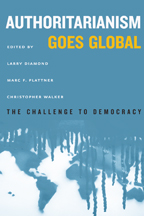
In recent years, as leading authoritarian countries such as China, Iran, Russia, Saudi Arabia, and Venezuela have become emboldened within the global arena, challenging the liberal international political order, the advanced democracies have retreated rather than responding to this threat.
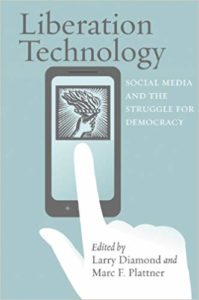
"Liberation technology" can help mobilize citizen protest and oust autocracies. Authoritarians can also use technology to stifle protest and target dissenters. Who will win the technological race between "netizens" demanding freedom and authoritarians determined to stay in power?