
July 2000, Volume 11, Issue 3
Arabs and Democracy: Illusions of Change
Many observers regarded 1999 as a year of progress for democracy in the Arab world. There is reason to doubt, however, whether any meaningful change has really occurred.
3081 Results
July 2000, Volume 11, Issue 3
Many observers regarded 1999 as a year of progress for democracy in the Arab world. There is reason to doubt, however, whether any meaningful change has really occurred.
April 2011, Volume 22, Issue 2
The past decade began at a high point for freedom but ended with freedom in peril. Yet the setbacks of the last five years do not outweigh the democratic gains of the last forty.
October 2017, Volume 28, Issue 4
Democracy’s retreat is real, yet alarmist reports of a global demise or crisis of democracy are not warranted.

October 2010, Volume 21, Issue 4
Religion in various forms is burgeoning in the PRC today, and the ruling Chinese Communist Party cannot decide what to make of it—or do about it.
July 2003, Volume 14, Issue 3
Liberty and self-government are not only good in themselves, but also have powerful and beneficial effects on a nation’s level of economic development and prosperity.
July 2016, Volume 27, Issue 3
Over the last decade or so, Bolivia has made great progress at wider political and social inclusion, but at some cost to civil liberties and horizontal accountability.
April 2006, Volume 17, Issue 2
The March 2005 “Tulip Revolution” that toppled President Askar Akeyev is often grouped with the “color revolutions” in Georgia and Ukraine, but in many ways the Kyrgyz case was unique.
October 2005, Volume 16, Issue 4
The election results reflect less what voters want than the ideological dynamics that shape the behavior of factions within the regime.
April 2001, Volume 12, Issue 2
Although friendly to business, Singapore’s government represses dissent and is far from transparent in its management of public funds. A leading dissident chronicles his struggle for greater openness.
April 2015, Volume 26, Issue 2
Saudi Arabia’s vast oil wealth sustains the antidemocratic policies that a nervous royal regime uses to defend against the threats and problems that confront it.
January 2011, Volume 22, Issue 1
Often thought of as a “nascent” democracy, Colombia actually has longstanding democratic institutions. In 2010, they were effective in determining who would succeed a highly popular, two-term president.
July 2010, Volume 21, Issue 3
For the first time since the fall of Pinochet, the Chilean right has come to power via free elections. The long-ruling center-left coalition leaves behind many achievements, but also disturbing signs of a weakened party system.

July 2024, Volume 35, Issue 3
LGBT+ rights are under threat across the globe. Populist leaders stirring fear and animosity for political gain understand how democratic institutions can be harnessed and manipulated to curtail these rights, not enshrine them.
July 2004, Volume 15, Issue 3
Over the ten years since its first nonracial elections in 1994, South Africa has seen its democratic order become more firmly institutionalized, even as the electoral dominance of the ANC has continued to grow.

January 2025, Volume 36, Issue 1
The 2024 election led to a dramatic changing of the guard, ushering in new political leaders and ousting dynastic elites. Can a new president correct the corruption and misgovernance of the past?

October 2023, Volume 34, Issue 4
Advances in AI are rapidly disrupting the foundations of democracy and the international order. We must reinvent our democratic infrastructure to ensure our ability to govern in a dramatically different technological world.
April 2010, Volume 21, Issue 2
Indonesia is widely lauded as a democratic success story for rolling back the military, keeping radical Islam in check, and institutionalizing democratic freedoms. But this success has had costs in terms of democratic quality.
April 2004, Volume 15, Issue 2
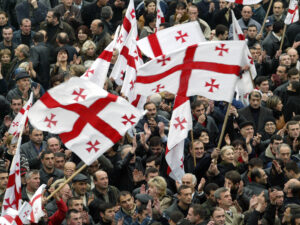
Events last November confouned expectations set by the failure of democratization in Russia and other ex-Soviet republics, and should prompt new reflections on how fragile openings to democacy may be sustained and widened.
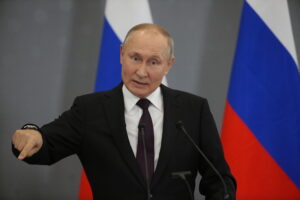
From Putin’s invasion to Kim’s nuclear saber rattling, the West has punished the world’s worst regimes. But have sanctions missed their targets?
July 1995, Volume 6, Issue 3
A review of Strong Parties and Lame Ducks: Presidential Partyarchy and Factionalism in Venezuela, by Michael Coppedge and Democracy for the Privileged: Crisis and Transition in Venezuela, by Richard S. Hillman.