
April 2018, Volume 29, Issue 2
China in Xi’s “New Era”: Singapore and Goliath?
Despite its tiny size, Singapore has shown that a firm stance can help to resist Chinese encroachment.
3081 Results
April 2018, Volume 29, Issue 2
Despite its tiny size, Singapore has shown that a firm stance can help to resist Chinese encroachment.
April 2010, Volume 21, Issue 2
Once touted as a regional success story, Mozambique has been backsliding toward one-party-dominant rule, and has now slipped off the Freedom House list of electoral democracies. How and why did this happen?
July 2004, Volume 15, Issue 3
Since the end of the Cold War, Central America has seen a regionwide diminution of military influence that bodes well for democratic governance and healthier civil-military relations.
July 2009, Volume 20, Issue 3
Read the full essay here. Although China’s farmers did not play a large role in the 1989 protests, they have been quite contentious since. Rural unrest has been triggered in part by reforms and in part by savvy “peasant leaders” who quickly seize opportunities that appear. Recently, many protest leaders have concluded that tame forms…
January 2009, Volume 20, Issue 1
Although the transfer of power from Fidel to Raúl has been relatively uneventful, potential divisions within the ruling elite, especially between the military and the Party, are likely to emerge before too long.
July 2009, Volume 20, Issue 3
Read the full essay here. Despite the suppression of the Tiananmen Uprising of 1989, popular protest in China has by all accounts escalated steadily over the ensuing two decades. These protests have spread to virtually every sector of Chinese society, prompting more than a few observers to proclaim the emergence of a “rising rights consciousness”…
January 2004, Volume 15, Issue 1
Since the fall of the Berlin Wall, the involvement of NATO and the EU with their prospective new members has worked strongly in favor of democratic governance in Central and Eastern Europe.
April 2024, Volume 35, Issue 2
The liberal emphasis on unhindered mobility comes with costs, particularly for those unable to leave.
July 2017, Volume 28, Issue 3
Read the full essay here. While the Constitution of India has not been amended after the rise of the Bharatiya Janata Party (BJP) to power in 2014, BJP-ruled states have passed laws which have reflected the Hindu-nationalist ideology of this party, including those known as “beef bans.” These laws and the activities of Hindu nationalist…
July 2014, Volume 25, Issue 3
Russia has witnessed a growing rapprochement between some of its nationalists and some of its democrats, but this trend is threatened by divisions over the annexation of Crimea.
July 2011, Volume 22, Issue 3
Despite signs of a cautious willingness to allow more political competition, the regime of newly reelected president Yoweri Museveni fell back on familiar habits of brutal repression when public unrest followed a sudden spike in the cost of living.

October 2016, Volume 27, Issue 4
What some had thought would be the “end of history” has instead turned out to be the “new world disorder.” Democratic liberalism may have no new ideological rival, but older identities are powerfully reasserting themselves.
April 2024, Volume 35, Issue 2
Praetorian politics are not making a comeback. Africa’s recent putsches have more to do with democracy’s failure to deliver than any fondness for military rule.
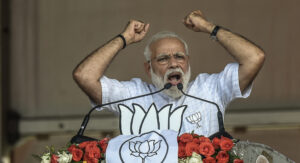
July 2023, Volume 34, Issue 3
Since the beginning of the second Modi government, an emboldened BJP has launched a steady, comprehensive, and unprecedented attack on civil liberties, personal rights, and free speech across India.
April 2023, Volume 34, Issue 2
Complaining about parties and politicians is common everywhere, but troubled Peru has devolved into a cautionary tale for what a democracy without established parties and professional politicians can look like.
July 2018, Volume 29, Issue 3
The retirement of President Ellen Johnson Sirleaf and George Weah’s election as her successor open a new chapter for a country that has made great strides since its brutal civil war, but where progress remains tenuous.
January 2017, Volume 28, Issue 1
Today, there are three parts of the old Soviet bloc—one is democratic, another is wholly authoritarian, and a third “intermediate” group is caught between two worlds. This last should be the main focus of Western assistance.
April 2012, Volume 23, Issue 2
The strong state in Malaysia and Singapore best explains why their authoritarian regimes have proved so stable and enduring. That is also the reason why democratization would go smoothly in both countries—yet, paradoxically, might never happen there at all.
July 2009, Volume 20, Issue 3
Despite increasing authoritarian tendencies at the national level, there are signs that Nicaragua has been making democratic advances at the local level.
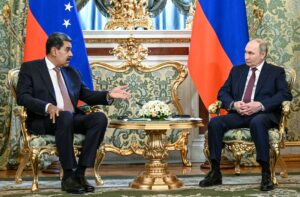
Nicolás Maduro’s regime has long relied on support from China, Cuba, Russia, and other authoritarians to stay afloat. But now that the United States is stepping up the pressure, will his fellow autocrats leave him high and dry?