
October 2005, Volume 16, Issue 4
Iran’s Peculiar Election: A Historical Perspective
The June 2005 presidential ballot marks the culmination of the regime’s effort to dominate even the limited powers of the popularly elected offices.
October 2005, Volume 16, Issue 4
The June 2005 presidential ballot marks the culmination of the regime’s effort to dominate even the limited powers of the popularly elected offices.

October 2005, Volume 16, Issue 4
In the lines of suffering etched on the visage of this courageous dissident may be read the drama of Iran today.
October 2005, Volume 16, Issue 4
Given the unaccountable authority of the supreme leader, the Islamic Republic should be classified as a sultanistic regime. In such regimes, democratic change is more likely to come from nonviolent resistance than from internal reform.
October 2005, Volume 16, Issue 4
The election results reflect less what voters want than the ideological dynamics that shape the behavior of factions within the regime.
October 2005, Volume 16, Issue 4
The large number of nonvoters suggests that the movement for a free, internationally monitored referendum on the Islamic Republic’s constitution could gain widespread support. We must now work to make that so.
October 2005, Volume 16, Issue 4
Basic demographic and socioeconomic factors in Iran are favorable to democratization. The mullahs may hope to stave off democratic change by emulating the Chinese model, but this strategy is doomed to fail.
October 2005, Volume 16, Issue 4
Having drawn lessons from the downfall of some of his fellow autocrats, President Alyaksandr Lukashenka is preventing the emergence of an effective democratic movement in Belarus.
October 2005, Volume 16, Issue 4
While Cambodia is often thought of as a “transitional” democracy and as a case where UN intervention succeeded, the truth is quite different.
October 2005, Volume 16, Issue 4
Recent works on regime types have led to confusion and a tendency to overstate the differences between established and newer democracies.
October 2005, Volume 16, Issue 4
Nepal’s people find themselves caught in an ugly struggle between two antidemocratic ideologies—royal absolutism and Maoism. What happened?
October 2005, Volume 16, Issue 4
In May, Ethiopia held its first genuinely competitive elections. The strong showing of opposition parties gives hope for a more democratic future.
October 2005, Volume 16, Issue 4
From hurricanes to ethnic and political tensions, the past decade has not been easy for the countries of the Caribbean Community. What does the future hold for these small democracies?
October 2005, Volume 16, Issue 4
A review of Beyond Free and Fair: Monitoring Elections and Building Democracy by Eric C. Bjornlund.
July 2005, Volume 16, Issue 3
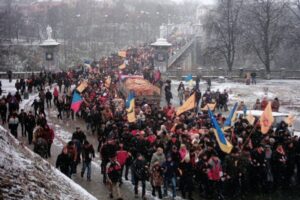
What made the “color revolutions” of the early 2000s possible? There were 7 factors that allowed for these democratic breakthroughs. Today, Venezuela has 6 of them, and it may soon have the last one it needs.
July 2005, Volume 16, Issue 3
The role of international factors varied greatly across the post-Cold War transitions to democracy, but the intensity and results of external democratizing pressure depended on two variables: linkage to the West and Western leverage.
July 2005, Volume 16, Issue 3
Even after its successful elections, Iraq remains a divided society. Democracy did not create these divisions, but it could be the key to managing them.
July 2005, Volume 16, Issue 3
For the Shi'ite majority and its senior religious leader, the January elections played out against the background of a longing for justice that has deep spiritual sources as well as more recent sociopolitical roots.
July 2005, Volume 16, Issue 3
If Iraq is to become the free and self-governing country that an overwhelming majority of its citizens want it to be, a "useable past" made accessible by historical memory will be vital.
July 2005, Volume 16, Issue 3
Is the Islamic-oriented party that has ruled since 2002 really the harbinger of 'Muslim democracy,' or is it something more familiar in Turkish politics: a hierarchical group none too closely in touch with society and overly focused on one man?
July 2005, Volume 16, Issue 3
Despite some moves toward liberalization in the past three decades, all Arab-majority countries remain authoritarian. Nonetheless, opinion surveys show that popular support for democracy in this part of the world is high.