

October 1995, Volume 6, Issue 4
The Indispensable Man
Review of Long Walk to Freedom: The Autobiography of Nelson Mandela (1994).
3264 Results
October 1995, Volume 6, Issue 4
Review of Long Walk to Freedom: The Autobiography of Nelson Mandela (1994).
January 2013, Volume 24, Issue 1
The Muslim Brotherhood is no longer a revolutionary movement, but rather a conservative one.
July 2023, Volume 34, Issue 3
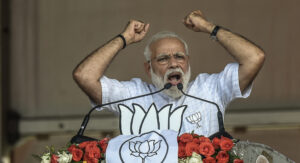
Since the beginning of the second Modi government, an emboldened BJP has launched a steady, comprehensive, and unprecedented attack on civil liberties, personal rights, and free speech across India.
January 2014, Volume 25, Issue 1
Liberalism as a governing order is barely two centuries old. A response to the great alternatives presented by Europe’s political history, it represents a unique synthesis of the ancient and the modern. But globalization has cast a deep shadow across liberalism’s future.
April 2007, Volume 18, Issue 2
The holding of competitive elections in this vast, strife-torn country must count as a significant achievement, even though voters signaled their disaffection with the entire array of political elites that had been ruling them.
July 2005, Volume 16, Issue 3
For the Shi'ite majority and its senior religious leader, the January elections played out against the background of a longing for justice that has deep spiritual sources as well as more recent sociopolitical roots.
April 2005, Volume 16, Issue 2
Thanks to a disputed presidential election and a narrowly divided parliament, Taiwan's politics remains tense. Yet the worst of the conflicts that gripped the island seem to have eased, and the difficult political events of the last few years may have some beneficial effects after all.
October 2002, Volume 13, Issue 4
How well-founded are Western concerns that the nascent parliaments of Kuwait, Qatar and Bahrain will be captured by antidemocratic Islamists and lead to the ‘Talibanization’ of the Gulf?
January 2002, Volume 13, Issue 1
After September 11 and the start of the U.S.-led war on terrorists in Afghanistan, the Pakistani military regime of Pervez Musharraf found itself at the center of world attention. What do these new and dramatically changed circumstances portend for a possible return to elected, civilian rule in Islamabad?
April 2000, Volume 11, Issue 2
With Austria’s and Switzerland’s leading political parties having “rigged the political marketplace” by forming Grand Coalitions, voters have turned to the radical right as the only available alternative.
January 2000, Volume 11, Issue 1
Excerpts from: a statement by Cuban dissidents entitled “All United”; a letter by former dissidents of the Soviet bloc to the so-called “Group of Four” critics of the Castro regime in Cuba; an address delivered by the Commonwealth’s outgoing secretary-general Chief Emeka Anayaoku; the “Seoul Statement” on human rights in North Korea; Abdurrahman Wahid’s speech…
April 2010, Volume 21, Issue 2
Reports on elections in Bolivia, Chile, Costa Rica, Croatia, Dominica, Honduras, Sri Lanka, Tajikistan, and Ukraine.
October 2012, Volume 23, Issue 4
Reports on elections in Angola, Egypt, Hong Kong, Libya, Mexico, Mongolia, Papua New Guinea, Republic of Congo (Brazzaville), Senegal, and Timor-Leste.
April 2005, Volume 16, Issue 2
Excerpts from: a statement by the Lebanese opposition; a speech by Ukrainian president Viktor Yushchenko; Indonesian president Susilo Bambang Yudhoyono’s inaugural address; inaugural remarks by Mahmoud Abbas, president of the Palestinian National Authority; a collective statement by Togolese civil society organizations; an appeal to the international community by 25 Nepalese human rights organizations; Romanian president…
April 2004, Volume 15, Issue 2
Excerpts from a United Nations report on the feasibility of early elections and possible alternatives in Iraq; an inaugural address by Georgian president Mikheil Saakashvili delivered in Tbilisi on January 25; a letter signed by more than 100 reformist Iranian parliamentarians criticizing Supreme Leader Ayatollah Ali Khamenei for approving the Guardian Council disqualification of more…
October 2005, Volume 16, Issue 4
In the lines of suffering etched on the visage of this courageous dissident may be read the drama of Iran today.
October 2006, Volume 17, Issue 4
Progressive politics in Latin America inevitably draws from the legacies of socialism and populism, but these categories are not very useful today. Can we find better tools for differentiating Latin America's "multiple lefts"?
October 2014, Volume 25, Issue 4
The protests that have been erupting around the world may signal the twilight of both the idea of revolution and the notion of political reformism.
April 2016, Volume 27, Issue 2
Seymour Martin Lipset argued that economic development would enlarge the middle class, and that the middle class would support democracy. To what extent will this general proposition prove true of China?
July 2013, Volume 24, Issue 3
The left-populist authoritarianism that is taking hold across a swath of Latin America bears many resemblances to the rightist populism that was once widespread in the region. There are signs, however, that the leftist variant will be an even bigger problem for liberal democracy. Listen to the podcast.