
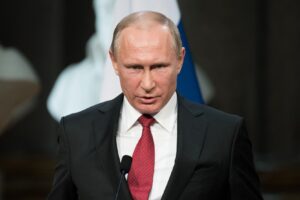
How Putin’s War in Ukraine Has Ruined Russia
In a matter of weeks, the Russian autocrat has erased his country’s prosperity in a feckless attempt to rebuild a doomed empire.
3292 Results
In a matter of weeks, the Russian autocrat has erased his country’s prosperity in a feckless attempt to rebuild a doomed empire.

April 2007, Volume 18, Issue 2
The Kremlin's ultimate need for democratic legitimacy, both at home and abroad, may be the key vulnerability of the Putin regime.
January 2009, Volume 20, Issue 1
Democracy-aid providers are moving away from one-size-fits-all strategies and are adapting their programs to diverse political contexts. Two distinct overall approaches to assisting democracy have emerged in response.
July 2010, Volume 21, Issue 3
Must every state be a nation and every nation a state? Or should we look instead to the example of countries such as India, where one state holds together a congeries of “national” groups and cultures in a single and wisely conceived federal republic?

July 2024, Volume 35, Issue 3
Pakistani voters sent the military a message in the February elections: They no longer trust the “guardian of the country.” Worse for the generals, they can no longer escape accountability for their corruption and incompetence because everyone knows the military is in charge.
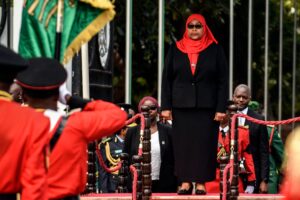
July 2025, Volume 36, Issue 3
President Samia Suluhu Hassan came into office promising democratic reforms. Four years later, it is clear she is more of a performer than a reformer. Far from delivering on her promises to unwind Tanzania’s authoritarian machinery, she is relying on the repressive tools we know so well.
Journal of Democracy contributors talk with Managing Editor Brent Kallmer about the articles in the Journal, which is published by Johns Hopkins University Press for the National Endowment for Democracy. Adrienne LeBas Adrienne LeBas discusses her essay “A New Twilight in Zimbabwe? The Perils of Power Sharing” from the April 2014 issue of the Journal of Democracy.…

Last month Rio’s police conducted the deadliest police operation in Brazil’s history, killing 117 people. It is one episode in a long history of state violence. Not only are such iron-fisted methods ineffective, they pose a danger for democracy itself.
April 2011, Volume 22, Issue 2
Paradoxically, the rising profile of “liberation technology” may push Internet-control efforts into nontechnological areas—imprisonment rather than censorship, for example—for which there is no easy technical “fix.”
July 2015, Volume 26, Issue 3
Why do significant numbers of people, after gaining the right to choose their leaders via free and fair elections, vote for political parties with deep roots in dictatorship, and how do such parties affect the consolidation of democracy?

January 2025, Volume 36, Issue 1
Even as Georgia lurches toward autocracy, the country’s pluralism and democratic culture are deepening. What can Georgia’s contradictory trends reveal about democratic resilience?
October 2019, Volume 30, Issue 4
The first half of President Rodrigo Duterte’s single six-year term saw steady erosion of legal barriers against abuses of power, typified by a bloody and extralegal “drug war.” Yet in midterm Senate elections, Filipino voters gave him a decisive victory.

October 2004, Volume 15, Issue 4
Law-based rule means a set of basic conditions that make civic life possible. A democratic rule of law requires all that and more, however.

July 2023, Volume 34, Issue 3
It is true that politics under the BJP is a break from the past. But attempts to reduce the country’s present condition to democratic backsliding misunderstands the moment and is an injustice to India’s journey as a democracy.
July 2011, Volume 22, Issue 3
How did South Korea lift itself from destitution to affluence? And how was its ruthlessly authoritarian regime able to metamorphose into a stable democracy? Coopting the business and voluntary sectors to deliver welfare positioned the country to accomplish both.

January 2026, Volume 37, Issue 1
Ukraine must win its war against Russian aggression. But it is also true that the decisions it makes now will determine what kind of state it will be when the war is over.
July 2002, Volume 13, Issue 3
The Editors’ introduction to “Debating the Transition Paradigm.”