
July 2014, Volume 25, Issue 3
El Salvador’s Beleaguered Democracy
In February 2014, Salvadorans narrowly elected as president a former FMLN guerrilla commander, but he will have to deal with a dire economy and horrific levels of crime.
3264 Results
July 2014, Volume 25, Issue 3
In February 2014, Salvadorans narrowly elected as president a former FMLN guerrilla commander, but he will have to deal with a dire economy and horrific levels of crime.
April 2013, Volume 24, Issue 2
Why do democracies survive or fail? An empirical study of Latin America finds that the fate of democracies depends largely on the regional political context, as well as the level of actors’ commitment to democracy and policy moderation.
April 2013, Volume 24, Issue 2
Data from the latest wave of the Asian Barometer Survey show commonalities and variations in the sources of regime support in Southeast Asian countries. Most regimes—democracies and nondemocracies alike—draw political legitimacy from perceptions of effective and upright governance.
January 2013, Volume 24, Issue 1
In October 2012, Georgia’s government lost power in an election, and peacefully stepped aside. But can a country with Georgia’s troubled history capitalize on this surprising achievement?
April 2012, Volume 23, Issue 2
Do democracy and good governance necessarily go hand-in-hand? In most Southeast Asian countries, a gap exists between the two. How should we understand good governance in an authoritarian context? And what does poor governance mean for the legitimacy of democracy?
October 2011, Volume 22, Issue 4
Since its transition to democracy barely a decade ago, Indonesia has begun projecting its newly democratic values across international borders. So far, however, its efforts have been largely rhetorical.
April 2010, Volume 21, Issue 2
In emerging democracies and postconflict countries, improved policing is almost always urgently required. Yet international-assistance efforts in this area pay almost no attention to the crucial need to ensure that the new-model police are not only effective, but democracy-friendly.
April 2010, Volume 21, Issue 2
Amid a climate of rising crime and insecurity as well as economic uncertainty produced by the global downturn, can the study of public opinion and attitudes reveal which Central American countries are most at risk of democratic reversals?
July 2008, Volume 19, Issue 3
Latin America’s recent experience shows that effective democratic governance is difficult to achieve and depends on many factors, some of them context-specific. Nonetheless, it is possible to draw some general lessons.
October 2007, Volume 18, Issue 4
They are good signs for the future of democracy in Iran, but it will take time and energy to organize these promising pieces into a greater democracy movement.
October 2005, Volume 16, Issue 4
In May, Ethiopia held its first genuinely competitive elections. The strong showing of opposition parties gives hope for a more democratic future.
April 2003, Volume 14, Issue 2
The strains of economic reform have not increased support for antidemocratic populism in Latin America, but they have led to acute dissatisfaction with democratic governments.
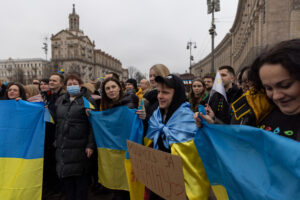
October 2022, Volume 33, Issue 4
The share of Ukrainians who endorse democracy as the best form of government has risen fast in short order, standing now at more than three-quarters. New data reveal a surprising explanation behind this remarkable shift.
April 2025, Volume 36, Issue 2
Democracy across the world is being undermined by the very forces that once made it possible: the liberal economic order and political competition. The global concentration of wealth has made democratic governance less effective and stripped the people of their power.
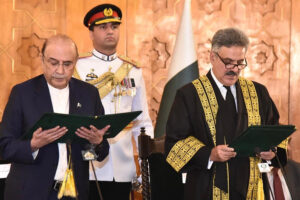
July 2025, Volume 36, Issue 3
Authoritarian regimes are not lawless. Rather, autocrats take to the courtroom not only to enforce their will but to justify their rule. So how do they appeal to reason? How do they rationalize their undemocratic turn?
January 2022, Volume 33, Issue 1
Excerpts from: Sviatlana Tsikhanouskaya’s Summit for Democracy speech; announcement by Women’s Tennis Association cancelling future tournaments in China; statement on sentencing of Tony Chung under Hong Kong’s National Security Law; Honduran president Xiomara Castro’s inauguration address; “Nigeria Unite” by DJ Switch.

July 2015, Volume 26, Issue 3
Rwanda under Paul Kagame has been hailed for its visionary leadership, economic progress, and reforms in education, health, and agriculture. Yet the regime’s autocratic rule, human-rights abuses, persecution of the Hutu majority, and growing inequality point to an ominous future.
April 2007, Volume 18, Issue 2
The Putin regime is plunging Russia into a deepening crisis. It is time to end the fiction that today's Russia is a democracy.
April 2006, Volume 17, Issue 2
Contemporary liberal democracies, especially in Western Europe, face a major challenge in integrating Muslim immigrants as citizens of pluralistic societies.
January 2007, Volume 18, Issue 1
Many critics of democracy promotion assert that the rule of law and a well-functioning state should be in place before a society democratizes, but this strategy of "sequencing" is based on a set of mistaken premises.