

October 2022, Volume 33, Issue 4
Questioning Backsliding
It is no easy feat to agree on how democratic backsliding should be measured. No surprise scholars are coming up with strikingly different results.
3081 Results
October 2022, Volume 33, Issue 4
It is no easy feat to agree on how democratic backsliding should be measured. No surprise scholars are coming up with strikingly different results.
July 2022, Volume 33, Issue 3
The first two months of the war alone turned the Russian clock back decades, undoing thirty years of post-Soviet economic gains and reducing the country to an international pariah state.
October 2021, Volume 32, Issue 4
Unlike in the past, populism in Latin America today is driven mainly by the power of charismatic leaders—and it is eating away at the region’s already weak party system.
July 2019, Volume 30, Issue 3
The military-backed regime of President al-Sisi seems secure, but study of the Egyptian internet reveals that the regime has failed to win over the young.
October 2021, Volume 32, Issue 4
Mass uprisings toppled dictators in both Sudan and Algeria in 2019, but only Sudan was able to secure a transition to democracy due to important differences in their protest movements, militaries, and the role of the international community.

July 2025, Volume 36, Issue 3
As President Erdoğan’s grip on power is slipping, his regime is turning more repressive. But Turkey may still avoid becoming a full-blown autocracy. The opposition is increasingly popular, and there remains a way to tilt the playing field to their advantage.
July 2002, Volume 13, Issue 3
Middle Eastern autocracies rely ever more on repression of both their Islamist and secular critics, and therefore increasingly fear that any opening will be uncontrollable. Is there a way out?
October 2000, Volume 11, Issue 4
Four excerpts from the Iranian press-on elections and democracy and on religious intolerance and intellectual pluralism-suggest the extent to which democratic thinking has gained a foothold in Iran.
July 2012, Volume 23, Issue 3
Although they have quieted down as quickly as they flared up, the clamorous protests that followed the dishonest Russian legislative elections in December 2011 have essentially destroyed Putin’s regime, the infamous “managed democracy.”
October 2017, Volume 28, Issue 4
Liberal democracy can never put down truly firm roots in Asia unless and until the fundamentals of democratic constitutionalism take hold. There are seven practical imperatives that friends of constitutionalism in the region must pursue.

October 2014, Volume 25, Issue 4
Indonesians came close to electing as their new president a populist challenger promising to restore the country’s predemocratic order. Democracy prevailed in the end, but its continued vulnerability was exposed.

The country’s 2024 presidential contest was a big surprise, as voters elected a new party for the first time. Despite decades of dominant-party rule, a strong democratic culture has long been ingrained in Botswana.
July 2021, Volume 32, Issue 3
With or without middleware, the basic challenge of responding to bad actors online remains.
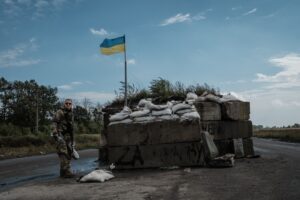
Putin doesn’t care how many of his troops die. He is looking to win a war of attrition. On the second anniversary of Russia’s invasion, Ukraine needs the West’s help—and it needs it now.
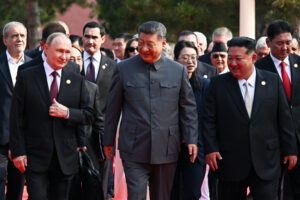
America’s promotion of democracy has always been highly imperfect. But the superiority of democracy—and the ideas that animate it—make it essential to securing America’s future.

January 2023, Volume 34, Issue 1
The government of Giorgia Meloni, the country’s first female prime minister, is popular, scary, and competent. Her far-right party also enjoys greater democratic legitimacy than any other Italian party in a long time.

In Bolivia’s presidential runoff on Sunday, center-right senator Rodrigo Paz Pereira defeated right-wing former interim president Jorge “Tuto” Quiroga.

October 2024, Volume 35, Issue 4
After thirty years of ANC dominance, the 2024 elections have ushered in multiparty politics in South Africa. Will the party’s centrist shift be enough to stop its descent, or is it destined to fracture further?
October 2011, Volume 22, Issue 4
In a runoff between candidates with dubious democratic credentials, former antisystem outsider Ollanta Humala defeated Keiko Fujimori by attracting votes from the middle class.