

January 2006, Volume 17, Issue 1
Getting to Arab Democracy: Lebanon Springs Forward
Taking advantage of the withdrawal of Syrian troops, Lebanese voters capped the "Beirut Spring" by electing a new majority in parliament.
3273 Results
January 2006, Volume 17, Issue 1
Taking advantage of the withdrawal of Syrian troops, Lebanese voters capped the "Beirut Spring" by electing a new majority in parliament.
July 2002, Volume 13, Issue 3
The author of “The End of the Transition Paradigm” responds to each of his critics in turn.
January 1993, Volume 4, Issue 1
A review of The Final Revolution: The Resistance Church and the Collapse of Communism, by George Weigel.

The Gulf kingdom has been a rare democratic experiment. But gridlock and the Emir’s mounting impatience with Kuwaiti politics may be on the cusp of bringing it to an end.

Hungary’s prime minister has been jet-setting across the globe to hobnob with Vladimir Putin, Xi Jinping, and Donald Trump, while doing his best to provoke European leaders at home. But Orbán’s grandstanding, argues Hungarian writer Sándor Ésik in a new Journal of Democracy online exclusive, is really just an attempt to mask his growing political weaknesses.
July 2015, Volume 26, Issue 3
It is fine to acknowledge the importance of law-based rule to the eventual rise of modern democracy, but we must not overlook the even greater contribution of the idea of equality.

Venezuela’s opposition defeated Nicolás Maduro in the country’s July presidential election, but the Venezuelan strongman refuses to relinquish power. The Journal of Democracy essays below, free for a limited time, chronicle Venezuela’s struggle against Maduro’s authoritarianism — and what makes this election different.
July 2001, Volume 12, Issue 3
There has been surprisingly little celebration of the tenth anniversary of the revolutions that brought down communism. The exaggerated hopes of the time have given way to disillusionment, but the real achievements of many of the postcommunist countries should not be discounted.
July 2011, Volume 22, Issue 3
After decades of civil war, Sudan is set to divide into two nations on 9 July 2011. Yet a number of explosive issues—including the drawing of borders and sharing of oil revenue—have still not been resolved, and the prospects for peace appear to be dimming.
January 2015, Volume 26, Issue 1
Can democracy prosper when democratic countries are in geopolitical retreat? History cautions against the notion that democracy will inevitably prevail.
Winter 1990, Volume 1, Issue 1
The Editors’ introduction to “The Crumbling Soviet Bloc.”
April 2003, Volume 14, Issue 2
The recent election of political outsider Lula da Silva as president is a sign of hope for the future of democracy in Brazil.

There is nothing inherently menacing or antidemocratic about conspiracy theories. They can even be a source of amusement. The trouble comes when political elites weaponize them to invite violence.
October 2010, Volume 21, Issue 4
Efforts to do comparative research on political attitudes have been complicated by varying understandings of “democracy.” The Afrobarometer is exploring new techniques to overcome this difficulty.
July 2000, Volume 11, Issue 3
The (Un)Rule of Law and the Underprivileged in Latin America, edited by Juan E. Méndez, Guillermo O’Donnell, and Paulo Sérgio Pinheiro, offers a harsh appraisal of the region’s legal and justice systems.
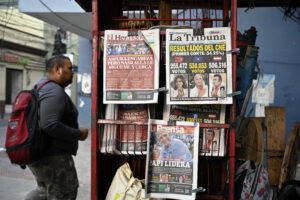
Days after the election and no one knows who the next president will be. Even worse, none of the likely winners offer much hope for the country’s democracy.
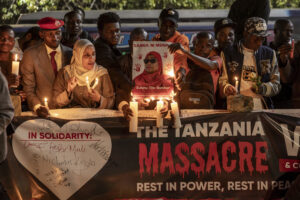
Tanzania’s Independence Day was Tuesday, barely a month since the shocking and brutal crackdown on thousands of protesters decrying the country’s sham election.
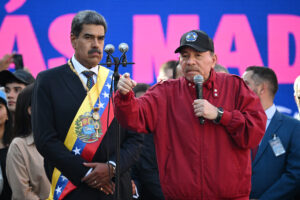
It may be the best weapon we have for holding autocrats accountable for their crimes, and the world’s democracies are beginning to rally behind it.
October 2000, Volume 11, Issue 4
Recent studies of democracy in Latin America overlook the role of civil society as an agent of accountability.