
October 2005, Volume 16, Issue 4
Babel in Democratization Studies
Recent works on regime types have led to confusion and a tendency to overstate the differences between established and newer democracies.
3273 Results
October 2005, Volume 16, Issue 4
Recent works on regime types have led to confusion and a tendency to overstate the differences between established and newer democracies.
October 2009, Volume 20, Issue 4
Latin American social policy has at times worked backwards, widening rather than narrowing economic and social inequalities. But new conditional cash-transfer programs seem to be producing positive outcomes.
January 2010, Volume 21, Issue 1
Reports on elections in Afghanistan, Botswana, Gabon, Honduras, Mozambique, Namibia, Niger, Romania, Tunisia, and Uruguay.
Spring 1990, Volume 1, Issue 2
Reports on elections in Brazil, Chile, Costa Rica, Grenada, Nicaragua, the Union of Soviet Socialist Republics, and Zimbabwe.
October 2007, Volume 18, Issue 4
Some skeptics have asked whether ordinary people possess an understanding of democracy that allows them to evaluate it as a form of government. Our research yields three generalizations about popular understanding of democracy.
April 2020, Volume 31, Issue 2
Reports on elections in Afghanistan, Algeria, Azerbaijan, Cameroon, Comoros, Croatia, Guyana, Iran, Mali, Peru, Saint Kitts and Nevis, Slovakia, Taiwan, Tajikistan, Uzbekistan, Vanuatu, Tunisia.
January 2021, Volume 32, Issue 1
Like the “transition paradigm” before it, the concept of democratic backsliding threatens to flatten our perceptions of complex political realities. Examples from East-Central Europe illustrate the ambiguous dynamics at play in many troubled democracies.
April 2020, Volume 31, Issue 2
Populists have often turned to referendums to dismantle a democracy. Democrats should be wary of turning to the same tool to rebuild what was lost. It may only pave the way for populism’s return.
October 2019, Volume 30, Issue 4
The military junta that seized power in 2014 finally organized an election in 2019, but with the goal of preventing rather than facilitating a return to civilian rule.

October 2005, Volume 16, Issue 4
In the lines of suffering etched on the visage of this courageous dissident may be read the drama of Iran today.
October 2021, Volume 32, Issue 4
Mass uprisings toppled dictators in both Sudan and Algeria in 2019, but only Sudan was able to secure a transition to democracy due to important differences in their protest movements, militaries, and the role of the international community.
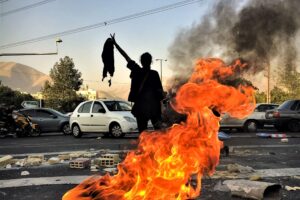
The escalating conflict between Iran and Israel now includes the United States, and fears are growing that it could become a regional war. But there’s another war that people aren’t talking about: the Islamic Republic’s brutal campaign against its own people.
Figure Axis Descriptions
July 2017, Volume 28, Issue 3
Reports on elections in Algeria, Armenia, the Bahamas, Bulgaria, the Gambia, Iran, Kosovo, Lesotho, Micronesia, Papua New Guinea, Serbia, South Korea, and Timor-Leste.
April 2004, Volume 15, Issue 2
Events last November confouned expectations set by the failure of democratization in Russia and other ex-Soviet republics, and should prompt new reflections on how fragile openings to democacy may be sustained and widened.
April 2014, Volume 25, Issue 2
After four years of sharing power with the opposition, Zimbabwe’s longtime president Robert Mugabe and his party claimed a huge victory in the 2013 elections. What accounts for the opposition’s stunning electoral decline?
October 2009, Volume 20, Issue 4
Parliamentary elections in 2008 secured the MPLA's hegemony and decimated the opposition, while paradoxically increasing the government's legitimacy.
July 2003, Volume 14, Issue 3
Reports on elections in Argentina, Armenia, Belize, Benin, El Salvador, Montenegro, Nigeria, Paraguay, and Yemen.
October 2004, Volume 15, Issue 4
Freedom has always been integral to democracy. How to guard liberty is a question every democratic regime must answer.
July 2004, Volume 15, Issue 3
Over the ten years since its first nonracial elections in 1994, South Africa has seen its democratic order become more firmly institutionalized, even as the electoral dominance of the ANC has continued to grow.