
January 2020, Volume 31, Issue 1
Rejuvenating Democracy Promotion
It is imperative to rethink how democracy support fits into today’s turbulent and threatening international political landscape.
2779 Results
January 2020, Volume 31, Issue 1
It is imperative to rethink how democracy support fits into today’s turbulent and threatening international political landscape.
October 2019, Volume 30, Issue 4
Beyond the commonly cited economic and cultural anxieties afflicting many Europeans, a key factor enabling the rise of populism across Europe has been the failure of mainstream parties on both the left and the right to offer clear and credible policy alternatives.
July 2019, Volume 30, Issue 3
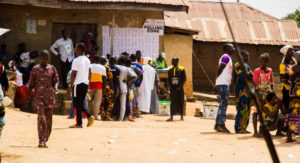
Election officials made strides toward secure voter identification, and a two-party system appears to be emerging, but the 2019 elections revealed continuing problems with vote-buying and violence.
April 2019, Volume 30, Issue 2
The Chinese Communist Party wields highly effective means to quash dissent, but Chinese intellectuals and interest groups continue to push for change.
April 2019, Volume 30, Issue 2
Spain’s system of Autonomous Communities had functioned fairly smoothly for decades following the country’s democratic transition, but events in Catalonia are putting it under unprecedented strain.
April 2019, Volume 30, Issue 2
Europe has seen a proliferation of laws governing historical memory, but they sometimes threaten to inflame social tensions and undermine liberal values.
January 2019, Volume 30, Issue 1
Charges that Prime Minister Narendra Modi and his party threaten liberal-democratic safeguards are best understood as the overheated reaction of an insular elite that is still struggling to come to terms with its democratic displacement from power.
January 2019, Volume 30, Issue 1
A crackdown on the opposition, followed by sham parliamentary elections in July 2018, has deepened and extended the decades-long personalist dictatorship of Hun Sen.
April 2018, Volume 29, Issue 2
It has long been hoped that China would be integrated into the liberal world order. That particular “China dream” has ended, however, as Beijing seeks to reshape the world order, with itself at the center.
July 2017, Volume 28, Issue 3
Read the full essay here. The relationship between democracy and civil society is not straightforward. Angry crowds can stymie the functioning of the democratic process, institutions, and governance. Drawing on recent Indian examples, this article sets out a typology of civil society movements in order to assess their impact on Indian democracy. It shows how…
July 2017, Volume 28, Issue 3
Turkmenistan’s authoritarian president Gurbanguly Berdimuhammedov attempted to use sham democratic elections in February 2017 to bolster his legitimacy both at home and abroad.
April 2017, Volume 28, Issue 2
In 2016, established democracies figured prominently on the list of countries experiencing declines in freedom, while emboldened autocracies stepped up their repression at home and interference abroad.
April 2017, Volume 28, Issue 2
Two of the Arab world’s more liberal regimes, the kingdoms of Jordan and Morocco, are sometimes said to be evolving toward democracy. Is this true, and what are the longer-term prospects for these two monarchies?
January 2017, Volume 28, Issue 1
The use of force and intimidation against women trying to take part in politics is a growing problem in many places. Such violence assumes a number of different forms, but all aim to keep women as women out of public life.
January 2017, Volume 28, Issue 1
This sparsely populated, landlocked country sandwiched between much larger authoritarian neighbors has nonetheless managed to maintain a fairly robust democracy. The secret lies in its energetic civil society.
October 2016, Volume 27, Issue 4
Post-1945 Western Europe benefited greatly from center-left parties offering real solutions to real problems. Where has that left gone?
July 2016, Volume 27, Issue 3
The interplay between elections, popular protests, and international pressures has a profound effect on the behavior of African autocrats and their ability to stay in power even after their time is up.
July 2016, Volume 27, Issue 3
After spending the 1990s coping with an overweening president, Peru settled into a more sedate style of politics, but it is one in which parties barely exist, voters feel unhappy with their elected chief executives despite strong economic growth, and technocracy rather than democracy is the key mode of decision making.
January 2016, Volume 27, Issue 1
Much can be done to uproot graft when a major event such as the Rose Revolution sweeps in a determined new team on a wave of massive public support.
October 2015, Volume 26, Issue 4
Once widely celebrated, civil society today is regarded as a threat by many governments, leading them to restrict its funding and activities.