
April 2009, Volume 20, Issue 2
Kosovo: Independence and Tutelage
In February 2008, Kosovo broke away from Serbia and declared its independence. But to what extent is it making progress toward its goals of sovereignty and democracy?
3272 Results
April 2009, Volume 20, Issue 2
In February 2008, Kosovo broke away from Serbia and declared its independence. But to what extent is it making progress toward its goals of sovereignty and democracy?
October 2004, Volume 15, Issue 4
Surveys show that Africans’ commitment to democracy fades over time, but also that their support can be refreshed by alternations in power via elections.
July 2003, Volume 14, Issue 3
New data covering most of the 1990s reveal that democracy, even when minimally defined, has a potent independent impact that tends to reduce infant mortality and promote overall social well-being.
April 2025, Volume 36, Issue 2
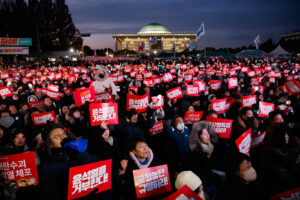
When South Korea’s president declared martial law last December, he shocked the country and sparked a political crisis that laid bare deep-seated divisions. Can Korean democracy overcome the nationalist polarization that has always defined it?
January 2018, Volume 29, Issue 1
International Forum for Democratic Studies report on "Sharp Power: Rising Authoritarian Influence"; Emmerson Mnangagwa's inaugural address as interim president of Zimbabwe; letter from Zimbabwean civil society organizations; address by U.K. prime minister Theresa May; statement by former Soviet political prisoners and dissidents.
January 2018, Volume 29, Issue 1
China has seen a staggering number of official corruption cases in recent years. But does it merit the label of kleptocracy?
October 2007, Volume 18, Issue 4
On 7 June 2007, the National Endowment for Democracy commemorated the twenty-fifth anniversary of the "Westminster Address" with a panel discussion and reception in Madison Hall at the Library of Congress.
July 2023, Volume 34, Issue 3
Under Xi Jinping, the Chinese Communist Party has wound down local elections and reasserted control in the countryside. But putting these burdens on its own shoulders brings new and significant risks for Beijing.
October 2021, Volume 32, Issue 4
Unlike in the past, populism in Latin America today is driven mainly by the power of charismatic leaders—and it is eating away at the region’s already weak party system.
October 2020, Volume 31, Issue 4
The People’s Republic of China uses massive amounts of propaganda to influence how it is perceived beyond its borders. “Big data” reveal how that image is carefully and deliberately shaped for different audiences in different places.
July 2016, Volume 27, Issue 3
President Alvaro Uribe’s time in office was marked by disturbing trends that included a spike in extrajudicial killings and an attempt to overthrow term limits, but the country’s institutions of horizontal accountability proved remarkably resilient.
April 2012, Volume 23, Issue 2
The strong state in Malaysia and Singapore best explains why their authoritarian regimes have proved so stable and enduring. That is also the reason why democratization would go smoothly in both countries—yet, paradoxically, might never happen there at all.
July 2011, Volume 22, Issue 3
Widely reported as “Facebook revolutions,” the upheavals in Tunisia and Egypt show that social media not only can ignite protests but also can help to determine their political consequences.
October 2010, Volume 21, Issue 4
Yemen today finds itself gripped by a set of crises that threatens its very unity as a country. Only a turn toward democratic dialogue offers a way out.
January 2007, Volume 18, Issue 1
When Abdullah Ahmad Badawi succeeded Mahathir Mohamad as prime minister in 2003, many expected far-reaching change in Malaysia. So far, however, turnover at the top has not led to significant democratic progress.
July 2006, Volume 17, Issue 3
January’s remarkably free and fair parliamentary elections broke the PLO’s longstanding monopoly over Palestinian politics. Given Fatah’s disarray and the difficulties facing Hamas, there is now a window of opportunity for a third and avowedly liberal-democratic option to emerge.
July 2003, Volume 14, Issue 3
After falling short in 1992 and 1997, Kenya’s large but fractious opposition coalition swept to victory at the polls in 2002. Transition has arrived, but can democratic transformation follow?
January 2002, Volume 13, Issue 1
The implicit social bargain that carried many East Asian countries through the Cold War has lost its currency. If the peoples of this region are to secure the blessings of peace, liberty, and prosperity in the century ahead, they will need to have a new and explicitly democratic bargain working for them.

January 2025, Volume 36, Issue 1
Citizens across the globe still value democracy, but they have become dissatisfied with the way it is working. A new era of representation is in order — one featuring more diverse leaders, responsive politicians, and empowered publics.

January 2025, Volume 36, Issue 1
Climate change is an urgent and unparalleled threat. Our best hope lies in radical, principled activism — at once more democratic and more authoritarian.