

October 2010, Volume 21, Issue 4
The Upsurge of Religion in China
Religion in various forms is burgeoning in the PRC today, and the ruling Chinese Communist Party cannot decide what to make of it—or do about it.
1256 Results
October 2010, Volume 21, Issue 4
Religion in various forms is burgeoning in the PRC today, and the ruling Chinese Communist Party cannot decide what to make of it—or do about it.
July 2021, Volume 32, Issue 3
Recent high-profile scandals have laid bare persistent shortcomings of Latin American democracy that, if unaddressed, could prove fatal.
April 2021, Volume 32, Issue 2
The year 2020 saw the global weakening of democratic norms reinforced by authoritarian influence campaigns, crackdowns on protest movements, and the use and abuse of new powers adopted in the name of responding to the covid-19 pandemic.
October 2019, Volume 30, Issue 4
To a degree that is still not widely appreciated, the BJP has replaced Congress as India’s party of welfarism. The carefully crafted political persona of Prime Minister Narendra Modi as the “leader of the poor” has been crucial to this shift.
January 2019, Volume 30, Issue 1
Zimbabwe’s first elections since the November 2017 coup that ousted nonagenarian dictator Robert Mugabe were marred by the abuse of state resources, electoral irregularities, and a tragic bout of postelection violence that saw soldiers use deadly force against civilians.
October 2018, Volume 29, Issue 4
In Malaysia’s May 2018 general election, a grand bargain between ex–prime minister Mahathir Mohamad and reform leader Anwar Ibrahim produced a political earthquake that ended 61 years of rule by the United Malays National Organization (UMNO).
April 2018, Volume 29, Issue 2
Despite current trends, Chinese thinkers friendly to human rights and liberal democracy have left behind a treasury of thought from which their country may one day draw new inspiration.
October 2016, Volume 27, Issue 4
Once a protest party, the right-wing National Front has sought to recast itself for electoral success. How will Marine Le Pen fare in the 2017 presidential race?
April 2016, Volume 27, Issue 2
Even though Burma’s military seems to have accepted the NLD’s stunning election victory, it can still use an array of constitutional provisions to hamstring the incoming NLD government.
January 2016, Volume 27, Issue 1
Ethiopia’s ruling party has long been tightening its grip, using antiterrorism laws and harsh restrictions on media and civil society to silence voices critical of the regime.
July 2015, Volume 26, Issue 3
The great achievements of Hungary’s 1989–90 transition—including democracy, rule of law, market-oriented reform, and pluralism in intellectual life—are being dismantled as the world looks the other way.
January 2012, Volume 23, Issue 1
Read the full essay here. Turkish state policy toward the Kurds, the Republic of Turkey’s largest ethnic minority, has evolved from denial and mandatory assimilation to cultural recognition to acknowledgment of the Kurds’ contested status as a political problem demanding political solutions. The election of 36 Kurdish-nationalist lawmakers, most of whom now sit in parliament…
October 2010, Volume 21, Issue 4
May 2010, Benigno Aquino III bested a crowded field to win the presidency. The election, which was remarkably clean and orderly, gave a clear victory to the reformist narrative that has long vied with populism in the Philippines.
July 2010, Volume 21, Issue 3
A new look at the World Values Survey data reveals how the Muslim world’s religious context affects individual Muslims’ attitudes toward democracy.
July 2024, Volume 35, Issue 3
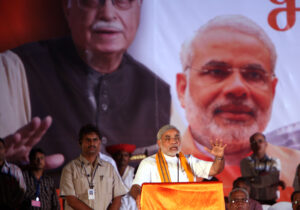
While he did not achieve the sweeping victory many predicted, Narendra Modi led his ruling coalition to a third consecutive victory. In so doing, he is laying the foundation for a new political order in which India is simultaneously more democratic and more illiberal.
October 2008, Volume 19, Issue 4
After the ethnic violence that marred its 2007 presidential election, Kenya must reform its institutions to better represent its diverse polity.
January 2008, Volume 19, Issue 1
Attitudes toward democracy in Latin America vary from country to country, and within countries between left and right. Public opinion is strongly affected by the success or failure of political leaders in delivering social and economic change.
October 2007, Volume 18, Issue 4
Where indigenous peoples constitute a smaller share of the electorate, their recent inclusion denotes a more generalized opening of the political system to excluded and vulnerable sectors of society.
October 2006, Volume 17, Issue 4
In reelecting President Alvaro Uribe by a landslide, Colombia's voters opted for continuity. But they chose continuity with an administration that has carried out a major series of policy innovations.
October 2005, Volume 16, Issue 4
The June 2005 presidential ballot marks the culmination of the regime’s effort to dominate even the limited powers of the popularly elected offices.