
April 2024, Volume 35, Issue 2
The Limits of Liberalism
The liberal emphasis on unhindered mobility comes with costs, particularly for those unable to leave.
3264 Results
April 2024, Volume 35, Issue 2
The liberal emphasis on unhindered mobility comes with costs, particularly for those unable to leave.
October 2023, Volume 34, Issue 4
When Africa’s leaders act undemocratically, they face an unexpected opponent—the power of the pulpit. Within civil society, church leaders and their faithful have become leading defenders of liberal democracy.
July 2023, Volume 34, Issue 3
This Arab state is different. It is far more liberal than any other Gulf kingdom, and it may even have a path, with much trial and effort, to becoming the region’s first democratic constitutional monarchy.
January 2023, Volume 34, Issue 1
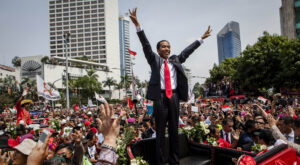
Indonesia is a leading example for fledgling democracies navigating tough transitions. But it is imperiled, and if it gives way, the loss for the democratic world will be enormous.
January 2023, Volume 34, Issue 1
This is the toughest time for Latin America’s democracies in decades. Democratic stagnation makes them ripe targets for illiberal populists and other would-be authoritarians who will feed the region’s worst vices.
July 2022, Volume 33, Issue 3
Any open society’s best weapon against Chinese influence operations is its openness—the ability to investigate and expose sharp-power manipulations, diminishing their strength.
January 2022, Volume 33, Issue 1
Tunisia’s once-promising democratic transition had long failed to de-liver on its promises. It was a crisis waiting to be exploited. Kais Saied is simply the man who set it aflame.
July 2021, Volume 32, Issue 3
The latest survey wave finds Africans with a still-robust demand for democratic governance, unblunted by covid or Chinese influence. Can governments deliver?
July 2021, Volume 32, Issue 3
With or without middleware, the basic challenge of responding to bad actors online remains.
July 2021, Volume 32, Issue 3
Chilean democracy has opted to throw off a constitution written by a dictator, and has chosen an assembly to craft a new one. Can Chile begin anew?
October 2020, Volume 31, Issue 4
Universities, publishers, and other knowledge-sector institutions face increasingly sophisticated authoritarian efforts to quash critics and subvert independent inquiry.
July 2019, Volume 30, Issue 3
Within Ukraine, Russia’s 2014 invasion has generated unprecedented pressures to impose restrictions on speech. While international norms allow some censorship during wartime, some of Ukraine’s new media and cultural policies raise risks not only for its democracy, but for its security as well.

January 2019, Volume 30, Issue 1
The triumph of far-right populist Jair Bolsonaro in Brazil’s October 2018 presidential election was made possible by a series of economic, social, and political crises that have shaken Brazilian democracy.
January 2019, Volume 30, Issue 1
A crackdown on the opposition, followed by sham parliamentary elections in July 2018, has deepened and extended the decades-long personalist dictatorship of Hun Sen.
July 2018, Volume 29, Issue 3
The political turmoil following a journalist’s murder in Slovakia has revealed serious dangers to the country’s democratic institutions.
October 2017, Volume 28, Issue 4
Democracy’s retreat is real, yet alarmist reports of a global demise or crisis of democracy are not warranted.
October 2017, Volume 28, Issue 4
Is liberal democracy the only suitable type of government for a strong, modern society? A quarter-century ago, the answer seemed to be a clear yes. But today the picture is much cloudier.
July 2017, Volume 28, Issue 3
The CCP regime has lost support among three groups it should normally be able to count on: street-level police, retired military officers, and state employees who are drafted into stifling dissent on the part of their own relatives.
July 2017, Volume 28, Issue 3
Read the full essay here. The relationship between democracy and civil society is not straightforward. Angry crowds can stymie the functioning of the democratic process, institutions, and governance. Drawing on recent Indian examples, this article sets out a typology of civil society movements in order to assess their impact on Indian democracy. It shows how…
July 2017, Volume 28, Issue 3
Plebiscites have grown less common in recent decades in authoritarian and semi-authoritarian countries, even as the use of referendums in democracies has expanded. Despite their many shortcomings, referendums are, on balance, a mechanism for strengthening democracy.