
October 2000, Volume 11, Issue 4
Is Iran Democratizing? Observations on Election Day
In hotly contested parliamentary elections, candidates supportive of President Khatami’s reforms won an overwhelming victory.
3264 Results
October 2000, Volume 11, Issue 4
In hotly contested parliamentary elections, candidates supportive of President Khatami’s reforms won an overwhelming victory.
January 1995, Volume 6, Issue 1
A review of Making Democracy Work: Civic Traditions in Modern Italy, by Robert D. Putnam, with Robert Leonardi and Raffaella Y. Nanetti.

April 2009, Volume 20, Issue 2
The secularization hypothesis has failed, and failed spectacularly. We must find a new paradigm to help us understand the complexities of the relationship between religion and democracy.
October 2009, Volume 20, Issue 4
The ANC saw its first-ever decline in vote share in South Africa's 2009 parliamentary elections. Will the ANC heed this warning to mend internal divisions and reconnect with voters?
April 2013, Volume 24, Issue 2
A particular pattern of institutional change—“serial replacement”—is dominant in Latin America and other developing countries with weak institutional contexts. This pattern is characterized by institutional change that is both frequent and radical.
January 2011, Volume 22, Issue 1
Why are peacebuilding operations rarely able to establish postconflict democracies, and are there other strategies that would yield more successes?
January 2008, Volume 19, Issue 1
The history of twentieth-century European communist parties shows that extremists can be moderated by robust democratic institutions. Without them, however, the inclusion of extremist parties may undermine democracy.
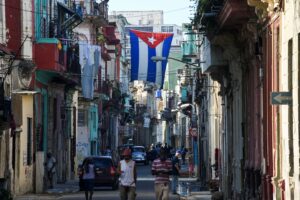
Cuba’s dictatorship has kept student movements under its thumb for decades. But the regime’s repressive tactics have inadvertently breathed new life into a new generation of student activists. These young people are willing to fight for the island’s freedom.

October 2025, Volume 36, Issue 4
Conventional wisdom says that, once in power, opposition parties will return backsliding countries to the democratic path. In reality, not only is this not true, but it is not uncommon for the opposition to adopt the autocratic habits of the regime they replaced.
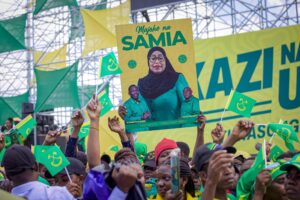
President Hassan promised Tanzanians freedom, transparency, and reform. Instead, she has delivered repression, violence, and arrests as she bars anyone who dares challenge her.
January 2016, Volume 27, Issue 1
Across East-Central Europe, the political center ground has long been characterized by the uneasy cohabitation of liberal and illiberal norms, but the latter have been gradually overpowering the former.
July 2015, Volume 26, Issue 3
How are trends in global democratization likely to be shaped by the distribution of such key structural factors as income, ethnic or religious diversity, and the quality of the state?
October 2011, Volume 22, Issue 4
When it comes to backing democracy and human rights in international forums, the behavior of the world’s six most influential rising democracies ranges from sympathetic support to borderline hostility.
July 2008, Volume 19, Issue 3
Conventional scholarly wisdom holds that ethnic diversity within a given society generally dims democracy’s prospects. Careful reflection on the experience of many post-Soviet states, however, suggests that this need not be so.
April 2008, Volume 19, Issue 2
Do young democracies have to "deliver the goods" economically in order to win political legitimacy in their citizens' eyes? Public opinion data from Asia, Africa, Latin America, and the Arab world suggest some fascinating answers.
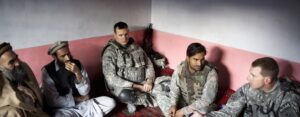
October 2022, Volume 33, Issue 4
Future state-building missions must learn from the failure of past U.S. interventions: It is critical to work with local power-brokers rather than relying on a centralized state.
January 2022, Volume 33, Issue 1
Christian Welzel’s case for a democratic future is based on the mistaken notion that opinion surveys can see the future. It is no more true today than it ever was.
October 2017, Volume 28, Issue 4
Once hailed as a megaphone for marginalized voices and an enabler of free discourse generally, social media now appear to have problematic consequences in both authoritarian and democratic regimes.
October 2017, Volume 28, Issue 4
After a presidential corruption scandal sparked peaceful mass protests leading to the impeachment and removal of the incumbent, South Koreans went to the polls to choose her successor. Was this drama a window on the troubles of South Korean democracy, or a testament to its strength and resilience?
April 2013, Volume 24, Issue 2
A number of countries including Russia and post-Mubarak Egypt are taking aggressive steps to limit or stop foreign funds from flowing to domestic NGOs that promote human rights and democracy. What is driving this trend, how far will it go, and what can be done to counter it?