
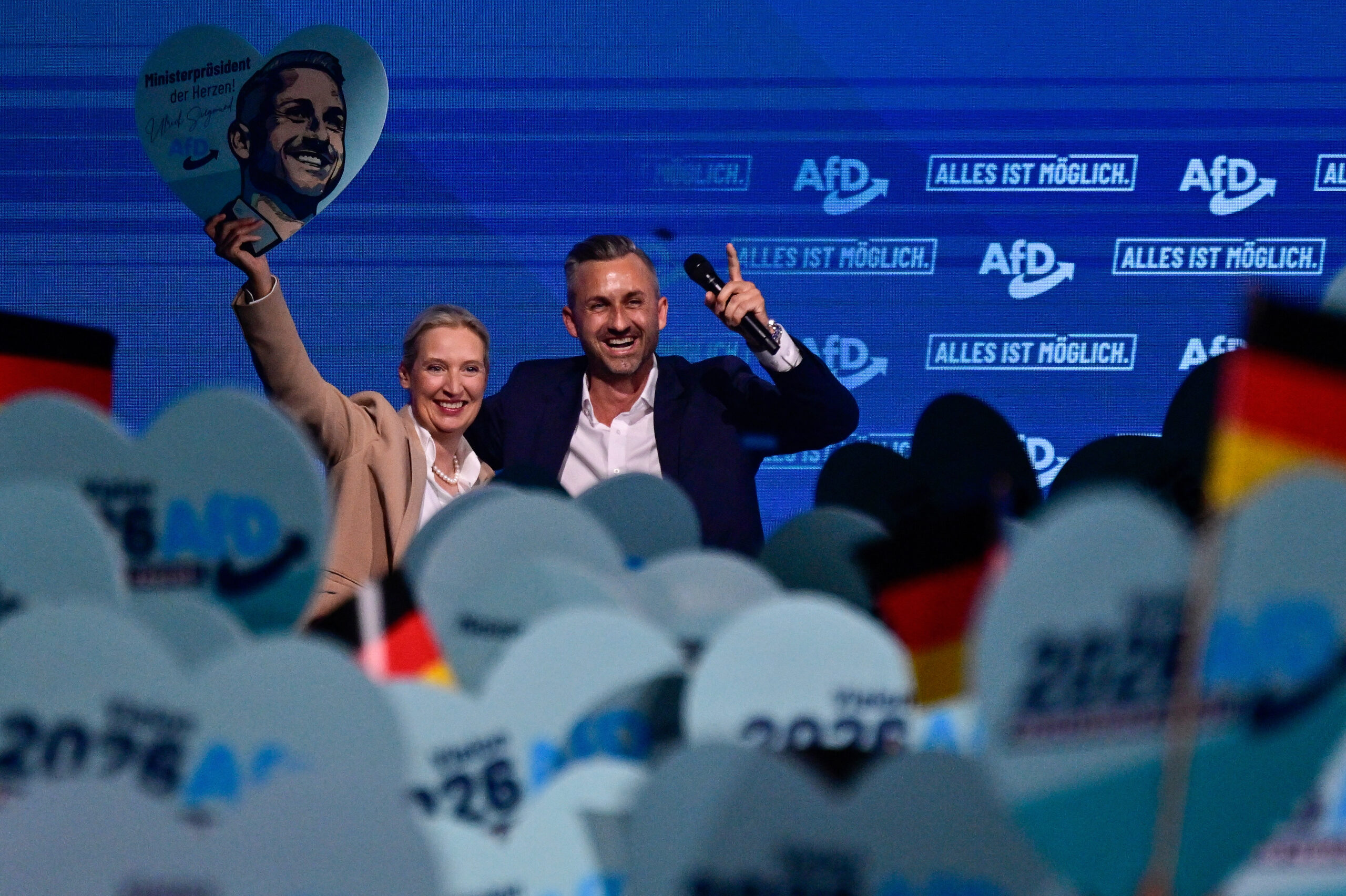
The AfD is softening its message on Europe, the economy, and debating migration as far-right rule in Germany becomes a real possibility.
November 2026
More than eighty years after the end of World War II, the prospect of a far-right government in Germany has once again become real. The Alternative for Germany (AfD) is now the country’s strongest political force, triumphant in recent state elections and routinely leading in national polls.
Meanwhile, trust in Chancellor Friedrich Merz’s coalition is eroding. Merz’s personal popularity is the lowest of any chancellor in thirty years, and barely one in four Germans expects his coalition to last until the next election in 2029.
As the AfD’s popularity rises, the instrument that has kept the party from power is crumbling. The Brandmauer (firewall) — the political mainstream’s refusal to cooperate with the AfD — has been breached.
In Saxony-Anhalt on October 6, where the AfD won nearly 44 percent of the votes in September elections, members of the left-wing populist Bündnis Sahra Wagenknecht (BSW) and apparently several lawmakers from Merz’s Christian Democratic Union (CDU) backed the AfD candidate for speaker of the state parliament — a first in German postunification history. The first AfD state premier may follow as early as December 15.
With the AfD on the cusp of power, the question arises: Will the party bring extremism to the heart of the continent, or will it follow other European far-right parties that moderated on their way to power? For now, the answer seems to be both. The AfD is practicing a strategy of selective moderation, shifting on European integration and economic policy while fiercely debating changes to its political position on migration. At the same time, it is holding firm in its opposition to supporting Ukraine in its defense against Russia.
From the Center to the Fringes — and Back?
When the AfD was founded by free-market economists revolting against the management of the eurozone crisis in 2013, the German media famously labeled the new political force “a party of professors.” Today, parts of the AfD are classified as “confirmed right-wing extremist” by German domestic intelligence agencies.
After narrowly missing the 5 percent threshold to enter the Bundestag in 2013, the AfD engaged in issue-hopping, shifting to migration, the covid-19 pandemic, cultural issues, energy prices, and the war in Ukraine. In each instance, the party attempted to close a representation gap left by a broadly converging consensus in the center.
This trajectory set the AfD apart from other European far-right parties, which started out on the fringes and have moved toward the center in the decades since.
A prime example is Italian prime minister Giorgia Meloni. Her victory in 2022 raised fears of an extremist government, given her party’s roots in postfascist movements. In power, however, her Brothers of Italy have largely abandoned inflammatory anti-Brussels rhetoric, supported Ukraine, and broken with Trump over the Iran war. On September 4, Meloni’s government became the longest serving in the history of the Italian Republic.
A similar story has unfolded in France, where Marine Le Pen is a leading contender in next year’s presidential election.
Admittedly, there is plenty of radicalism left in her National Rally (RN), but while the sincerity of the party’s dédiabolisation strategy can be contested, it is clear that the RN of today is not the same as the Holocaust-denying, white supremacist movement once led by her father.
Similar trends are visible in northern Europe, where the Sweden Democrats, another party founded with links to neo-Nazi movements, dissociated themselves from their extremist youth wing and replaced their flaming-torch logo with a spring flower.
Scholars have long debated the “inclusion-moderation” argument. Does the pull of power tame radical parties or merely normalize their ideas? The case of Germany’s AfD suggests that long-lasting categorical exclusion may have inadvertently facilitated the opposite effect: a process of programmatic self-radicalization. As other far-right parties in Europe attempted to outgrow their extremism, the AfD grew into its own.
This trend was accompanied by the serial defenestration of AfD leaders who failed to keep up with the party’s ideological changes. Cofounder Bernd Lucke — the professor behind the “party of professors” moniker — was voted out of office in 2015. His successor, Frauke Petry, threw in the towel in 2017. Jörg Meuthen left the party in January 2022, criticizing its “totalitarian echoes.”
With recent electoral success, however, this trend has begun to reverse, at least in part. A closer look at the AfD’s programmatic shifts shows that radical stances, for instance calls to revise Germany’s culture of remembrance, now coexist with attempts at strategic moderation. Both form a single strategy: The party shifts where its positions cost support and doubles down where they win popularity or set the agenda. The AfD’s stance on Europe is a case in point.
Exit from “Dexit”
Leaving the euro and, eventually, the European Union has been a hallmark AfD position for years. Both the party’s 2021 and 2025 election platforms called for a Federation of European Nations and an end to the common European currency, lambasting the breaking of rules and undue burdens for German taxpayers.
However, in October, an internal strategy paper broke with this tradition. While it continued to call for a “union of sovereign nations,” dismantling the EU and leaving the euro were relegated to options of last resort. The document cannot be formally adopted until a party congress next year, but it received the blessing of co-leader Tino Chrupalla. René Aust, a leading AfD lawmaker in the European Parliament, presented the paper as proof that the AfD was now “a Europe-friendly party.”
Party strategists seem to understand that criticizing “Eurocrats” in the town squares of Mecklenburg is different from wooing voters in Germany’s western industrial heartland. Up to 87 percent of the German public opposes “Dexit” — the German, or Deutsch, exit from the EU, à la Brexit — and even within the AfD, opinions are split. One poll from 2023 indicates that 52 percent of AfD supporters opposed leaving the EU. For a party preparing to govern, the specter of Dexit has become a liability it is increasingly willing to shed.
Adding to the changing calculation is the AfD’s expectation of an EU increasingly dominated by the right. The AfD strategy paper explicitly treats elections for the European Parliament in 2029 as a historic window for a “patriotic and right-wing majority.” Why leave the EU when you can run it?
Selective moderation has also played out on socioeconomic policy. Since its founding, the AfD has carried a neoliberal legacy, with early party leaders calling for privatization of pensions, the raising of the retirement age, and a flat tax. Today, the AfD program calls for a higher minimum wage, increased pensions, and additional support for German (only) families and children, essentially turning social policy into a tool of ethnonationalist population policy. An internal paper presented to the AfD’s parliamentary group in 2025 explicitly calls for challenging the Christian Democrats’ “claim to the social market economy,” the formula behind decades of postwar growth.
In addition, tentative changes are even debated with regard to one of the key drivers of AfD success: the topic of migration. A recent study by researchers at Saarland University found that concern about immigration is the most consistent predictor of AfD support and a recent Ipsos poll shows that 51 percent of Germans now favor completely closing the borders to refugees.
Certainly, the AfD’s general stance on immigration remains critical. The 2025 federal platform embraces the concept of “remigration,” and campaigns in eastern Germany earlier this year doubled down on the issue. In Saxony-Anhalt, the party proposed more than fifty measures for a “migration turnaround,” while in Mecklenburg-Western Pomerania it called for a state-level deportation police.
After the U.S. midterms, however, co-chair Chrupalla urged the party to seek consensus with a majority of society on migration, attributing the Republicans’ defeat partly to polarizing immigration policies. Maximilian Krah, a member of the Bundestag, went further, warning against “remigration maximalism” and arguing that “exaggeration to the point of mercilessness” was costing the party younger and urban voters. To be sure, these changes are controversial within the AfD, and hardliners as well as co-leader Alice Weidel are pushing back. The AfD’s parliamentary group just held a heated two-hour debate on Chrupalla’s statements, with a majority critical of changing course. But as on Europe, there seems to be a growing understanding in influential segments of the leadership that a party that wants to move beyond permanent opposition must appeal to the more diverse electorates of the country at large.
If European integration, socioeconomic policy, and migration show where the AfD is ready to debate change, Russia’s war against Ukraine shows where it is not.
No Change on Russia
German state parliaments rarely weigh in on foreign policy. Yet on October 14, Saxony-Anhalt’s Landtag passed a resolution titled “Peace Talks Instead of Expansion of the War in Ukraine.” Sponsored by the AfD and the BSW, it was the AfD’s first parliamentary initiative since its landslide victory in September.
On October 15, Weidel demanded an immediate end to support for Ukraine, arguing that Kyiv had already “lost the war.” After the U.S. midterms, she read the Republicans’ defeat as a rebuke of interventionism and a validation of her party’s stance on Ukraine, noting that “Trump had promised his voters not to pursue an interventionist foreign policy.”
For the AfD, Ukraine has become what could be called a catchall cause, a question that conveniently binds together policies from energy and social issues to refugees and geopolitics. Short of a drastic escalation on the ground, changing this position seems unlikely.
On November 2, two working papers presented by the party’s foreign-policy spokesmen underlined this point. They reaffirm the party’s support for NATO membership and embrace Trump’s United States as a key partner. At the same time, they call for an end to military support for Ukraine and for renewed gas deliveries from Russia. And they firmly rule out Ukrainian membership in the EU, citing costs, corruption, and the Copenhagen criteria.
The key is public opinion. On Ukraine, German voters are moving in AfD’s direction, with 53 percent now calling for a reduction of financial aid to Ukraine. On EU membership for Ukraine, support has fallen from 61 percent in 2022 to 41 percent in June 2026 . This is not to say that a majority of Germans now supports the AfD’s position, but there is a notable shift toward, not away from, the party’s stance.
Orbánism Without Orbán?
On one level, the AfD has mirrored the trajectory of its Western European peers. On European integration, the euro, and on socioeconomic policy, the party is currently trying to present itself as less disruptive, quite explicitly to maximize its electoral appeal. On migration, change is being debated. On another level, however — most notably, on the war in Ukraine — the party has stood its ground and shows no signs of changing course.
For the future of European democracy and the process of European integration, this combination could prove challenging. Of course, without an absolute majority, an AfD-led federal government would need a willing coalition partner, and none is yet in sight. But barring further radical shifts, an AfD in power could look much like a model Europe has only just left behind: that of Viktor Orbán. As prime minister, Orbán used the European Union wherever convenient, pursued rapprochement with Moscow, and transformed Hungary into what he called an “illiberal democracy.” A German variant of Orbánism, however, would not be coming from a country of fewer than ten million but from the EU’s biggest net contributor and Ukraine’s largest European backer. It would not be a mere echo of Budapest, but an amplification from Berlin unlike anything Europe has heard before.
Michael Bröning is a political scientist and a member of the basic-value commission of the German Social Democratic Party. His most recent book is Die Hetzer sind immer die Anderen (2024).
Copyright © 2026 JoD Productions Inc
Image Credit: John MACDOUGALL / AFP via Getty Images
|
FURTHER READING |
||
|
The Alternative for Germany Is Triumphant
|
Will Germany’s Firewall Fall? |