
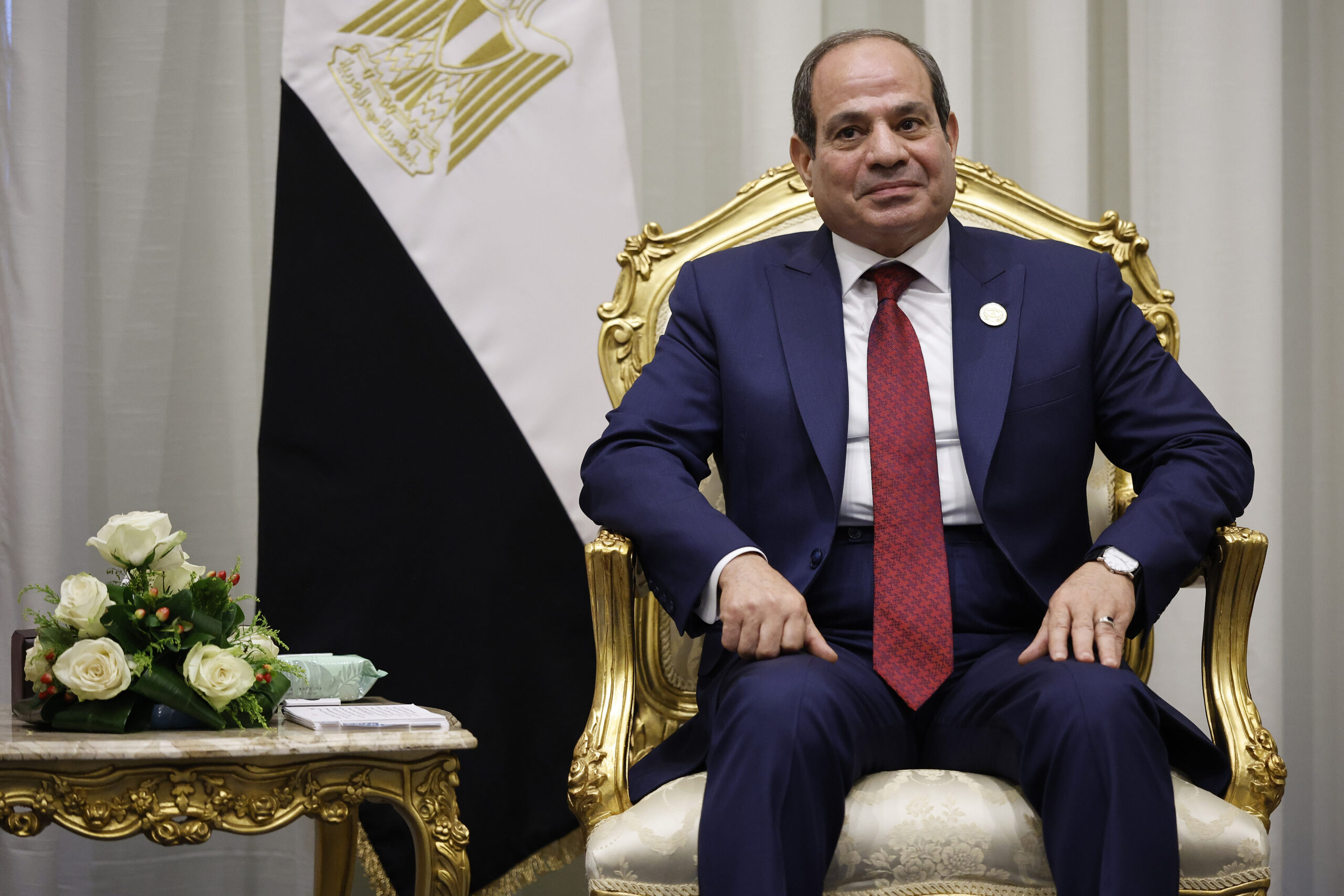
Or is this just another ruse? Either way, the fine print in Sisi’s statements suggests even greater military control of Egypt’s elections and political life.
October 2026
Last week, in a shocking turn of events, Egyptian president Abdel-Fattah Al-Sisi announced that he would not seek reelection in 2030 and would leave office upon completing his third and final presidential term. The announcement surprised many observers. After all, in 2019, Sisi had arranged an amendment to the Egyptian Constitution to allow himself (and only himself) to run for office, and many expected that, as the end of that term approached, another round of constitutional engineering was inevitable. Sisi’s recent declaration seems to take this off the table.
As one might expect, public reaction to Sisi’s dramatic revelation has alternated between speculation over who might succeed him and suspicion that the whole thing is a prelude to stage-managed “popular” demands for the strongman to remain. What few are talking about is the wild vision Sisi has laid out for the future of Egypt’s political system.
In an October 17 speech at the Military Academy, Sisi laid out his vision for the 2030 presidential race. He reiterated his intention not to seek reelection or amend the constitution. But he said a lot more; he outlined guidelines determining who would be allowed to contest the presidency in 2030 and what political life would look like in a post-Sisi Egypt.
The president framed his proposal around Article 200 of the constitution, which tasks the Armed Forces with upholding the constitution and democracy. Invoking that mandate, Sisi said that prospective candidates for executive office (the presidency or otherwise) would be required to undergo training at the Military Academy. “They will spend 30 months here at the academy, where they will be taught what a state is, what its resources and assets are, and how to safeguard them,” he said. What’s more, Sisi declared that to be eligible for office, candidates must be between the ages of 40 and 50 and, in a bizarre twist, hold doctorates from prominent local or foreign universities.
These remarks are important for two reasons.
First, Sisi’s proposed criteria for presidential candidates, if enacted, would mark an important shift in the regime’s management of electoral politics. These criteria would effectively pull the rug out from under civilian politicians and political parties, whether regime-backed or independent. Sisi’s vision would instead hand authority to opaque, military-sponsored bodies with the ultimate say over who qualifies to run.
Some might wonder whether this represents a real change. After all, casual observers of Egypt in the thirteen years since Sisi overthrew the country’s first democratically elected president would not have been wrong in classifying Egypt as a military dictatorship. That said, this was a military dictatorship that increasingly sought to exert its power through nominally civilian political institutions and interlocutors. Independent political parties, such as Al-Wafd and the Egyptian Social Democratic Party, have participated in recent multiparty presidential elections, albeit without fielding serious challengers to Sisi. In previous elections, getting on the ballot required endorsements from twenty lawmakers or at least 25,000 citizens across fifteen governorates. Whether or not this requirement remains in place in 2030, the additional layer of vetting Sisi proposes would undermine licensed parties’ ability to put forward their own presidential candidates. The arrangement would help to ensure that competitive candidates could not use these parties as back doors onto the ballot.
Sisi’s proposal would also constrain independent figures, including retired officers, seeking to launch bids of their own, which some attempted in the lead-up to the 2018 presidential race. By limiting the proposed pool to individuals between 40 and 50 years old, the president would effectively exclude the older retired generals most likely to mount such bids. His vision likewise leaves little room for state-backed parties such as Mustaqbal Watan, Humat Al-Watan, and Al-Gabha Al-Wataniyya. The regime has a strong incentive to limit their role in presidential selection, perhaps out of concern that their involvement could invite competition among the security agencies sponsoring them.
Second, Sisi’s insistence that presidential candidates undergo military indoctrination is consistent with the institution-building trajectory his regime has pursued over the past twelve years. The regime has developed a host of initiatives and programs designed to instruct future executive leaders, bureaucrats, and public servants in military nationalist dogmas and cultivate a blind loyalty to the political status quo. This expanding training apparatus includes programs housed under the so-called National Training Academy, whose “Presidential Leadership Program” promises to “inject competent cadres into the pipelines of the governmental sector and any other sectors that contribute to building and supporting the national economy and developing and raising the efficiency and performance of their workers in the administrative sector of the state.” Meanwhile, military institutions have assumed a growing role in training civilian officials, and completing such programs has even become a requirement for employment in certain government agencies.
Sisi, in other words, is laying out a vision for a much more controlled process of presidential nomination and ballot fixing. This could be a prelude to a new form of military management of civilian politics, one that institutionalizes military control over access to senior executive offices in anticipation of his departure. It could also be a bluff.
Sisi could of course backtrack on his commitment to leave office. He denied presidential ambitions before running in 2014, and later pledged to respect constitutional term limits before engineering the 2019 amendments that cleared the way for his third term. Appeals to “popular demand” have long helped justify his continued rule. That his latest announcement comes amid a visible clampdown on the press, alongside a florid public display of his ostensible accomplishments, makes it all the harder to take at face value.
Sisi’s invocation of Article 200 in his October 17 speech may offer clues about how he might justify a fourth presidential bid. By assigning the military a role in vetting candidates and supposedly “preventing violations of the Constitution and transgressions against democracy,” he cast the military as the arbiter of the political process. One could imagine a scenario in which the military declares that Sisi is the only one capable of protecting Egypt’s “democratic” order. Combine such a declaration with a state-orchestrated popular campaign calling on him to run, and the regime could claim a justification for circumventing term limits without even needing to formally amend the constitution.
Whether or not Sisi abides by the pledge he made this week, the fine print of his statements points toward greater military control over the electoral field and civilian politics more generally. None of this should surprise anyone who has followed Egypt closely under Sisi, but his announcement is less likely to herald a major political opening than a further tightening of political space and the sidelining of civilian political life.
Hesham Sallam is senior research scholar and associate director for research at Stanford University’s Center on Democracy, Development and the Rule of Law.
Copyright © 2026 JoD Productions Inc
Image Credit: Chip Somodevilla/Getty Images
|
FURTHER READING |
||
Cracks in Sisi’s Façade |
 Will Egypt Be the Next Syria? |
 The Autocrat-in-Training: The Sisi Regime at 10
|