
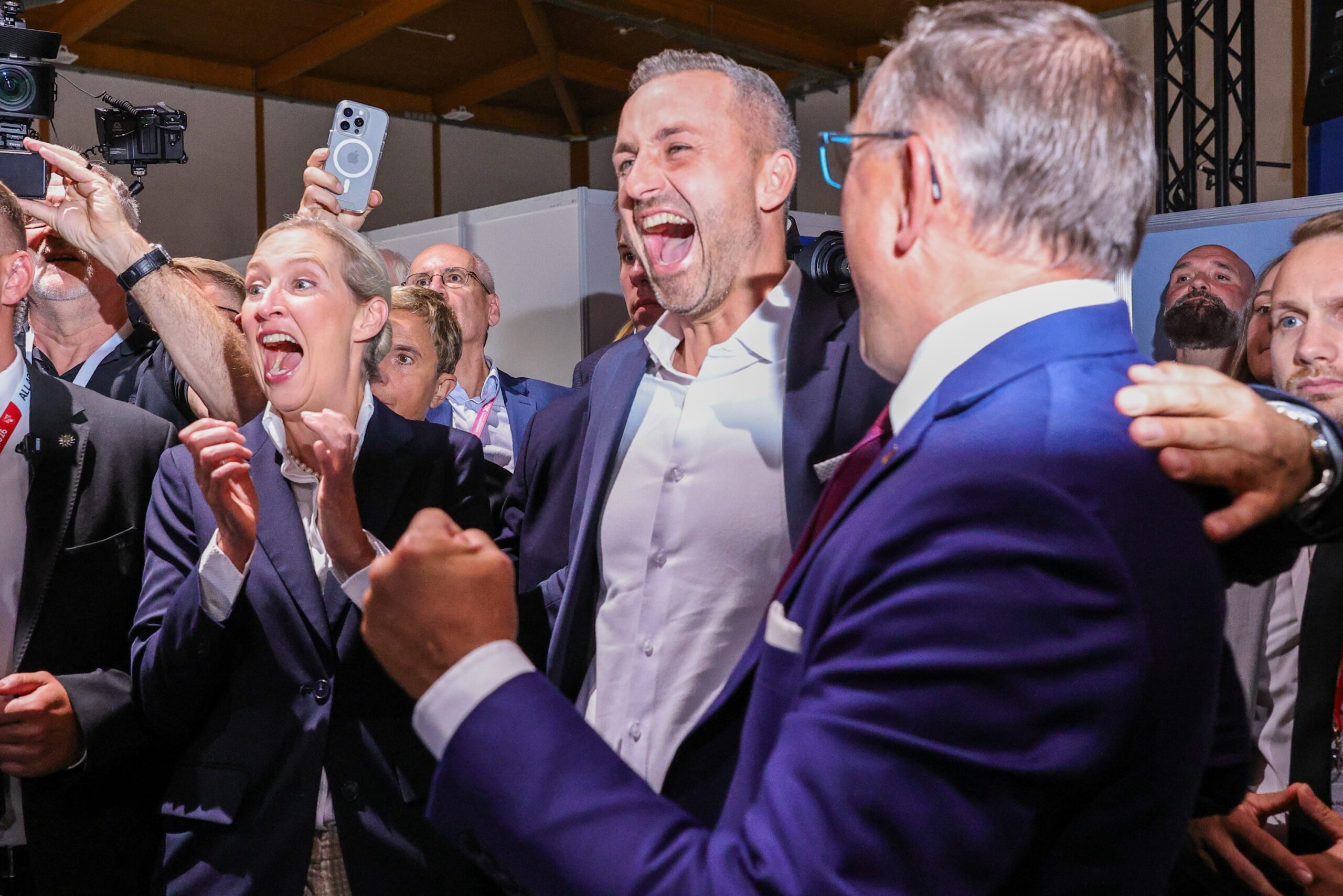
The far-right German party is surging on the heels of a historic victory. The so-called Blue Storm is no longer a force on the horizon. It has arrived, and Germany’s political center is falling fast.
September 2026
G ermany’s far-right AfD scored a historic victory in a key state election on Sunday, September 6. In what has been dubbed a “blue storm” by German media, the party won close to 44 percent of the vote in the eastern state of Saxony-Anhalt, more than doubling its performance from five years ago. The AfD, which has been classified as right-wing extremist by Germany’s domestic-intelligence agency, is now only three seats short of an absolute majority in the state’s legislature.
Coming in at a distant second was Chancellor Friedrich Merz’s Christian Democratic Union (CDU). The party lost half of its support from 2021, falling to just above 17 percent. The Social Democrats, the Greens, and Die Linke each received about 9 percent of the vote. In preelection polls from a few weeks ago, both the Social-Democrats and Greens failed to break through the 5 percent threshold for parliamentary representation. In the end, however, both parties benefited from last-minute mobilization efforts to prevent a far-right majority. The BSW, a party that combines left-wing economic ideas with social conservatism and a benign view of Russia, also narrowly cleared the 5 percent threshold for the first time. It could now emerge as a kingmaker.
Political polarization caused electoral participation to jump to a high of just under 80 percent, an increase of more than 17 percentage points. More than 150,000 former nonvoters were brought to the polls to support the AfD.
The AfD ran a campaign geared toward its youthful lead candidate, the 35-year-old former salesman Ulrich Siegmund, who has cultivated a likable aura of can-do common sense despite an entourage of advisors with links to the identitarian right. His campaign slogans read “Everything will be good” and “Anything is possible.”
Siegmund also stressed his East German identity, organizing county-fair-style family gatherings and campaign rallies with East German motorcycles. At one campaign event, he even joined a crowd to sing the former East German national anthem.
In the month before the election, a Der Spiegel cover story became a Siegmund campaign prop. The August edition of Germany’s biggest news magazine featured a mug-shot-style photo of the candidate bearing the caption “Germany’s most dangerous man.” Siegmund soon began signing copies of the magazine for his supporters at campaign stops.
Social media and alternative media platforms proved essential. On TikTok alone, Siegmund’s almost 900,000 followers contrast markedly with the mere 4,000 followers of the state’s sitting premier, Sven Schulze of the CDU.
The AfD’s “government platform” embraces a plethora of issues, ranging from demanding the “re-migration” of illegal immigrants and an end to climate policies to removing the rainbow flag, furthering respect for Germany’s war memorials, canceling funding for the country’s public broadcast media, and highlighting Russia as a potential partner.
The campaign’s success went beyond tapping into single-issue discontent but blended into a multi-issue vote of no confidence in Germany’s established parties. Postelection data indicate that, at 25 percent, social justice was considered the most important election issue, followed by peace in Europe with 17 percent and economic issues with 15 percent. The topic of migration was ranked at 9 percent.
Exit polls also illustrate that the AfD has significantly broadened its support base. It now ranks as the strongest party in almost every demographic group, including women — despite the fact that only two women were elected to the state parliament on an AfD-ticket.
Notably, the AfD evolved from a party of protest into a party supported for its political stances, and has broadened its appeal to a general perception of governing competence.
In a direct comparison with the CDU, the AfD outranked its competitors in perceived competence on issues ranging from energy and migration policy to economics and security. At the same time, 87 percent of AfD voters in Saxony-Anhalt consider the party “a movement with individual right-wing extremist politicians but in general mainly in the political center.”
According to the state constitution, State Premier Sven Schulze will remain in office until a successor has been elected. That, however, could prove difficult. During the campaign, Siegmund stressed that he would only govern with a stable majority of his own making. But he shifted his language on election night, declaring his intention to hold talks and “extend a hand to everyone.”
For Siegmund there are now two options. Either an AfD collaboration — formal or otherwise — with the BSW or ad hoc support from lawmakers breaking away from the CDU. Either option would mark the end of the cordon sanitaire politics that has kept the AfD away from power since its founding in 2013.
The AfD leadership in Berlin has shown early signs of support for the prospect of working with the BSW, with AfD co-leader Alice Weidel indicating that a government that included the BSW would be “very interesting.” Likewise, the BSW’s lead candidate in Saxony-Anhalt, Thomas Schulze, has stressed similarities with the AfD, not least on energy and foreign policy. One potential scenario for the BSW, short of a formal coalition, would be to abstain in the final round of electing the new state premier, which would then hand Siegmund a de facto majority.
The unlikely alternative would be a CDU-led minority government, bringing together the CDU, the Social Democrats, and the Greens, and tolerated by Die Linke. Such a government would be compatible with a longstanding CDU party decision which prohibits collaboration with the formerly communist Die Linke but would still fall three seats shy of a majority. Alternatively, Social Democrats have suggested exploring options for a nonpartisan state premier.
While AfD leaders have been quick to interpret their success as a mandate to govern, failing to enter government at this point would not necessarily be problematic for the AfD. An all-party coalition keeping it from power would only further its narrative of antidemocratic establishment forces conspiring against the will of the majority. On election night, Siegmund already went on record saying that in case of failing coalition talks he would not shy away from new elections. “Then we would get 50 or 55 percent.”
In two weeks’ time, voters will head to the polls in Mecklenburg-Vorpommern and Berlin. While the AfD is expected to do less well in both states, the Christian Democratic strategic dilemma will continue.
For years, the CDU has insisted on the strategy of isolating the AfD behind what has been dubbed the Brandmauer, or firewall. With the AfD emerging as the country’s strongest political force, however, critical voices from within the Christian Democrats are starting to wonder if this strategy remains feasible. Chancellor Merz has linked his leadership to the promise that “left-wing politics is over.” Given that the Brandmauer forces Germany’s center right into constant cooperation with parties on the left, however, it significantly limits the CDU’s chance to deliver on this promise.
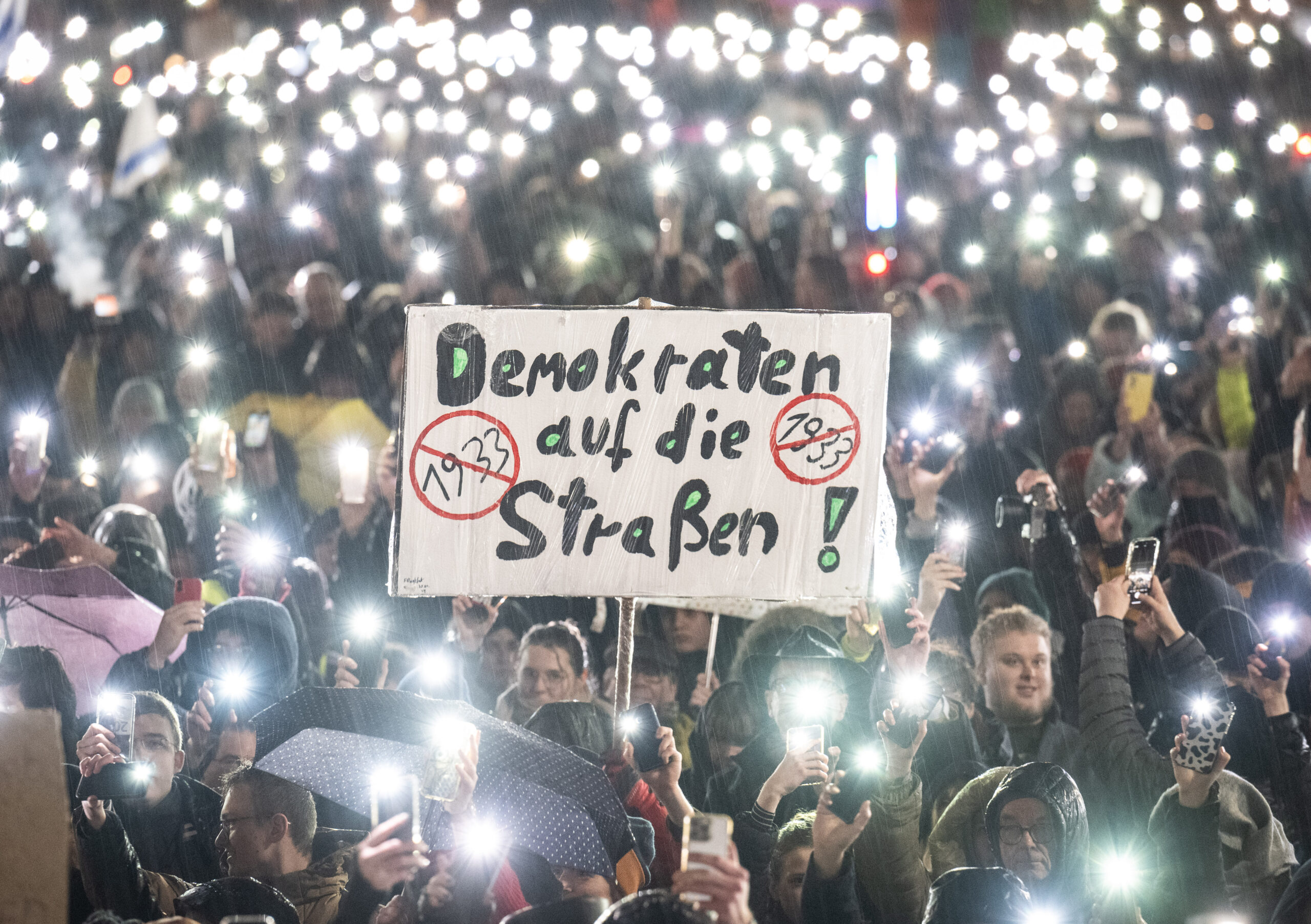
As Germany’s political center heads to Berlin to chart a way forward, the Berlin coalition has announced that it intends to review some of its recent initiatives on health and pension reforms. At the same time, anti-AfD protests are expected to take place in German cities starting today. But will this be enough to stem the “Blue storm”?
Michael Bröning is a political scientist and a member of the basic-value commission of the German Social Democratic Party. His most recent book is Die Hetzer sind immer die Anderen (2024).
Copyright © 2026 JoD Productions Inc
Image Credit: Omer Messinger/Getty Images
|
FURTHER READING |
||
Will Germany’s Firewall Fall? |
Why Germany’s Far Right Is Winning Big |
Why Germans Are Rallying Against the Far RightHundreds of thousands of Germans are taking to the streets in protest against the country’s far-right parties. Will it shift the tide or leave Germany further divided? |