

Will Kuwait’s Next Parliament Be Its Last?
The Gulf kingdom has been a rare democratic experiment. But gridlock and the Emir’s mounting impatience with Kuwaiti politics may be on the cusp of bringing it to an end.
3272 Results
The Gulf kingdom has been a rare democratic experiment. But gridlock and the Emir’s mounting impatience with Kuwaiti politics may be on the cusp of bringing it to an end.

Establishment parties are flagging. They should learn from political disruptors.

Russian rockets are targeting Ukrainian journalists’ ability to report the news, but the country’s media is finding new ways to stay on the air. 9 March 2022 By Marta Dyczok As I sat writing this article, the people I was writing about, many of whom are my friends, were being attacked by Russian military forces.…
October 2003, Volume 14, Issue 4
Civic education can enhance democratic values and participation among adults in young democracies, but the training must be frequent and participatory. Otherwise adult civic education may not be worth doing.


October 2023, Volume 34, Issue 4
Generative AI can flood the media, internet, and even personal correspondence, sowing confusion for voters and government officials alike. If we fail to act, mounting mistrust will polarize our societies and tear at our institutions.
Just a month after its introduction, ChatGPT, the generative artificial intelligence (AI) chatbot, hit 100-million monthly users, making it the fastest-growing application in history. For context, it took the video-streaming service Netflix, now a household name, three-and-a-half years to reach one-million monthly users. But unlike Netflix, the meteoric rise of ChatGPT and its potential for…
October 2023, Volume 34, Issue 4
A final statement by Russian activist and opposition politician Alexei Navalny; The North Atlantic Council’s communiqué on Ukraine; Legal analyst Ethan Hee-Seok’s testimony on North Korean asylum-seekers at the China–North Korea border; “Voices of a New Belarus” by playwright Andrei Kureichik; Guatemalan president-elect Bernardo Arévalo’s victory speech.

He is rude, foul-mouthed, and one of the most popular politicians in the world. Like it or not, Argentina’s chainsaw-wielding president is the new face of populism.
October 2012, Volume 23, Issue 4
Contrary to the expectations of some democratic theorists, the EU will not collapse because of the “democratic deficit” of European institutions. Nor will it be saved by the democratic mobilization of civil society. Paradoxically, it is widespread disillusionment with democracy—the shared belief that national governments are powerless in the face of global markets—that may be…

July 2025, Volume 36, Issue 3
Restoring liberalism after illiberalism is no easy task: Leaders face hard choices between acting quickly and effectively while maintaining a commitment to democratic procedure. Worse, their illiberal opponents stand to benefit either way.

October 2021, Volume 32, Issue 4
The National Endowment for Democracy’s founding president made enormous contributions to the fight for freedom and human rights. Reflections on what his 37-year tenure meant for the democratic cause—and this journal.

The Venezuelan strongman is attempting to steal the country’s presidential election and daring the people to stop him. But even if military leaders are backing him, Maduro is already weaker than he appears.
July 2021, Volume 32, Issue 3
Excerpts from: Maria Ressa’s comments on social media at the 2021 Copenhagen Democracy Summit; NGO statement on the arrest of Algerian human-rights defenders; statement denouncing the dismissal of Constitutional Court judges and the attorney general; letter on the sentencing of a Saudi man for allegedly running a satirical Twitter account.
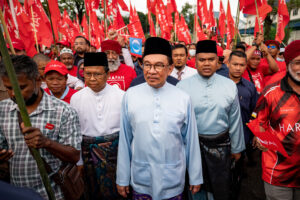
The democratic icon’s path to prime minister has been tortuous and long. But is Malaysia’s pluralism slipping away precisely when Anwar is getting his shot to lead the nation?
January 2009, Volume 20, Issue 1
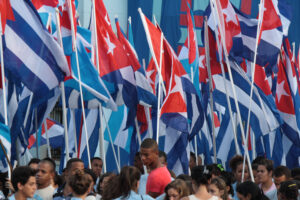
The opposition within Cuba has become more diverse as well as more unified, and the regime, despite its enduring capacity for repression, is showing signs of underlying weakness.
January 2011, Volume 22, Issue 1
Imprisoned Chinese dissident Liu Xiaobo, who was awarded the 2010 Nobel Peace Prize, is best known for his eloquent and incisive essays. Two of them are featured here: “Can It Be That the Chinese People Deserve Only ‘Party-Led Democracy’?” and “Changing the Regime by Changing Society.”

October 2025, Volume 36, Issue 4
Today, governments can see who buys what, who pays whom, and who donates to which cause. But they cannot easily trace or confiscate Bitcoin. The digital currency offers a lifeline to democratic movements operating in the most repressive places.
January 2014, Volume 25, Issue 1
A review of The End of Power: From Boardrooms to Battlefields and Churches to States, Why Being In Charge Isn’t What It Used to Be by Moisés Naím.
October 2017, Volume 28, Issue 4
A tribute in remembrance of Liu Xiaobo (1955–2017).
April 2015, Volume 26, Issue 2
A review of Power Politics in Zimbabwe by Michael Bratton.