
July 2007, Volume 18, Issue 3
Personalizing Power in Uganda
For more than two decades, President Yoweri Museveni has been building an authoritarian regime that answers closely to his personal will.
3265 Results
July 2007, Volume 18, Issue 3
For more than two decades, President Yoweri Museveni has been building an authoritarian regime that answers closely to his personal will.
October 2006, Volume 17, Issue 4
Over the past decade, a series of "electoral revolutions" has taken place from Slovakia to Kyrgyzstan. Why has this path to democratization been especially common in the postcommunist region?
January 2006, Volume 17, Issue 1
There is a widespread desire for democracy among the Iraqi public, but when it comes to the roles of religion, ethnicity, and gender equality in Iraq's new democracy, attitudes are more varied.
January 2005, Volume 16, Issue 1
In the 15 years since the Journal of Democracy‘s inception, democracy has made extraordinary progress. But no challenge is greater than building democratic institutions in postconflict situations.
Winter 1990, Volume 1, Issue 1
This past spring the world looked on in wonder as millions filled the streets of Beijing and 80 other Chinese cities, defying the Communist regime and demanding democracy.

October 2018, Volume 29, Issue 4
What factors help a democracy to survive a crisis? A study of cases in which democracy suffered a steep decline, yet ultimately recovered and endured, offers new insights. In moments of crisis, unelected and nonmajoritarian actors can play a pivotal role.
April 1993, Volume 4, Issue 2
Reports on elections in Cyprus, Djibouti, Ghana, Kenya, Lithuania, Madagascar, Niger, Senegal, South Korea, Taiwan, Yugoslavia.
July 2001, Volume 12, Issue 3
A bloodless revolution toppled the corruption-ridden 13-year-old regime of Slobodan Milosevic and brought to power a team led by committed democrats. Although strains exist within the new 18-party ruling coalition, there are strong reasons for it to hold together during the current period of transition.
January 2001, Volume 12, Issue 1
The military regime of General Musharraf has been less repressive than many had feared, but there is little sign that it is overcoming the deep-seated problems that led to the failure of Pakistani democracy.
January 2020, Volume 31, Issue 1
The country’s hold on electoral democracy is firm, but its claim still to be a liberal democracy is increasingly dubious.
July 2017, Volume 28, Issue 3
Read the full essay here. Seven decades after gaining its independence from the British Empire, India retains all the hallmarks of a functioning democracy: It holds reasonably free and fair elections, has a mostly independent judiciary plus a largely free press, and enjoys a robust and growing civil society. Yet thanks to India’s colonial inheritance…
January 2012, Volume 23, Issue 1
Social activist Anna Hazare’s hunger strike has helped to turn the world’s attention to India’s rampant corruption.
October 2010, Volume 21, Issue 4
Arabs express a clear preference for democracy, which they define in ways similar to citizens elsewhere in the world. But their authoritarian regimes are not listening.
January 2010, Volume 21, Issue 1
Today, twenty years after the fall of the Berlin Wall, there is a growing ambiguity about the historical significance of 1989 and about the state of democracy in Europe (particularly Central Europe).
October 2007, Volume 18, Issue 4
Under the pressure of compliance with the Maastricht convergence criteria governments implement painful welfare state reforms.
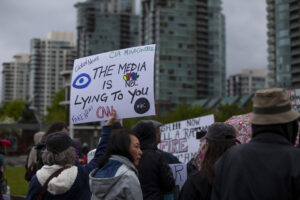
April 2022, Volume 33, Issue 2
Conspiracy theories are not the sole preserve of dictatorships, but a global phenomenon. Worse, the political competition that is inherent to democracy is driving the spread of lies, fake schemes, and half-truths.
July 2020, Volume 31, Issue 3
Although South Korea is praised for its success at fighting covid-19, the triumph came at a cost to rights and privacy, and is drawing attention away from a larger drift toward illiberalism and bitterly factionalized politics.

October 2025, Volume 36, Issue 4
Artificial intelligence and its effects on democracy are a matter of choice, not fate. The concerns are longer term than the recent spate of worry about “generative” AI would suggest. The democratic conversation about AI has hardly begun.
April 1997, Volume 8, Issue 2
Reports on elections in Chad, Gabon, Gambia, Madagascar, Pakistan, Russia (Chechen Republic), Singapore.
October 2005, Volume 16, Issue 4
The May 2005 presidential election capped a process of conservative reentrenchment, but with a surprising populist twist.