
October 2022, Volume 33, Issue 4
The Danger Is Real
Analysis that subtly defines away problems is not going to help democracies survive the threats they now face. The fear is warranted.
3266 Results
October 2022, Volume 33, Issue 4
Analysis that subtly defines away problems is not going to help democracies survive the threats they now face. The fear is warranted.

October 2022, Volume 33, Issue 4
Democracies are increasingly under attack by the leaders they elect. We may not know the damage until it is too late.

July 2023, Volume 34, Issue 3
When Israel’s new government introduced proposals that threatened the judiciary’s independence, the country erupted in protest. These tensions will not soon end. Likud, once a center-right party, is now as populist as the European far right.
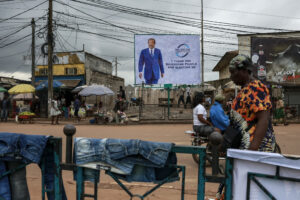
Cameroonians just reelected the 92-year-old Paul Biya in an election that voters rightly view with suspicion. The tensions under the surface don’t bode well for the country or its people.

January 2014, Volume 25, Issue 1
Four leading experts on democracy discuss the relevance of the “transition paradigm” in light of the “Arab Spring” and other developments in the world today.
July 2007, Volume 18, Issue 3
No one should underrate the will and skill that the ruling Chinese Communist Party will put into keeping its grip on power.
July 2018, Volume 29, Issue 3
The president of Tunisia’s Ennahdha party, Rached Ghannouchi, argues that the solution to extremism is more (not less) freedom and democracy, along with more moderate religious teachings.
July 1995, Volume 6, Issue 3
A review of From Reform to Revolution: The Demise of Communism in China and the Soviet Union, by Minxin Pei and Sowing the Seeds of Democracy in China: Political Reform in the Deng Xiaoping Era, by Merlec Goldman.
April 2014, Volume 25, Issue 2
How do democracies emerge from monarchies? In an essay that eminent political scientist Juan J. Linz was working on when he passed away in October 2013, he and his coauthors draw lessons from the European experience about whether and how Arab monarchies might aid or resist democratic development.
April 2014, Volume 25, Issue 2
In severely divided societies, ethnic cleavages tend to produce ethnic parties and ethnic voting. Power-sharing institutions can ameliorate this problem, but attempts to establish such institutions, whether based on a consociational or a centripetal model, face formidable difficulties.
July 2014, Volume 25, Issue 3
The year 2013 featured unprecedented strides for gay rights in some parts of the world, particularly in Western Europe and the Americas, but also startling setbacks elsewhere, as in Russia and some countries in Africa.
October 2015, Volume 26, Issue 4
Widely believed to be hopelessly mired in poverty, stagnation, and dictatorship, the developing world has in fact been making steady progress for over two decades in health, education, income, and conflict reduction, along with democracy.
October 2023, Volume 34, Issue 4
AI is destined to become another stage for geopolitical conflict. In this contest, autocracies have the advantage, as they vacuum up valuable data from democracies, while democracies inevitably incorporate data tainted by repression.
April 2022, Volume 33, Issue 2
In 2021, autocrats’ efforts to reshape the global order enabled heavier repression and brazen power grabs, while democracies faltered. Is this a tipping point?
January 2022, Volume 33, Issue 1
Kyrgyzstan’s parliamentary-style constitution was a democratic bright spot in Central Asia. But the legislature quickly devolved into a corrupt bazaar, dimming its democratic prospects.
January 2019, Volume 30, Issue 1
Zimbabwe’s first elections since the November 2017 coup that ousted nonagenarian dictator Robert Mugabe were marred by the abuse of state resources, electoral irregularities, and a tragic bout of postelection violence that saw soldiers use deadly force against civilians.
July 2018, Volume 29, Issue 3
In Romania today, as in Italy twenty years ago, the gradual politicization of anticorruption has come to shape the political scene.
January 2018, Volume 29, Issue 1
The worldwide popularity of runoff rules for presidential elections has grown strikingly in recent decades. In Latin America, contrary to scholarly expectations, this shift has had important benefits for democracy.
October 2017, Volume 28, Issue 4
Wrongly viewed by many media sources as a victory for “reform” and “openness,” the recent presidential election in Iran actually reflected the demoralization and disengagement of the country’s prodemocratic opposition.
January 2017, Volume 28, Issue 1
The British party system is being fundamentally reshaped by the consequences of the British decision to leave the EU, which also threatens to reduce Britain’s influence on the rest of the world.