
January 2022, Volume 33, Issue 1
Exchange: Why the Future Cannot Be Predicted
Christian Welzel’s case for a democratic future is based on the mistaken notion that opinion surveys can see the future. It is no more true today than it ever was.
2116 Results
January 2022, Volume 33, Issue 1
Christian Welzel’s case for a democratic future is based on the mistaken notion that opinion surveys can see the future. It is no more true today than it ever was.
July 2020, Volume 31, Issue 3
The encrypted messaging service WhatsApp has become an increasingly important tool for “fake news” in Nigeria, while weakening government control of information and broadening opportunities for political participation.
July 2016, Volume 27, Issue 3
Latin America’s largest country has managed vastly to enlarge the share of its citizens who can take part in politics and need no longer live in poverty, and has robust horizontal accountability to boot. Vertical accountability, however, has suffered.
April 2012, Volume 23, Issue 2
Does recourse to the ballot box spur violence and instability in the world’s poorest countries? Despite the worries of modernization theorists such as Paul Collier, the evidence indicates that, over time, elections are not associated with higher levels of political violence.
April 2012, Volume 23, Issue 2
Among a new generation of international democracy promoters—often former recipients of democracy assistance themselves—Poland stands out. Its efforts, though mostly in its own neighborhood, show the importance of combining direct assistance with quiet diplomacy.
October 1994, Volume 5, Issue 4
Excerpts from: the statement of Wangarí Maathai, the founder and head of the Kenyan Greenbelt Movement; recommendations from the First International Conference on the Peoples of the Arab World and the Middle East and the United Nations Declaration on the Rights of Minorities.
April 2015, Volume 26, Issue 2
A review of Power Politics in Zimbabwe by Michael Bratton.
January 2015, Volume 26, Issue 1
Reports on elections in Bolivia, Bosnia-Herzegovina, Botswana, Brazil, Bulgaria, Croatia, Latvia, Liberia, Mauritius, Moldova, Mozambique, Namibia, Romania, Tunisia, Ukraine, and Uruguay.
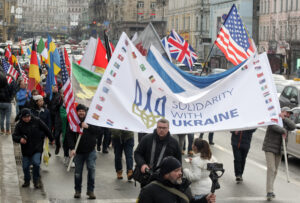
Forget his excuses. Russia’s autocrat doesn’t worry about NATO. What terrifies him is the prospect of a flourishing Ukrainian democracy.
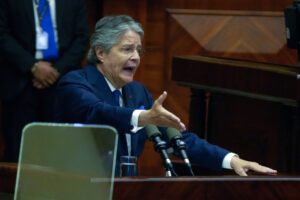
The small Latin American country was a brief democratic bright spot. But it appears to have fallen victim to a clash between populists and anti-populists, without a democrat in sight.
July 1998, Volume 9, Issue 3
The death of Mexican poet and essayist Octavio Paz on April 20 was (in the words of Mexico’s president Ernesto Zedillo) “an irreplaceable loss for contemporary thought and culture—not just for Latin America but for the entire world.” Born in Mexico City on 31 March 1914, Paz published his first book of poetry while still…
July 2004, Volume 15, Issue 3
Excerpts from: the Alexandria Declaration, a document emanating from a March 2004 conference on Arab reform convened under the auspices of Egyptian president Hosni Mubarak; an initiative on political reform issued by the first Arab Civil Forum on March 22; the Tunis Declaration, issued at the end of the Arab Summit; a response from 34…
April 2007, Volume 18, Issue 2
Excerpts from: an open letter to Russian president Vladimir Putin in response to the decision to close the Society for Russian-Chechen Friendship; a message delivered by Democratic Republic of the Congo president Joseph Kabila acknowledging his victory in the 2006 elections.
April 1998, Volume 9, Issue 2
Excerpts from: remarks and homily of Pope John Paul II given during his visit to Cuba; South Korean president Kim Dae Jung’s inaugural address.

It is almost a year since the death of Alexei Navalny. The Russian opposition leader sought to channel Russian nationalism as a challenge to Putin’s autocracy. He gave everything in the fight.
April 2021, Volume 32, Issue 2
Recent survey research suggests that most voters disapprove of antidemocratic acts by elected leaders. Yet there are critical exceptions when a significant minority of voters are sympathetic to or even supportive of violations of democratic laws and norms.

October 2004, Volume 15, Issue 4
Over the last two decades, Latin America has seen more than a dozen presidencies come to a premature end. It is time to consider changing constitutional designs that promote conflict rather than more consensual ways of doing politics.