
July 2021, Volume 32, Issue 3
Election Watch
Reports on elections in Algeria, Benin, Cape Verde, Chad, Congo-Brazzaville, Djibouti, Mongolia.
2195 Results
July 2021, Volume 32, Issue 3
Reports on elections in Algeria, Benin, Cape Verde, Chad, Congo-Brazzaville, Djibouti, Mongolia.
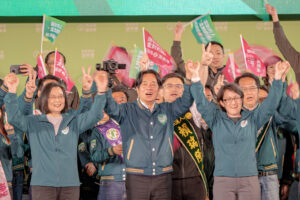
Taiwan’s voters rewarded the ruling party with an unprecedented third consecutive term, despite the mainland’s attempts to intimidate. Expect Beijing to find new ways to threaten the democracy off its coast.
July 2016, Volume 27, Issue 3
Excerpts from: a letter by Thich Quang Do, Supreme Patriarch of the Unified Buddhist Church of Vietnam and a leading human-rights advocate, to U.S. president Barack Obama; a declaration by prominent Latin American political leaders and activists calling for political and social opening in Cuba; the inaugural address of Taiwan’s new president Tsai Ing-wen.

April 2025, Volume 36, Issue 2
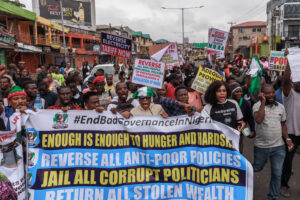
Voters around the world are losing faith in democracy’s ability to deliver and increasingly turning toward more authoritarian alternatives. To restore citizens’ confidence, democracies must show they can make progress without sacrificing accountability.
Journal of Democracy Web Exchange – Norris_0 Pippa Norris–Is Western Democracy Backsliding? Diagnosing the Risks
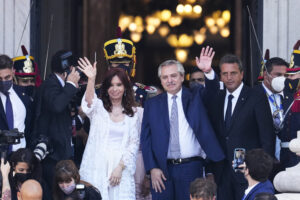
Across Latin America, former leaders are keeping a chokehold on their countries’ politics. It’s time their successors break free.
January 2022, Volume 33, Issue 1
Halting a decade of democratic backsliding, Haikainde Hichilema defeated an increasingly iron-fisted incumbent president. How did he do it and can others learn from his example?
July 2018, Volume 29, Issue 3
A review of How India Became Democratic: Citizenship and the Making of the Universal Franchise by Ornit Shani.
July 1993, Volume 4, Issue 3
Excerpts from: speeches from the three recipients of the National Endowment for Democracy’s biennial Democracy Award; the inaugural address of the New Civic Forum, an Egyptian NGO; “Enhancing the Effectiveness of the Principle of Periodic and Genuine Elections”, a UN resolution; the Conference on Security and Cooperation in Europe’s Moscow communiqué.
April 2013, Volume 24, Issue 2
Excerpts from: The Declaration of Free Citizens by Vietnamese bloggers; Somali president Hassan Sheikh Mohamud’s speech at the Center for Strategic and International Studies; a letter issued by the Anglican bishop of the Diocese of Colombo; the inaugural address of South Korean president Park Geun-hye; a speech given by Shin Dong-hyuk who fled North Korea.
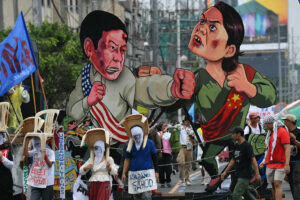
The ICC arrest of former Philippine president Rodrigo Duterte is a shocking blow for the Duterte clan, and the Marcos family isn’t letting up. Is this the political last stand for the Dutertes?
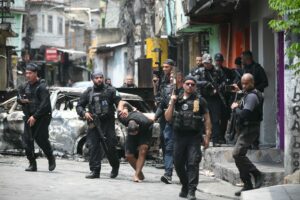
Last month Rio’s police conducted the deadliest police operation in Brazil’s history, killing 117 people. It is one episode in a long history of state violence. Not only are such iron-fisted methods ineffective, they pose a danger for democracy itself.
April 2004, Volume 15, Issue 2
Events last November confouned expectations set by the failure of democratization in Russia and other ex-Soviet republics, and should prompt new reflections on how fragile openings to democacy may be sustained and widened.
October 2015, Volume 26, Issue 4
Excerpts from: remarks by Nigeria's new president Muhammadu Buhari; statement by Azerbaijani investigative journalist Khadija Ismayilova; statements on abuses against lawyers and activists in China
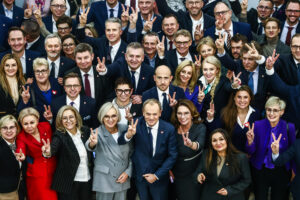
There is no clear roadmap. But Poland may be setting out on its first steps in stamping out populism and holding accountable those responsible for the worst violations of the rule of law.
January 2005, Volume 16, Issue 1
The democratic forces had an uphill climb going into the September 2004 legislative elections, but they made unforced errors as well. What were these, and how can the democrats do better next time?
July 2015, Volume 26, Issue 3
In a surprising turn of events, opposition candidate Muhammadu Buhari was able to outpoll incumbent Goodluck Jonathan—and the latter peacefully acknowledged his defeat.
October 2007, Volume 18, Issue 4
The failure of the elections has been partly mitigated by the hope of judicial review of electoral malfeasance, the stabilizing ingenuity of ethno-regional power-sharing, and renewed national discussions of electoral reforms.
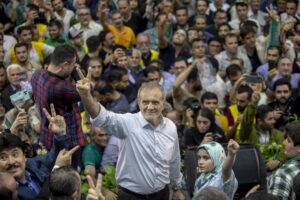
Masoud Pezeshkian won’t be a “reformer” in any genuine sense. Like all Iranian presidents, he has pledged his loyalty to Iran’s supreme leader. What he really offers is a softer version of Iran’s grim repression.

Romania’s democracy just survived a near-death experience, but it may be more vulnerable going forward. How far can leaders go in defending democracy without compromising their claim to represent the people?