
October 2000, Volume 11, Issue 4
Is Iran Democratizing? The Role of the Intellectuals
The “Fourth Generation” of Iranian intellectuals has a vital role to play in strengthening civil society and fostering democratization.
3264 Results
October 2000, Volume 11, Issue 4
The “Fourth Generation” of Iranian intellectuals has a vital role to play in strengthening civil society and fostering democratization.
October 2000, Volume 11, Issue 4
Recent studies of democracy in Latin America overlook the role of civil society as an agent of accountability.
July 2000, Volume 11, Issue 3
As the experience of Latin America makes clear, a strong civil society is not necessarily a democratic one. Democratic deficits within civil society jeopardize its ability to perform its proper social functions.
April 2000, Volume 11, Issue 2
Since its establishment in 1964, the Press Union of Liberia has championed the right of journalists to report freely on events in Liberia and abroad. Political setbacks continue to put it to the test.
July 1995, Volume 6, Issue 3
A review of Strong Parties and Lame Ducks: Presidential Partyarchy and Factionalism in Venezuela, by Michael Coppedge and Democracy for the Privileged: Crisis and Transition in Venezuela, by Richard S. Hillman.
January 1994, Volume 5, Issue 1
A review of Elites and Democratic Consolidation in Latin America and Southern Europe, edited by John Higley and Richard Gunther.
July 1993, Volume 4, Issue 3
A review of The Ennobling of Democracy: The Challenge of the Postmodern Age, by Thomas Pangle.
Fall 1991, Volume 2, Issue 4
A review of Exporting Democracy: Fulfilling America’s Destiny, by Joshua Muravchik and Exporting Democracy: The United States and Latin America, edited by Abraham F. Lowenthal.

October 2018, Volume 29, Issue 4
Taking advantage of broad global respect for regionalism, authoritarian regimes are using their own regional organizations to bolster fellow autocracies. These groupings offer a mechanism for lending legitimacy, redistributing resources, and insulating members from democratic influences.
July 2011, Volume 22, Issue 3
Reports on elections in Benin, Central African Republic, Chad, Djibouti, Estonia, Haiti, Kazakhstan, Micronesia, Niger, Nigeria, Peru, Singapore, and Uganda.
January 2020, Volume 31, Issue 1
A review of This Is Not Propaganda: Adventures in the War Against Reality by Peter Pomerantsev.
April 2020, Volume 31, Issue 2
A review of Democracies Divided: The Global Challenge of Political Polarization, edited by Thomas Carothers and Andrew O’Donohue.
October 2000, Volume 11, Issue 4
Excerpts from: a victory speech by Mexican president-elect Vicente Fox; a final declaration of a conference entitled “Towards a Community of Democracies”; the “Declaration of Unity” signed by democratic activists from 11 Asian countries.
October 2018, Volume 29, Issue 4
Reports on elections in Cambodia, Maldives, Mali, Mauritania, Mexico, Pakistan, Rwanda, Swaziland, Turkey, and Zimbabwe.
April 2009, Volume 20, Issue 2
Since Vladimir Putin’s rise to power at the end of the 1990s, siloviki—the people who work for, or used to work for, Russia’s “ministries of force” have spread to posts throughout all the branches of power in Russia.
April 2016, Volume 27, Issue 2
Public anger at revelations of widespread corruption, along with the rising cost of coalition politics, has brought Brazilian president Dilma Rousseff to the brink of impeachment. Yet the crisis has also revealed the strength of the country’s law-enforcement and judicial institutions.
January 2010, Volume 21, Issue 1
In recent years, scholars have begun to focus on the sources of "authoritarian resilience." But democracy has also shown surprising resilience, in part because the disorders to which it is prone tend to counteract each other.
October 2017, Volume 28, Issue 4
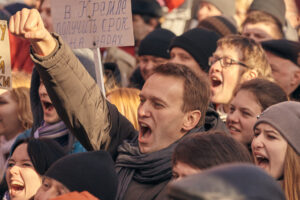
More Russians are rejecting the Kremlin’s corruption and authoritarianism. They—and not the regime—are Russia’s future.
July 2021, Volume 32, Issue 3
Comprehensive regulation can strengthen user rights in the face of tech firms’ exploitative practices.
October 2019, Volume 30, Issue 4
To a degree that is still not widely appreciated, the BJP has replaced Congress as India’s party of welfarism. The carefully crafted political persona of Prime Minister Narendra Modi as the “leader of the poor” has been crucial to this shift.