

Why Trouble Is Brewing in the Czech Republic
It has long been a stalwart defender of democracy. But in this election season, the Czech Republic’s growing polarization is bringing illiberal political parties to the fore.
1951 Results
It has long been a stalwart defender of democracy. But in this election season, the Czech Republic’s growing polarization is bringing illiberal political parties to the fore.
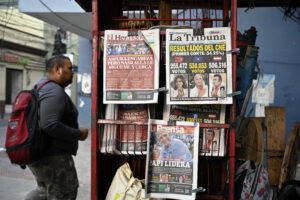
Days after the election and no one knows who the next president will be. Even worse, none of the likely winners offer much hope for the country’s democracy.
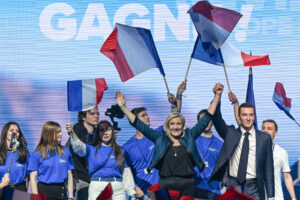
Authoritarian aggression, democratic recession, political violence, nationalism, and far-right resurgence. The latest issue of the Journal of Democracy offers incisive analysis and cogent solutions to these troubling trends across the globe.
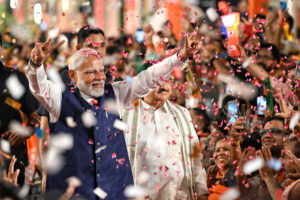
For all the warning signs, India held the line after a decade of backsliding.
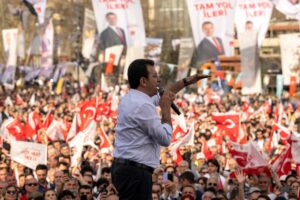
Don’t miss your chance to read the Journal of Democracy’s July issue for free through the 31.
These excerpts pertain to Rachid al-Ghannouchi and the challenge of blending Islam and democracy.
October 3, 2011
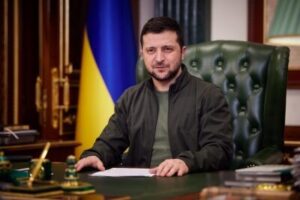
President Volodymyr Zelensky is in Washington to rally support for Ukraine’s defense against Russia’s unprovoked invasion. As the war’s second year grinds on, the Ukrainian people are looking for Zelensky to help their country succeed, not just survive. Will Zelensky be able to shepherd Ukraine to victory?
New works on China, Russia, political philosophy, English history, and much more graced our shelves this year. Here are the JoD staff’s favorite books of the year.
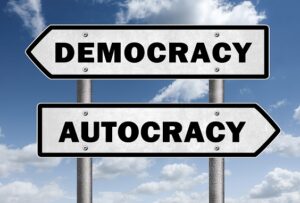
In the new issue of the Journal of Democracy, Kurt Weyland argues that democracy almost always triumphs over populism. In fact, while strongmen may strain democratic institutions, they rarely come out on top.
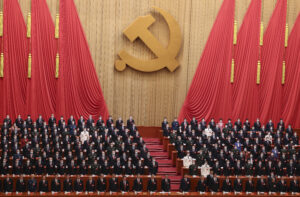
Most of the world’s democracies remain extremely vulnerable to sharp-power threats. The following Journal of Democracy essays explore how authoritarians weaponize universities, technologies, media, entertainment, and culture to attempt to crack democracy’s foundations.
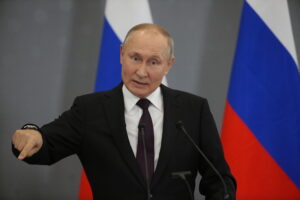
From Putin’s invasion to Kim’s nuclear saber rattling, the West has punished the world’s worst regimes. But have sanctions missed their targets?
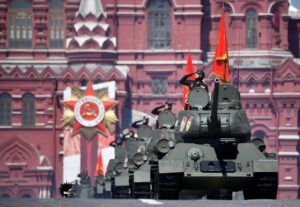
How does a Russian autocrat celebrate Victory Day while losing a war? Expect lies, myths, and propaganda.
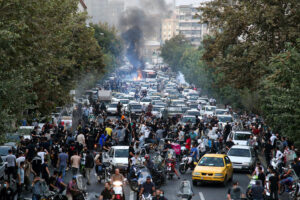
Iran’s president, Ebrahim Raisi, died in a helicopter crash on Sunday. The mullahs may become more repressive in the lead up to the next presidential election. Read about Iran’s most recent wave of unrest, and explore why it may “only [be] a matter of time before a new wave erupts.”
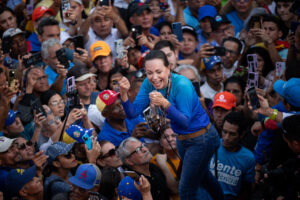
For years, the Venezuelan opposition has fought hard against a corrupt regime — and come up short. But this time, with four key ingredients in place, we are on the cusp of a historic victory.

Hungary’s prime minister has been jet-setting across the globe to hobnob with Vladimir Putin, Xi Jinping, and Donald Trump, while doing his best to provoke European leaders at home. But Orbán’s grandstanding, argues Hungarian writer Sándor Ésik in a new Journal of Democracy online exclusive, is really just an attempt to mask his growing political weaknesses.
Reports on elections in Austria, the Czech Republic, and Tunisia.
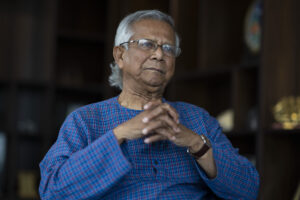
The famed economist and Nobel laureate is charged with repairing what remains of Bangladesh’s democracy. But is someone even as accomplished as Yunus up to the task?
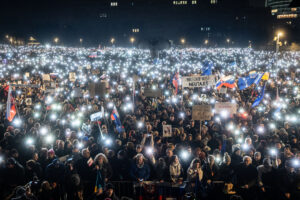
The people have taken to the streets to demonstrate against corruption and Prime Minister Robert Fico’s pro-Moscow policies. Once again, Slovaks see their future in Europe, not Russia.
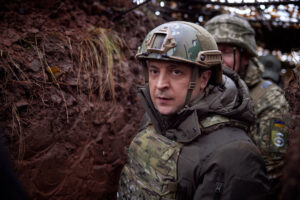
On March 11, Ukraine agreed to a thirty-day ceasefire with Russia. But Vladimir Putin is holding out, insisting that his harsh demands must first be met. Does Putin really hold all the bargaining chips, or is he weaker than we think?

Determined to project their influence abroad, authoritarian regimes are subverting international rules and norms while disguising their misdeeds. The easiest way to do this? Convince the world they are benign, upstanding members of the international community.