
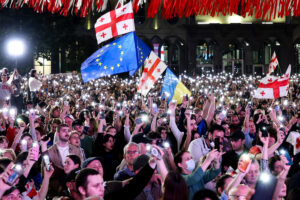
Georgia’s Make-or-Break Election
Later this month the country will be holding an absolutely pivotal election. The stakes? Whether Georgia will remain anchored to the West or become Vladimir Putin’s newest satellite state.
3081 Results
Later this month the country will be holding an absolutely pivotal election. The stakes? Whether Georgia will remain anchored to the West or become Vladimir Putin’s newest satellite state.
October 2009, Volume 20, Issue 4
Parliamentary elections in 2008 secured the MPLA's hegemony and decimated the opposition, while paradoxically increasing the government's legitimacy.
January 2022, Volume 33, Issue 1
Christian Welzel’s case for a democratic future is based on the mistaken notion that opinion surveys can see the future. It is no more true today than it ever was.
April 2011, Volume 22, Issue 2
Even before Argentina’s landmark gay-marriage law was passed in July 2010, a gay-rights revolution was well underway across Latin America. But do gay rights by law equal acceptance of gays in practice?
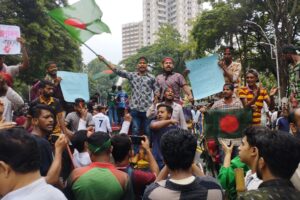
January 2025, Volume 36, Issue 1
The student movement that toppled Bangladesh’s longtime autocratic ruler wants more than a return to the old order. These young revolutionaries are seizing a chance to start anew. How and by whom will the country’s future be decided?
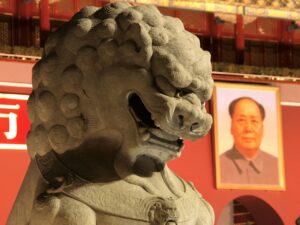
January 2003, Volume 14, Issue 1
Successful institutionalization will help the regime survive the pressures of advanced modernization and integration with the global economy.
October 2001, Volume 12, Issue 4
Except for the Baltic states, the countries of the former Soviet Union may be less democratic today than in the last years of the USSR.
January 2022, Volume 33, Issue 1
The country’s armed forces opened the door to democracy, only to help slam it shut a decade later. A desire for prestige and political influence has turned them into an autocrat’s accomplice.
October 2017, Volume 28, Issue 4
Is pressing a troubled, intensely fragile “postconflict” country to hold elections a good idea? Somalia did so in late 2016 and early 2017, and the process was not pretty. But was it better than the alternative?
January 2014, Volume 25, Issue 1
A year after the election that ended the rule of president Mikheil Saakashvili’s National Movement, Georgia has seen further remarkable developments that raise key questions for struggling postcommunist democracies and, indeed, democracies everywhere.
Appendix – How Much Democratic Backsliding
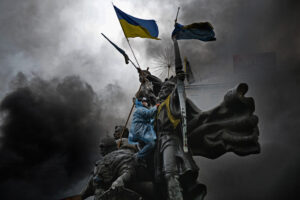
If liberal norms and institutions are to prevail, they need to be defended from the left and the right. | By Ghia Nodia
July 2021, Volume 32, Issue 3
Chilean democracy has opted to throw off a constitution written by a dictator, and has chosen an assembly to craft a new one. Can Chile begin anew?
January 2017, Volume 28, Issue 1
Following the end of the Cold War, an international norm against coups began gaining strength, but it seems to have lost momentum in recent years. What has happened?
January 2015, Volume 26, Issue 1
Since the mid-2000s, democratization in Africa has faltered, in large part due to its elites’ waning commitment to democracy.
October 2006, Volume 17, Issue 4
As leftist victories accumulate, it becomes increasingly clear that they represent a regional trend. But why is this trend happening now, and how far will it spread?
July 2017, Volume 28, Issue 3
The CCP regime has lost support among three groups it should normally be able to count on: street-level police, retired military officers, and state employees who are drafted into stifling dissent on the part of their own relatives.
October 2017, Volume 28, Issue 4
Wrongly viewed by many media sources as a victory for “reform” and “openness,” the recent presidential election in Iran actually reflected the demoralization and disengagement of the country’s prodemocratic opposition.
October 2015, Volume 26, Issue 4
Latin American countries are burdened with domestic security problems and institutional weaknesses that have led to a rising political role for the military forces. Are there serious dangers in this “turn toward the barracks”?