

Is This the Beginning of Maduro’s End?
The Venezuelan strongman is attempting to steal the country’s presidential election and daring the people to stop him. But even if military leaders are backing him, Maduro is already weaker than he appears.
1984 Results
The Venezuelan strongman is attempting to steal the country’s presidential election and daring the people to stop him. But even if military leaders are backing him, Maduro is already weaker than he appears.
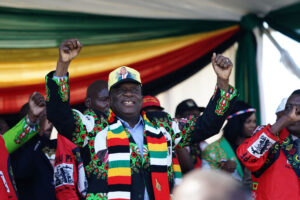
The continent’s aspiring dictators are attacking term limits with a vengeance, finding new ways to avoid handing over power. But citizens are overwhelmingly against it — and can help keep their leaders in check.

The danger is greater than the rise of far-right parties. In fact, there is a risk that in their eagerness to contain the far right, European leaders may do greater damage to democracy itself.

Faith in democracy is fading, as citizens increasingly find self-rule slow, tired, and opaque. It’s time for democratic institutions to lean into the tech revolution. Digital governance isn’t a gadget; it’s democracy’s lifeline.

The African National Congress can no longer call all the shots, and opposition parties will have more sway. Will this lead to a more inclusive democracy or gridlock and division?
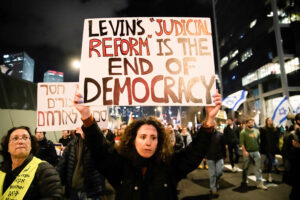
Prime Minister Benjamin Netanyahu wants the public to see his efforts to overhaul the Israeli judiciary as a “reform.” But people have seen it for what it is: a struggle over the very future of democracy itself.

The suffragists imagined that a greater role for women in democratic politics would lead to a more peaceful world. Few realize how right they were.

The election of Rodrigo Paz Pereira as Bolivia’s new president signals the end of the MAS era. But it is more than an end to Evo Morales’s leftist party. It showcases how Indigenous political power has transformed the country’s political landscape.

Romania’s democracy just survived a near-death experience, but it may be more vulnerable going forward. How far can leaders go in defending democracy without compromising their claim to represent the people?
"The Authoritarian Resurgence: China, Russia, Saudi Arabia, and Venezuela" panel discussion featuring JoD authors Javier Corrales, Andrew J. Nathan, Lilia Shevtsova, and Frederic Wehrey. (4/23, 12-2 pm, at NED)
April 14, 2015

When democracies are clearly outperforming autocracies in so many ways, why the widespread disenchantment with democratic government? Why are democracy and human-rights activists across the globe turning to Bitcoin?
Essays on Eygpt and Syria in latest issue of the Journal of Democracy, as well as Francis Fukuyama and Marc F. Plattner on governance and democracy & essays on the “Arab Spring,” Paraguay, Malaysia, & more.
October 15, 2013
Reports on elections in Comoros, El Salvador, Senegal, and Tuvalu.
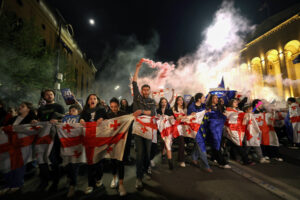
On Tuesday, Georgia’s Parliament passed a controversial new law that would brand NGOs and media organizations receiving foreign funding as “foreign agents.” Countries across the globe are following the Russian model and painting liberal-democratic values as malign foreign interference. Read about the strategies autocrats are devising to repress civil society and stifle dissent.

Citizens have lost faith in democracy. Misinformation, disinformation, hyperpolarization, and conspiracies, exacerbated by the modern media environment, have heightened distrust and anger. The following Journal of Democracy essays explore these dynamics and the important role ordinary citizens can play in countering democratic erosion.
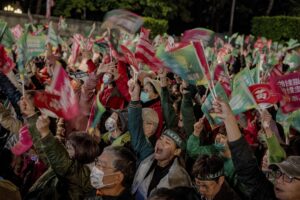
Millions of voters are casting ballots in a string of elections across the globe this year. At the midyear point, how well is democracy holding up?

As 2024 draws to a close, democracy faces urgent threats: increasing aggression from Russia and China, rapidly advancing AI, heightened polarization, and populist leaders in India and elsewhere bending democracy to their will. Here are the Journal of Democracy’s ten most-read essays over the past month.
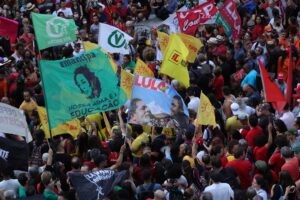
How resilient are democracies, really? While many countries have gone from democratic to authoritarian and back again, few have been able to sustain their recovery. The following essays offer strategies for defending and deepening democracy around the world.

There is nothing inherently menacing or antidemocratic about conspiracy theories. They can even be a source of amusement. The trouble comes when political elites weaponize them to invite violence.

The Hungarian leader appears to be working overtime at fraying the country’s ties with even its longstanding friends and allies — and the strain is beginning to show.