
October 2002, Volume 13, Issue 4
Democratization in the Arab World?: Stirrings in Saudi Arabia
Saudi Arabia would seem to exemplify full-blown authoritarianism. Yet there are trends pushing the country toward more open politics.
3292 Results
October 2002, Volume 13, Issue 4
Saudi Arabia would seem to exemplify full-blown authoritarianism. Yet there are trends pushing the country toward more open politics.
July 2001, Volume 12, Issue 3
An increase in women’s political mobilization has accompanied the global trend toward democratization, but women’s movements have taken diverse paths in different regions of the world.
October 1996, Volume 7, Issue 4
A review of Enlightenment’s Wake: Politics and Culture at the Close of the Modern Age, by John Gray and An Intellectual History of Liberalism, by Pierre Manet.
October 1994, Volume 5, Issue 4
A review of South Africa: The Political Economy of Transformation, edited by Stephen John Stedman.
April 2000, Volume 11, Issue 2
The unexpectedly strong showing of media-savvy rightist candidate Joaquín Lavín in the 1999 presidential elections and the move to the center by Concertación candidate Ricardo Lagos suggest that Chile has begun to put the ghosts of Allende and Pinochet to rest.

January 2013, Volume 24, Issue 1
The resilience of the Chinese authoritarian regime is approaching its limits. A breakthrough moment could be triggered by several kinds of events.
January 2014, Volume 25, Issue 1
In 2013, Bulgaria’s historically passive citizenry exploded in outrage over soaring energy bills and shady elite actions. What does Bulgaria’s year of protest tell us about how civic anger is generated and when it becomes a transformative political resource?
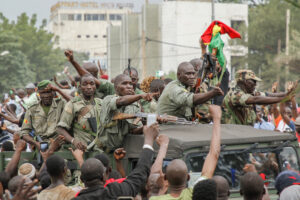
October 2022, Volume 33, Issue 4
Many fear that coups are making a comeback. While this is not true, one thing is alarming: Anti-coup norms are starting to erode.
October 2017, Volume 28, Issue 4
Read the full essay here. The Kremlin’s ability to maintain power and popularity despite an aging leader, an ailing economy, a rallying opposition, and many other domestic and international challenges is puzzling given current theories of authoritarianism. These theories focus on some combination of material interests, institutional engineering, and the charisma and skill of the…
October 2015, Volume 26, Issue 4
We are still struggling to understand the mostly bitter harvest of the Arab Spring, but there are a few lessons that can be drawn.
April 2009, Volume 20, Issue 2
Read the full essay here. In contrast to authoritarian power structures, which rest on a form of bureaucratic corporatism that makes the leader its hostage, the regime in Moscow rests on personalized power, something that signals a return to the traditional Russian political matrix. The regime has fused power and property in a manner that…
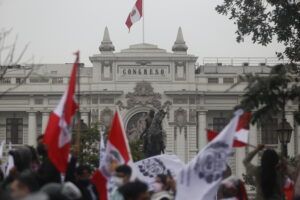
April 2025, Volume 36, Issue 2
Democratic backsliding is usually seen as something driven by presidents, but under certain circumstances elected legislatures can cause it, too. Legislative hegemony is a growing danger.
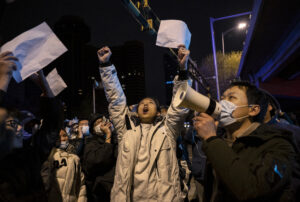
Chinese citizens from Urumqi to Shanghai took to the streets, blank sheets of white paper in hand, to denounce the CCP and call for change. Xi Jinping’s repression and zero-covid lockdowns have united the public in empathy and anger. | Guoguang Wu
October 2019, Volume 30, Issue 4
A trio of national ballotings in 2019 tell a tale of waxing authoritarianism in Southeast Asia, but things could have turned out worse.
July 2014, Volume 25, Issue 3
Regime change will always be a feature of political life, but we are unlikely to see again transitions to democracy on the scale of the “third wave.”
July 2006, Volume 17, Issue 3
Much like other institutions in post-Soviet Russia, the intelligence and security services have yet to make a transition to real democratic control, and remain infused with the authoritarian tendencies of their Soviet predecessors.
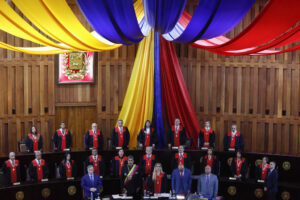
April 2015, Volume 26, Issue 2
Why do some hybrid regimes remain stable over time, while others become more authoritarian? Venezuela’s autocratic turn has been driven by the ruling party’s declining electoral fortunes and by a foreign policy that has shielded it from international scrutiny.
October 2012, Volume 23, Issue 4
The Burmese transition that began in 2011 will be a protracted process. The main challenge now is to build a state in which democracy can take root and grow.
October 1995, Volume 6, Issue 4
Review of Long Walk to Freedom: The Autobiography of Nelson Mandela (1994).
January 2013, Volume 24, Issue 1
The Muslim Brotherhood is no longer a revolutionary movement, but rather a conservative one.