
Excerpts from Robin Wright’s 1996 Journal of Democracy article “Islam and Liberal Democracy: Two Visions of Reformation”
These excerpts pertain to Rachid al-Ghannouchi and the challenge of blending Islam and democracy.
October 3, 2011
3292 Results
These excerpts pertain to Rachid al-Ghannouchi and the challenge of blending Islam and democracy.
October 3, 2011

April 2003, Volume 14, Issue 2
The claim that ethnic minorities have a moral and legal right to secede from states is a dangerous fiction with perilous implications for divided societies.
October 2020, Volume 31, Issue 4
India’s covid-19 response has accelerated the country’s slide toward competitive authoritarian rule by centralizing decision making, undermining federalism, and providing new pretexts for stifling dissent.

The 2022 World Cup has just kicked off in Qatar. Long before the first match, the small Arab monarchy made a bet that investing billions in the “beautiful game” might do wonders for their reputation, too.
October 2007, Volume 18, Issue 4
They are good signs for the future of democracy in Iran, but it will take time and energy to organize these promising pieces into a greater democracy movement.

July 2025, Volume 36, Issue 3
Authoritarian regimes are not lawless. Rather, autocrats take to the courtroom not only to enforce their will but to justify their rule. So how do they appeal to reason? How do they rationalize their undemocratic turn?
April 2023, Volume 34, Issue 2
Oppositions in monarchies don’t have to stage revolutions to win freedom: Monarchies are as compatible with democracy as they are with autocracy. The challenge for those who would remove a king is not to fall for the promises of reform that never come.
July 2010, Volume 21, Issue 3
Although many Iraqi parties continue to be organized along religious or ethnic lines, both the tone and the results of the 2010 parliamentary election campaign show that most Iraqi voters prefer a broader national agenda over narrow sectarian appeals.
July 2020, Volume 31, Issue 3
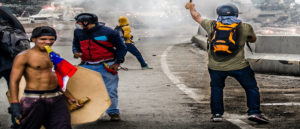
His regime has hung onto power despite setbacks that would have toppled most democratic governments. Besides pure repression, Maduro has developed new autocratic tools that have kept Venezuela’s authoritarian state afloat.

October 2024, Volume 35, Issue 4
Under Xi Jinping, the PRC has grown more assertive in the Global South. China aggressively targets country after country, often zeroing in on small but strategically significant states. But there are proven ways for even fragile democracies to resist Beijing’s influence.
January 2021, Volume 32, Issue 1
The alleged tradeoff between economic development and political democracy-building is more fiction than fact. Indeed, progress toward fuller democratic governance can in fact enhance development.

January 2024, Volume 35, Issue 1
Populism is a mortal threat to liberal democracy, but it rarely hits the mark. The evidence shows that these would-be strongmen require an extraordinary set of circumstances to succeed, which is why they so rarely do.
April 2024, Volume 35, Issue 2
Violence need not be lethal to pose a threat to democracy. Indeed, low-scale violence has proven to be a far more effective means of manipulating elections.
April 2013, Volume 24, Issue 2
A particular pattern of institutional change—“serial replacement”—is dominant in Latin America and other developing countries with weak institutional contexts. This pattern is characterized by institutional change that is both frequent and radical.
July 2012, Volume 23, Issue 3
Although they have quieted down as quickly as they flared up, the clamorous protests that followed the dishonest Russian legislative elections in December 2011 have essentially destroyed Putin’s regime, the infamous “managed democracy.”
April 2012, Volume 23, Issue 2
In 2011, Thais reelected a party backed by deposed prime minister Thaksin Shinawatra. Why is his brand of populism so irrepressible, and what can be done to reconcile the voting power of Thailand’s rural lower classes with the establishment dug in around the Thai monarchy?
July 2025, Volume 36, Issue 3
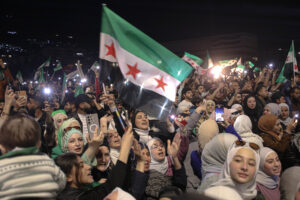
Syria is a rare case. A state being governed by a new elite that is committed to Islamic thought but open to a wide range of intellectual influences. While it is early, we may see the rise of a novel brand of Islamic presidentialism in the works.
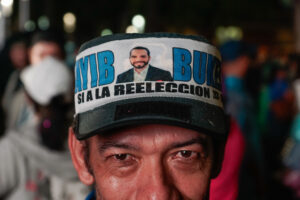
Of course not. But the region’s democratic hopes are fighting an uphill battle against corruption, crime, and a violent past.
July 2009, Volume 20, Issue 3
Evidence suggests that under some circumstances repeated elections, even if flawed, can lead to democratization.
July 2005, Volume 16, Issue 3
The role of international factors varied greatly across the post-Cold War transitions to democracy, but the intensity and results of external democratizing pressure depended on two variables: linkage to the West and Western leverage.