
July 2021, Volume 32, Issue 3
Latin America Erupts: The Danger of Democratic Delinquency
Recent high-profile scandals have laid bare persistent shortcomings of Latin American democracy that, if unaddressed, could prove fatal.
3291 Results
July 2021, Volume 32, Issue 3
Recent high-profile scandals have laid bare persistent shortcomings of Latin American democracy that, if unaddressed, could prove fatal.
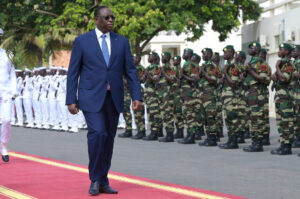
President Macky Sall has called off his country’s presidential election just weeks ahead of the vote. His unconstitutional decree will not only keep him in power, but threatens to throw Senegal into violent chaos.
July 2015, Volume 26, Issue 3
A review of The Nature of Asian Politics by Bruce Gilley.
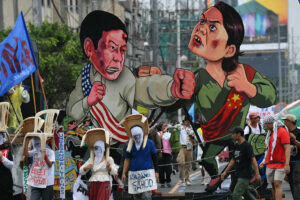
The ICC arrest of former Philippine president Rodrigo Duterte is a shocking blow for the Duterte clan, and the Marcos family isn’t letting up. Is this the political last stand for the Dutertes?
January 2008, Volume 19, Issue 1
While the people of South Asia, especially those with higher levels of education and exposure to the media, prefer democracy to authoritarianism, they are willing to relax some of the requirements of liberal democracy.
January 2011, Volume 22, Issue 1
In most Arab countries, Islamist groups are the only ones with the popular support needed to win free and fair elections. Yet Islamist parties have shown an ambivalence about and in some cases even an aversion to seeking power via the ballot box.
July 2013, Volume 24, Issue 3
Reports on elections in Bhutan, Bulgaria, Equatorial Guinea, Kenya, Malaysia, Montenegro, Pakistan, Paraguay, Philippines, and Venezuela.
October 1999, Volume 10, Issue 4
Reports on elections in Indonesia, Kuwait, Malawi, and Venezuela.
October 2009, Volume 20, Issue 4
Jordan gets much good press for having one of the more open and liberal regimes in the Arab world, but that reputation masks a considerably grimmer reality.
January 1999, Volume 10, Issue 1
Reports on elections in Azerbaijan, Bosnia-Herzegovina, Brazil, Burkina Faso, Czech Republic, Gabon, Latvia, Macedonia, Slovakia, Taiwan, and Venezuela.

By choosing Javier Milei, Argentinian voters didn’t just reject the status quo. They have sent their country hurtling in an unknown direction.
July 2019, Volume 30, Issue 3
Reports on elections in Benin, Comoros, Estonia, India, Indonesia, Kazakhstan, Lithuania, Malawi, Maldives, Mauritania, Nigeria, North Macedonia, Panama, Philippines, Slovakia, South Africa, Thailand, and Ukraine.
April 2017, Volume 28, Issue 2
Despite pre-election fears, the victory of the opposition NPP over the ruling NDC in Ghana’s December 2016 elections became the prologue to a peaceful transfer of power. This outcome suggests that the advantage of incumbency in African elections may be on the wane.
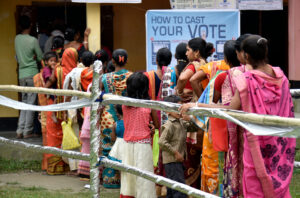
National politics is increasingly overshadowing everything else, even as local government does more and more. Here’s how to right the balance.
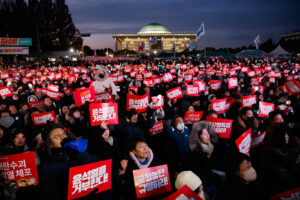
April 2025, Volume 36, Issue 2
When South Korea’s president declared martial law last December, he shocked the country and sparked a political crisis that laid bare deep-seated divisions. Can Korean democracy overcome the nationalist polarization that has always defined it?
July 2019, Volume 30, Issue 3
A review of Responsible Parties: Saving Democracy from Itself by Frances McCall Rosenbluth and Ian Shapiro.
July 2020, Volume 31, Issue 3
Evo Morales lost the presidency in November 2019 due not to a coup, but to a citizen revolt. After his controversial bid for a fourth consecutive term, the opposition mobilized against him and his regime disintegrated.
January 2011, Volume 22, Issue 1
A review of Lonely Power: Why Russia Has Failed to Become the West and the West Is Weary of Russia by Lilia Shevtsova.
April 2013, Volume 24, Issue 2
Why do democracies survive or fail? An empirical study of Latin America finds that the fate of democracies depends largely on the regional political context, as well as the level of actors’ commitment to democracy and policy moderation.
January 2013, Volume 24, Issue 1
Over the past decade, Chinese authorities have turned against many of the legal reforms they themselves had enacted in the late 20th century. Lawyers have come under increased pressure. Political campaigns warning against rule-of-law norms have rippled through the courts. And central authorities have massively increased funding for extralegal institutions aimed at curtailing and suppressing…