
The South American country may be on the verge of real change. But it isn’t going to descend into civil-war chaos like Libya. It will be difficult, imperfect, and far better than what Venezuelans have had to endure.
December 2025
Leer en español aquí.
As U.S. military assets accumulate in the Caribbean and diplomatic pressure on the Nicolás Maduro regime intensifies, two starkly different visions of Venezuela’s future dominate policy discussions. The first envisions a seamless democratic transition: Maduro steps down, Edmundo González assumes the presidency he won in July 2024, and Venezuela rejoins the community of democratic nations. The second invokes the specter of Libya — a collapsed state fractured by civil war, with armed factions competing for territory and plunging the country into chaos worse than autocratic stability.
Both scenarios are analytically lazy. The first ignores the profound institutional decay that Chavismo has wrought. The second imports an analogy that collapses under scrutiny. Understanding what a Venezuelan transition will actually look like — and preparing accordingly — requires moving beyond these convenient framings to examine the specific conditions that can shape a post-Maduro Venezuela.
Why Venezuela Is Not Libya
The Libya analogy has become a rhetorical shortcut for those warning against regime change, but it fundamentally misunderstands the Venezuelan context. Libya’s descent into prolonged civil conflict followed the collapse of a highly personalist regime that had hollowed out national institutions and concentrated coercive power in loyalist security networks. In a society with significant regional, tribal, and local cleavages, this left no credible, unified state structure capable of managing the transition. As Colonel Muammar Qadhafi fell in 2011, city-, region-, tribe- and ideology-based militias with distinct territorial bases competed to fill the vacuum and to capture state resources, entrenching a fragmented and violent order.
Venezuela shares none of these characteristics. The country has no ethnic or religious cleavages that could substantiate competing armed factions. There is no regional separatism, no sectarian divide, no tribal structure that maps onto potential military fragmentation. Venezuelan society is remarkably homogeneous in precisely the dimensions that drove Libya’s disintegration. The country’s armed forces, for all their corruption and politicization, remain a national, hierarchical institution rather than a patchwork of regional militias. The desire for change is held by a decisive majority that spreads across the whole territory, as Edmundo González won the July 2024 elections in all states in the country and in 90 percent of the 335 municipalities.
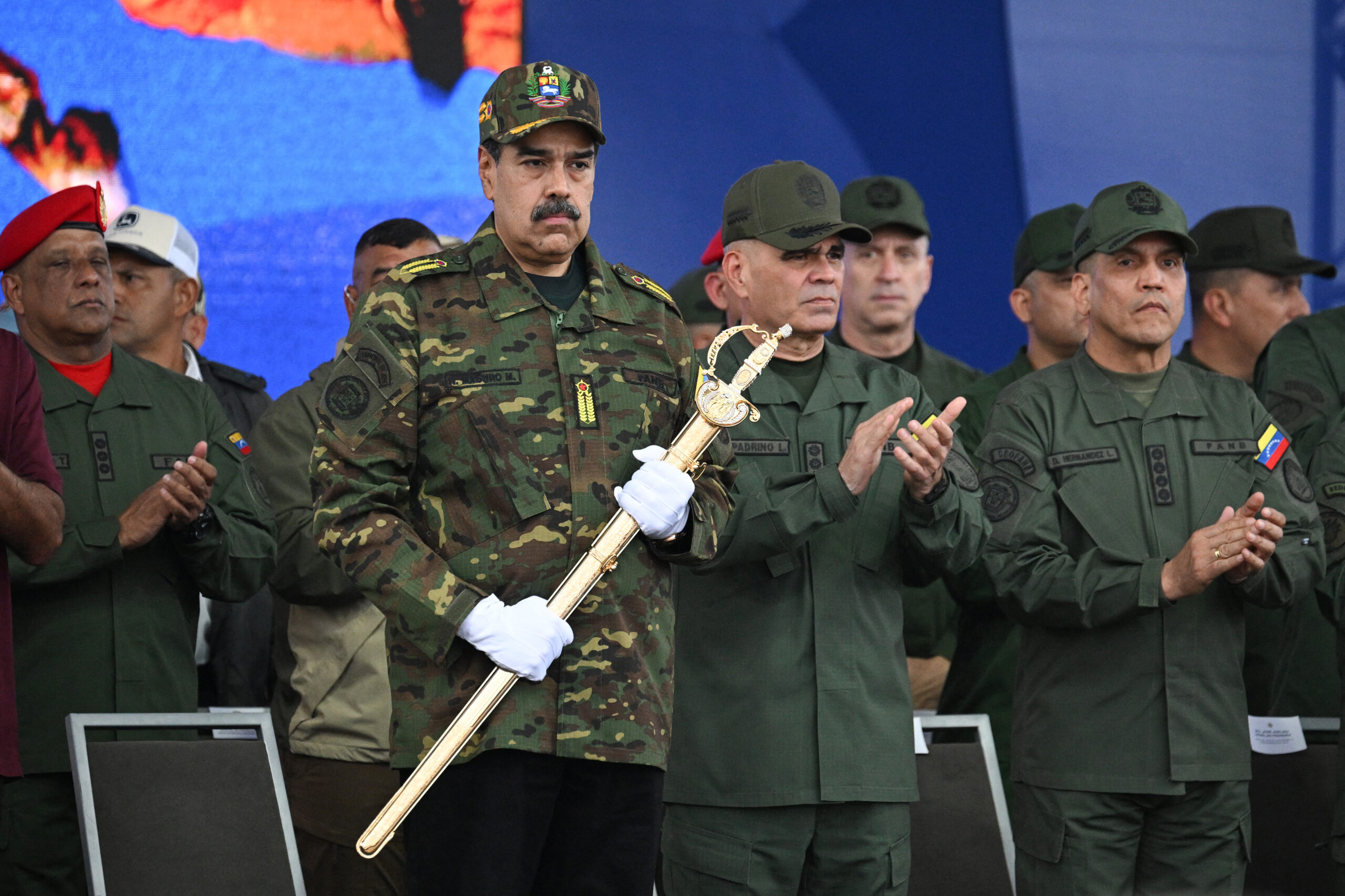
But perhaps most fundamentally, the Libyan civil war required multiple armed coalitions that were comparable to one another in coercive capacity. Venezuela today has only one source of overwhelming coercive power: the military and security establishment, which as of today remains loyal to the Maduro regime. The opposition’s power derives entirely from its democratic legitimacy and popular support — it commands no militias, no armed insurgency, no territorial strongholds. The balance of power is asymmetrical in the extreme: One side has votes while the other has guns. This configuration can produce and has produced repression, but it cannot produce civil war in any meaningful sense.
For all these reasons, the Libyan scenario — often invoked by analysts and repeatedly threatened by the Maduro regime — is highly unlikely as the outcome of a transition in Venezuela. These same factors that work against a “Libya on the Caribbean” scenario, however, also make it hard for the military to break with the regime. Such a break is precisely what a well-designed transitional justice framework should seek to induce.
Incentives for Breaking with the Regime
The strategic logic of differentiated amnesty — offering a narrow window of “safe conduct to protected exile” to those guilty of the gravest crimes while extending broad domestic amnesty to a wider class of regime insiders — serves a crucial purpose beyond enabling individual defections. It creates conditions under which the armed forces as a unified institution can enable the transition.
Consider the alternative: If military officers believe that any transition means prosecution for all regime participants — from the worst human-rights violators to low-ranking officers who followed orders and exploited their positions for personal gain — then everyone’s incentive will be to support regime survival. Faced with existential risk, the military will continue to rally around the regime as the only hope for survival. The coalition between the political higher-ups and the military will hold together because everyone’s fate will hinge on the continuation of the status quo.
Differentiated amnesty would break this logic. Officers whose conduct falls below a clearly defined threshold of criminal responsibility can rationally expect to remain in the country with their careers, pensions, and families intact, provided that they help rather than hinder transition. Regime leaders whose offenses exceed that threshold — those responsible for crimes against humanity — can be offered a single, carefully circumscribed chance at going into an exile shielded by robust international guarantees. For the vast bulk of officers, this will introduce a new calculus: They can begin to see that their interests diverge from those of the regime’s most compromised figures. They can envision a future in post-transition Venezuela, not as hunted criminals but as participants in the country’s reconstruction. That vision will allow them to accommodate change rather than resist it, and crucially, will let them make that accommodation as an institution.
This is where the division of labor between international and domestic actors becomes essential. The opposition cannot credibly guarantee safe exile for those who fall outside the scope of amnesty. That role falls to international partners with the capacity to offer safe conduct to protected exile. Countries willing to host such individuals, under conditions that prevent them from undermining the new democratic order but shield them from further accountability, must guarantee the logistics of departure and the credibility of the arrangement.
But the broader amnesty — covering corruption, electoral manipulation, and the daily complicity that sustaining an authoritarian regime entails — must come from Venezuelans themselves, especially from rightful president-elect Edmundo González and opposition leader María Corina Machado. This offer must be public, detailed, and unambiguous. It cannot wait for the moment of transition; it has to be put on the table now, while regime insiders are still weighing their options. This commitment is self-enforcing, as the new government will need the acquiescence and cooperation of the military officers, bureaucrats, and political operators covered under the amnesty agreement. This will allow military and civilian officials to make forward-looking calculations about their place in post-transition Venezuela, and to act accordingly today.
The Turbulence Scenario
Even if the transition succeeds — if Maduro and other compromised regime figureheads depart, the military stands down, and González assumes the presidency — Venezuela is also highly unlikely to become a peaceful democracy overnight. The honest assessment of the situation is that the likely outcome of a transition lies somewhere between Libya and Utopia: Let us call it the “turbulence scenario.”
Twenty-five years of Chavismo have fundamentally compromised the country’s security landscape. Long before the current crisis, the regime cultivated a dense ecosystem of armed nonstate actors as tools of control and revenue generation. Colombian guerrilla groups — the ELN and FARC dissidents — operate openly in Venezuelan territory, with the regime’s acquiescence and often its collaboration. Armed colectivos, prison gangs, and mining mafias control significant portions of the territory. The Cartel de los Soles — the drug-trafficking network implicating senior military officers — has thoroughly penetrated the military and other state institutions.
A democratic transition will not automatically dissolve these structures. Some groups — especially those whose power depends on regime patronage, access to state-controlled rents, or impunity for past crimes — will see democratization as a direct threat. Others may reasonably fear that a new democratic government will cooperate with international partners to dismantle their operations. Individual commanders, midlevel operators, and remnants of Chavismo’s security apparatus may fall through the cracks of transitional arrangements — unable or unwilling to accept exile, excluded from amnesty, or rejecting the prostpect of a democratic government that they oppose for ideological reasons. These individuals may retreat to remote areas and attempt to mount insurgent resistance against the new government.
This turbulence scenario will not amount to the apocalyptic fragmentation suffered by Libya, but neither will it constitute the smooth restoration of liberal democracy. Instead, it will resemble what Venezuela and much of Latin America have seen in recent decades: a democratic government facing persistent armed challenges from nonstate actors (whether ideologues or criminals) who take advantage of institutional weaknesses and limited state capacity to resist the consolidation of a constitutional-democratic political order.
Learning from Venezuela’s Own History — and the Region’s
Venezuela has faced this challenge before. In the 1960s, the young democracy confronted a far-leftist guerrilla insurgency backed by Fidel Castro’s Cuba. The armed forces and the democratically elected government of the center-left Acción Democrática party found common cause despite their longstanding conflicts, and the insurgency was gradually contained through a mix of military pressure, political opening, and negotiated demobilization. Venezuela’s forty-year democratic period — for all its flaws — emerged from that turbulent beginning.
The region, too, has learned hard lessons about counterinsurgency and state-building. Despite the negative consequences of trying to eradicate coca fields from the air, Plan Colombia also demonstrated that sustained international cooperation to strengthen state capacity can dramatically reduce the operational capacity of armed groups. A democratic Venezuela could, for the first time in years, access the kind of security assistance, intelligence cooperation, and institutional support that Chavismo foreclosed. Such support, adapted to Venezuela’s main situation (it is not a drug-production hub but rather is a drug-shipment route), and focused on consolidating democratic governance through a capable state that can contain insurgency, would provide robust help to the new democratic government.
Crucially, any post-transition insurgency would lack the political and social foundations that sustains destabilizing guerrilla movements. Colombia’s FARC originally drew on genuine grievances regarding unequal land ownership and political exclusion; the Viet Minh and later Viet Cong resistance was fueled by nationalism and anticolonial sentiment as well as communist ideology with popular support; countless other insurgencies fed on real or perceived exclusion from political power. What would be the banner of a posttransition Chavista insurgency? Returning to a regime that destroyed the economy, drove eight-million citizens into exile, and lost a presidential election by forty points, across all of Venezuela’s territory? Such movements may cause violence, but they would struggle to claim legitimacy and recruit from broad segments of society. They could certainly pose security problems, but lacking an alternative claim to rule with any persuasive power, they would be unlikely to become an existential threat.
The Case for Imperfection
The relevant comparison to guide decisions now is not one that casts fears of civil war against hopes for overnight Tocquevillian democracy. The choice, rather, is between a turbulent but real democratic transition and the status quo of autocracy, economic collapse, mass emigration, and continued general suffering. By that standard, even an imperfect transition will amount to an enormous improvement.
A democratic government in Caracas — even one that must contend with guerrilla warfare and entrenched criminal networks — will be able to pursue economic reforms, access international financing, and begin rebuilding destroyed institutions. It will be able to create conditions for millions of Venezuelans abroad to begin returning home to take part in the work of reconstruction. It will be able to seek truth and justice on behalf of the victims of crimes against humanity — by using legitimate legal processes rather than revolutionary violence. And it will be able to give Venezuelans what they have lacked for at least a decade: a government that derives its authority from the consent of the governed.
Fear of post-transition instability should not be an argument against transition. A flawed democracy battling insurgency and organized crime would not be the worst outcome. The worst outcome would be the perpetuation of a brutal dictatorship that destroyed a once prosperous nation, and that grants its resources and geostrategic position to organized criminals and the worst international actors. The real possibility of resistance to democratic rule should be an argument for preparing and managing the transition wisely. Achieving the transition and minimizing resistance to it will require a combination of external pressure and differentiated “off ramps” with internal and external guarantees. This nuanced amnesty approach, which can influence the calculations of regime insiders today, is not a moral concession to impunity, but a path to achieve and consolidate a return to democracy.
Venezuela’s way forward runs between Libya and Utopia. Recognizing that reality — and planning for the messy, hard, but vastly better middle path — is essential for the opposition, for the United States, and for the international community. The goal is not a perfect transition, but a successful one. If Venezuelans can secure a government chosen by them to pursue the challenging but possible work of reconstruction, that would be achievement enough.
José Ramón Morales-Arilla is a Research Professor at Tecnológico de Monterrey’s Graduate School of Government and Public Transformation. He received his PhD in Public Policy from Harvard University.
Copyright © 2025 National Endowment for Democracy
Image credit: Federico PARRA / AFP via Getty Images
|
FURTHER READING |
||
Will Maduro’s Autocratic Allies Desert Him? |
How Venezuela Became a Gangster StateNicolás Maduro is a mafia boss, not a president, and the Venezuelan government is now a criminal enterprise with the power of a state. It poses a threat to democracies everywhere. |
Venezuela’s Lost YearA year ago Nicolás Maduro stole Venezuela’s election and entrenched his power by jailing and killing those who opposed him. But the world’s democracies don’t need to sit on the sidelines. Here is how they can raise the costs for Maduro. |