
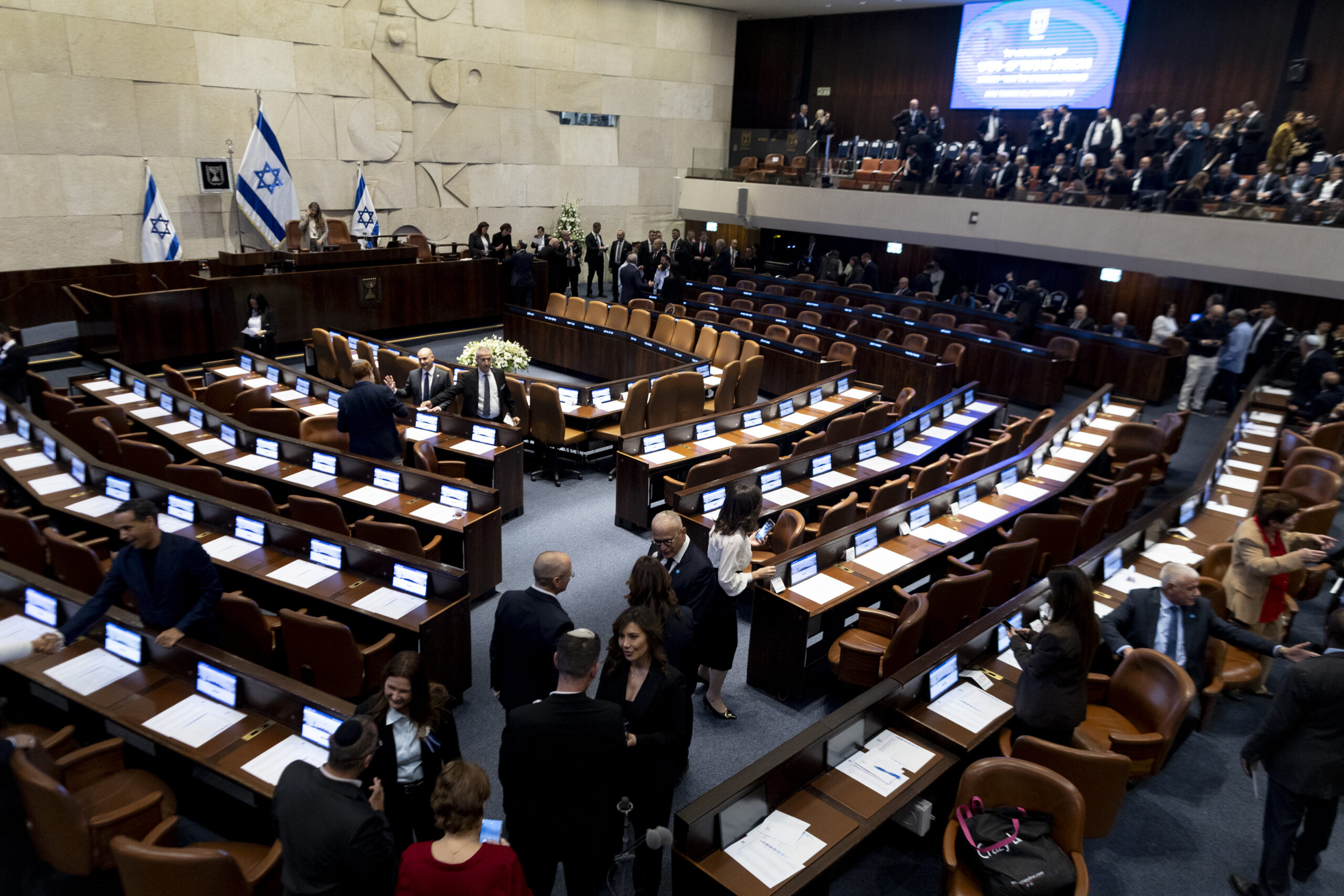
Israel’s Arab citizens voted in record numbers, winning their largest Knesset bloc ever. But when will those votes equal a seat at the table?
By Sultan Tepe and Amir Toumie
November 2026
Israel’s democracy is under renewed scrutiny. Scholars argue that the country has crossed the threshold into competitive authoritarianism, as incumbents increasingly manipulate state institutions and the electoral playing field. Yet this diagnosis leaves a deeper question unresolved: What does democratic competition mean when an indigenous ethnonational group can vote, win parliamentary seats, and potentially determine governing majorities, but its elected representatives remain unacceptable coalition partners to significant segments of the political establishment? Israel’s Palestinian parties expose a problem that cannot be reduced to incumbent authoritarianism alone: the boundaries of political membership and the unequal legitimacy accorded to elected representatives.
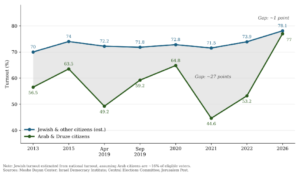
Israel’s claim to be a democracy now faces an unusually concrete trial. In the October 2026 election, Palestinian citizens voted in exceptional numbers (Figure 1) and sent 19 representatives to the 120-seat Knesset. Palestinian votes counted in the allocation of parliamentary seats. Whether those seats will count in the formation of a government is less obvious. The distinction matters: Formal representation in a legislature is not the same as a recognized capacity to exercise political power.
Figure 1 — Voter Turnout in Knesset Elections, Arab and Jewish Citizens, 2013–26
Prime Minister Benjamin Netanyahu’s bloc won 53 seats, while the Jewish-led opposition won 48. The Joint List (composed of Palestinian-majority parties) secured 11 seats and Ra’am (the United Arab List), 8; four of these 19 lawmakers are women. Together, the opposition and the Palestinian lists hold 67 seats, surpassing the 61 needed for a majority — but only if political opponents can agree to cooperate. Most Jewish-led opposition parties have resisted allying with Palestinian representatives, even as both Palestinian lists have explored ways to influence government formation. The resulting impasse turns a familiar parliamentary question into a test of democratic inclusion: Whose votes are deemed legitimate enough to govern?
Israel defines itself as Jewish and democratic. Its defenders point to competitive elections, Palestinian representation in the Knesset, and the participation of Palestinian citizens in public life. Critics emphasize the unequal standing of Palestinian citizens and the boundaries placed around their collective political influence. The 2026 election puts these rival interpretations to a measurable institutional test: Can members elected by Palestinian citizens become accepted partners in assembling a governing majority?
Insecurity and Unequal Citizenship
For many Palestinian citizens of Israel, the political stakes are immediate. Their political agenda includes ending the occupation and securing collective equality, but it also includes staying safe in their neighborhoods, obtaining building permits, keeping homes from demolition, and securing adequate schools, infrastructure, and employment. These concerns are not separate from the national question. They are the everyday forms through which unequal citizenship is experienced.
The scale of insecurity is striking. In 2024, 220 Arab citizens and 58 Jewish citizens were victims of homicide, making the homicide rate among Palestinian citizens roughly fourteen times that of Jewish citizens. The disparity raises urgent questions about policing, organized crime, state capacity, and equal protection. For more than a decade, state authorities have failed to confront organized crime in Palestinian communities. Palestinian politicians disagree over the most effective remedy, but none can afford to treat public safety as a secondary issue.
Economic concerns also shape electoral choices. Some 43.5 percent of Palestinian respondents named the cost of living as the issue most likely to shape their vote, compared with 22 percent of Jewish respondents. That is because the poverty rate among Palestinian families is 38.4 percent compared with 15.4 percent for Jewish families. By contrast, 42.5 percent of Jewish respondents prioritized foreign affairs and national security, compared with 19 percent of Palestinian respondents. These gaps show how differently citizens experience the political agenda of the same state.
The struggle for Palestinian political representation is increasingly inseparable from concerns about everyday survival. The UN Office for the Coordination of Humanitarian Affairs documents more than 1,700 Palestinians displaced across the West Bank, including East Jerusalem, in 2025 by demolitions for lack of Israeli-issued building permits — the highest since monitoring began in 2009. Beyond the West Bank, Palestinian citizens of Israel face their own pressing challenges, including organized crime, inadequate housing and infrastructure, restrictions on land development, and persistent socioeconomic inequality.
For instance, home demolitions rose sharply, most visibly in Bedouin villages facing large-scale development projects without secure rights to their land or homes. Knesset members from the alliance of the non-Zionist Hadash party and the Palestinian party Ta’al noted that missing or outdated master plans block most Palestinian (including Druze) citizens from building legally, inviting heavy fines and deterring young families. For voters whose homes, livelihoods, and safety hang in the balance, representation is no longer about being heard in the Knesset but about being shielded in daily life.
The October election made these frustrations visible. Palestinian turnout rose to about 77 percent from roughly 53 percent in 2022, and the 19 Knesset seats won by Arab parties was their largest combined total ever. That surge cannot be reduced to newfound confidence in Israel’s political institutions. It also reflected alarm over violence and organized crime in Palestinian communities and over the far-right government’s rhetoric, racial incitement, and policies. For citizens who feel increasingly vulnerable, abstention can come to seem less a principled rejection of the political system than an unaffordable luxury. Palestinian political participation has a double meaning: It is both a claim to equality within the state and an attempt to obtain practical protection from it.
Palestinian Parties Change Strategy
Palestinian citizens of Israel are not represented by a single party or ideological tendency. Their electoral politics combines secular nationalism, socialist and communist traditions, pragmatic parliamentary brokerage, and political Islam. That diversity makes the convergence on political influence all the more telling: Parties with different views of Israel’s constitutional character, Zionism, and Palestinian national rights now confront the same question of how to make parliamentary representation consequential.
The Joint List brought together the Hadash, Ta’al, and Balad parties for the 2026 election. Hadash combines Jewish-Arab leftist and communist traditions; Ta’al is associated with Ahmad Tibi and a pragmatic emphasis on civic and national equality; and Balad advances a secular Palestinian-nationalist vision of a state comprising all its citizens. The differences among these parties should not be flattened into an undifferentiated Palestinian bloc.
The Joint List connects opposition to the occupation and demands for Palestinian collective rights to concrete concerns over organized crime, discriminatory planning, housing, public services, and economic inequality. Its proposed route to changing the government is primarily external support — a parliamentary “safety net” for an alternative coalition rather than formal cabinet participation. Ra’am offers perhaps the most striking illustration of the transformation in Palestinian electoral politics. Rooted in the Islamic Movement’s Southern Branch, the party broke from the Joint List before the 2021 election and joined the Naftali Bennett–Yair Lapid coalition (formed in 2013 by the two then-future prime ministers), making Ra’am the first independent Palestinian party to enter an Israeli government. Earlier inclusion was either indirect (the Arab satellite lists of Mapai, the party of Israel’s first prime minister, David Ben-Gurion, which merged into the Labor Party in 1968) or external (the Arab “blocking bloc” behind Prime Minister Yitzhak Rabin’s 1992–95 government). Against this history, Palestinian parties’ readiness to join or sustain a coalition marks a substantial shift.
Under the leadership of Mansour Abbas, Ra’am has developed what it calls a politics of influence: Rather than remaining permanently outside government for ideological reasons, it seeks to trade parliamentary cooperation for budgets and policies addressing public safety, housing, employment, and public services. The wager is that Palestinians can secure substantive gains by bargaining with Jewish-led parties without first resolving the foundational conflict over national identity. In 2026, Ra’am went further, placing Yoav Segalovitz, a Jewish Zionist and former senior police officer and lawmaker, second on its slate. An Islamist-rooted Palestinian party had opened its doors to a Jewish Zionist for pragmatic reasons, while much of the Jewish-led opposition still would not open theirs to Palestinian votes for the same reasons.
The strategies of Palestinian parties are not identical. The Joint List’s emphasis on Palestinian national rights and its willingness to support a cabinet from outside the governing coalition differ from Ra’am’s search for a formal share in government. Nor should electoral pragmatism be mistaken for an abandonment of Palestinian identity. What unites the parties is a shift from demonstrating political presence toward seeking the means to shape policy. They offer different answers to the same predicament: How can a historically marginalized indigenous community make its electoral weight matter?
When Other Channels Narrow, Voting Carries a Heavier Burden
The turn toward elections must also be understood against the constraints on other forms of political participation. Palestinian citizens have a long history of organizing around land rights, national equality, and opposition to the occupation, from the Land Day general strike in 1976 to the protests of October 2000 and the mobilizations of the 2021 Dignity Uprising. Electoral politics has never exhausted the repertoire of Palestinian civic engagement. Yet the costs of dissent have risen sharply since the Hamas attacks of 7 October 2023 and the subsequent devastation of Gaza. By early November 2023, Adalah was tracking 251 cases of arrests, detentions, or police “warning talks” against Palestinian citizens for protests or social-media posts, 121 of them over online posts. According to data from the Palestine Liberation Organization’s Commission of Detainees and Ex-Detainees Affairs, the number of people held in Israeli prisons and detention centers had reached more than 11,100 by early October 2025 — approximately double the number before 7 October 2023. The underlying democratic concern remains: When people fear that protest or public expression will bring punishment, an already unequal political field becomes narrower.
It would overstate the case to say that the ballot box has become the only available channel. Palestinian civic organizations, lawyers, journalists, and activists continue to operate. But increased pressure on extraparliamentary expression makes the electoral channel more consequential. There is a cruel asymmetry when a national minority is pressed toward institutional participation while its elected representatives still face categorical barriers to shaping government. The political system invites Palestinian citizens to vote, but disputes whether their votes should count in the formation of political authority.
A Seat in the Knesset, Not the Cabinet Table
Palestinian participation also reflects shifts in Jewish-led politics. Mainstream parties and citizens have moved rightward on sovereignty, security, and Palestinian claims, and the Zionist left has withered: In 2024, Labor and the social-democratic Meretz party merged into the Democrats, which won just eight seats in 2026. In this setting, refusing to depend on Palestinian parties has become a way for politicians to establish their national credentials, including among parties that oppose Netanyahu.
The boundaries of acceptable speech have shifted as well. In 2016, Bezalel Smotrich, leader of the right-wing Religious Zionist Party who would later become finance minister, defended the separation of Jewish and Palestinian mothers in maternity wards; in 2021, he opposed reliance on Ra’am and described Palestinian citizens as citizens “for now at least.” Such statements treat Palestinian citizens less as voters with contestable political positions than as an inherently suspect collectivity.
The 2018 Nation-State Basic Law is a different but related expression of the hierarchy built into Israeli state identity. It declares that the exercise of national self-determination in Israel is unique to the Jewish people. Supporters regard this as a statement of Jewish nationhood; critics argue that it entrenches the inferior collective status of Palestinian citizens, even as individual voting rights formally remain intact. The law does not prohibit Palestinian parties from running for office. Its relevance is that it sharpens the unresolved question of what equal democratic membership entails when the state reserves national primacy for one community.
The electoral arena shows how such boundaries can be reinforced. Netanyahu famously warned in 2015 that Arab voters were going to polling stations “in droves,” a formulation that made group turnout sound like a political danger. In the 2026 campaign, fears of high Palestinian turnout again featured in right-wing mobilization; after the election, Netanyahu challenged aspects of the Palestinian parties’ gains with unsubstantiated allegations of irregularities. When one community’s participation is repeatedly framed as a threat, the act of voting becomes simultaneously necessary to that community and suspect to its opponents.
Yet treating Jewish Israelis or Jewish-led parties as a monolith would obscure a crucial divide. The Democrats, for example, have been more open than other Jewish-led opposition parties to cooperating with Palestinian parties.
The Israeli Democracy Institute’s preelection survey found that a majority of Jewish respondents on the left supported some role for Ra’am in or alongside government, while resistance rose sharply toward the political center and right; support for the Joint List was generally lower. Among Jewish respondents as a whole, large majorities opposed either Palestinian list’s participation in government or even its outside support. Around three-quarters of Palestinian respondents favored some role for Palestinian parties. The issue, then, is not an immutable refusal shared by every Jewish voter. It is the marked shift of much of the Jewish-led mainstream toward the far right, compounded by the constraints of the coalition system.
Kingmakers Without a Kingdom
The election’s most revealing number is not 19 but 67: the total seats held by the Jewish-led anti-Netanyahu parties and the two Palestinian lists. This is a majority by arithmetic, not a coalition. The opposition is ideologically fractured, and the Palestinian parties disagree over whether and how to back a government. Other arrangements, including shifts among Jewish-led factions, remain possible. None of these complexities should be wished away. But neither can they explain away the central contradiction.
Some leaders reject Palestinian parties not over a specific budget, security policy, or governing agreement, but because relying on them is deemed politically disqualifying in the current right-wing climate. There is a principled distinction between refusing to cooperate with a party because of its platform and treating parties that represent a national group as beyond the bounds of legitimate government. The first is normal democratic politics. The second risks making citizenship equal in the polling booth but unequal in the corridors of power.
The legitimacy of Palestinian participation was contested before a single vote was cast. In September 2026, the eligibility of Palestinian parties and candidates to run, and ultimately to serve in the Knesset, came under political attack. The institutional structure of Israel’s Central Elections Committee (CEC) makes this particularly consequential. Although chaired by a Supreme Court justice, the committee’s voting members represent the parties of the outgoing Knesset, giving the governing coalition 18 of its 31 seats. Political competitors thus participate directly in determining who is eligible to compete against them. In late September, the CEC disqualified both Palestinian-led lists and two Joint List candidates, Ofer Cassif and Sami Abu Shehadeh. On October 2, the Supreme Court, finding the evidence insufficient, unanimously reversed the rulings on both lists and, by a 7-2 vote, restored Cassif as well. In regard to Abu Shehadeh, the court signaled that it would disqualify him from running if he does not resign on his own. Thus, even the Court did not secure their legitimacy. Palestinian inclusion was contested twice: once to run, and again to govern.
Political exclusion is rarely absolute. Minority representatives can serve in parliament, chair committees, win discrete concessions, and sometimes cast decisive votes. These openings matter. Yet when a persistent boundary separates minority representation from a recognized right to participate in forming a governing majority, formal electoral inclusion may coexist with substantive political subordination. This is the more important lesson of the 2026 election: An election can register a community’s political voice with unusual clarity and still fail to translate that voice into an accepted governing mandate.
The dilemma is also strategic. If the anti-Netanyahu parties cannot reach a majority without Palestinian support, their refusal may prolong the incumbent’s tenure or trigger yet another election. And if Palestinian parties moderate their coalition strategies and still find themselves rejected, an important incentive for democratic participation is weakened, and thus Israel’s flawed democracy becomes exposed. Palestinians who voted for safer streets and better schools would ask what more it takes for their votes to matter.
The Trial of Israel’s Democratic Claim
Israel’s immediate challenge is coalition formation; its deeper challenge is whether electoral representation can become effective citizenship. The 2026 result exposes an asymmetry: Palestinian parties have pursued new ways to participate in the political system and influence policy, while major Jewish-led parties remain unwilling to treat their support as an ordinary instrument of parliamentary government. One need not agree with every Palestinian party platform to recognize the democratic stakes of that refusal.
No democracy guarantees cabinet seats to any minority party. Yet the difference between contesting a party’s proposals and categorically excluding the people it represents is decisive. In Israel, that boundary runs through the unresolved relationship between the state’s Jewish national character as connected to the occupation and the political equality of its indigenous Palestinian citizens. The existential trial of Israel’s democratic claim therefore cannot be settled by pointing to the presence of Palestinian members in the Knesset. They are there; they speak and they vote. The question is whether they can also exercise the bargaining power that elections have conferred on them. Palestinian citizens were not denied a ballot in this election, but they have been reduced to a voting bloc that bolsters Israel’s democratic credentials without being granted a democratic role.
At stake is not simply who will form the next governing coalition, but whether the ballot box offers all citizens an equal opportunity to influence political power. Robert Dahl’s insight endures: A vote that can never alter who governs is participation without power, not a check on power but a ritual that confirms it. When elected representatives are shut out of government because of whom they represent, democratic competition becomes a contest with a predetermined loser.
Palestinian citizens of Israel have already done everything democracy asks of them: They turned out, organized, compromised, and won representation that reflects their diverse views. For years, Israel’s democracy accommodated a Palestinian electorate that was free to vote but often stayed home or boycotted elections, an arrangement that allowed fundamental questions about equal citizenship to remain unresolved. Israel has opened the door to inclusion but closed the room where power is contested: Palestinian citizens may enter the hall but may not sit at the table.
Democracy, as Adam Przeworski argues, institutionalizes uncertainty. When a community is excluded from governing in advance, by identity alone, democracy’s uncertainty ends for them. They are invited to the election but not to its outcome. The test for Israel’s democratic process, then, is not whether Palestinian citizens can vote but whether their representatives can be legitimate partners in government rather than a presence that lends legitimacy to the system that excludes them. Israel can no longer defer the question at the heart of its political order: How long can it keep counting Palestinian votes without letting those votes count? The answer will shape more than the quality of Israeli democracy, or even whether its elections remain genuinely competitive. It may well decide whether there is still a democracy left to save.
Sultan Tepe is professor of political science at the University of Illinois Chicago and coeditor-in-chief of Politics and Religion. She is the author of Beyond Sacred and Secular: Politics of Religion in Israel and Turkey (Stanford University Press) and Zoning Faith (NYU Press). Amir Toumie is a founder and member of Haifa Youth Movement and Iqrit Youth Movement, and former Director of Government Relations at the Mossawa Center, the Advocacy Center for Palestinian Citizens of Israel.
Copyright © 2026 JoD Productions Inc
Image Credit: Amir Levy/Getty Images
|
FURTHER READING |
||
Israel’s Slide into Competitive Authoritarianism |

How Mislabeling Jewish Extremism Undermines Israel’s Democracy |
Is Israel Losing Its Last Democratic Safeguard? |