
July 2009, Volume 20, Issue 3
Samuel P. Huntington (1927–2008)
A tribute in remembrance of Samuel P. Huntington (1927–2008).
July 2009, Volume 20, Issue 3
A tribute in remembrance of Samuel P. Huntington (1927–2008).

April 2009, Volume 20, Issue 2
The secularization hypothesis has failed, and failed spectacularly. We must find a new paradigm to help us understand the complexities of the relationship between religion and democracy.
April 2009, Volume 20, Issue 2
The same policies that fostered decades of prosperity in Singapore have also led to longer-term economic ills that might have been averted in a freer society.
April 2009, Volume 20, Issue 2
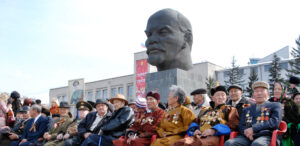
There is no consensus about the nature of the political system in Moscow today. Yet how one understands the motivations propelling Russian policy abroad depends on how one understands its regime at home.
April 2009, Volume 20, Issue 2
A fan of Mario Puzo’s Godfather novels will see the Putin government for what it is: a mafia.
April 2009, Volume 20, Issue 2
Read the full essay here. Arguably a flawed democracy in the 1990s, Russia took a distinctly authoritarian turn under President Vladimir Putin from 2000 to 2008. The country now lives under a façade democracy that barely conceals the political and administrative dominance of a self-interested bureaucratic corporation. The regime manufactures consent by means of three…
April 2009, Volume 20, Issue 2
Read the full essay here. Twenty years ago, there was a more thoroughgoing political pluralism in Russia than there is today. In some respects, the forms of democracy-including party consolidation-have been enhanced, but they have been so manipulated as to deprive them of substance. Either “electoral authoritarianism” of “multiparty authoritarianism” (Juan Linz’s terms) may reasonably…
April 2009, Volume 20, Issue 2
Read the full essay here. The corporatist kleptocracy being erected by Russian President Vladimir Putin is profoundly misunderstood in the West. This model dooms Russia to economic degradation and margin-alization. The current global crisis has made this truth painfully clear. The artificially created image of a threatening West (and U.S. in particular) is now becoming…
April 2009, Volume 20, Issue 2
Read the full essay here. Of all of the national republics that emerged out of the dissolution of the Soviet Union, Russia has had the most profound difficulties in determining its national identity. What is the essence of being Russian, and where are the boundaries of the “Russian World”? There has never been a Russian…
April 2009, Volume 20, Issue 2
Read the full essay here. In contrast to authoritarian power structures, which rest on a form of bureaucratic corporatism that makes the leader its hostage, the regime in Moscow rests on personalized power, something that signals a return to the traditional Russian political matrix. The regime has fused power and property in a manner that…
April 2009, Volume 20, Issue 2
Read the full essay here. The regime in Moscow mixes key features of a capitalist economy with a political system wherein power is monopolized by a close-knit professional and age cohort whose members often have a background in the secret police. Instead of seeking to base its legitimacy on broad-based, transpersonal institutions with character and…
April 2009, Volume 20, Issue 2
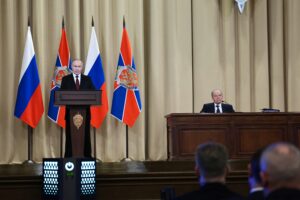
Since Vladimir Putin’s rise to power at the end of the 1990s, siloviki—the people who work for, or used to work for, Russia’s “ministries of force” have spread to posts throughout all the branches of power in Russia.
April 2009, Volume 20, Issue 2
The image of Putin’s Russia as an authoritarian oil state attracts many Western analysts because it seems to carry a promise that falling oil prices will bring regime change. Thus, many were convinced that a major economic crisis would force the Kremlin either to open up the system and allow more pluralism and competition, or…
April 2009, Volume 20, Issue 2
Will Hugo Chávez’s victory in the 15 February 2009 vote to end term limits enable him to drive Venezuela toward “Bolivarian socialism”? There are reasons to doubt this, but for now democracy’s prospects do not look encouraging.
April 2009, Volume 20, Issue 2
Although 2008 was marked by democratic setbacks as well as authoritarian “pushback” against reformers, democracy remains the only system of government that commands global respect.
April 2009, Volume 20, Issue 2
The North Atlantic Treaty Organization played a key role in safeguarding Western democracy during the Cold War. With that conflict over, NATO must continually adapt and evolve in a fast-changing world.
April 2009, Volume 20, Issue 2
For the past few decades, scholars have been focusing on the causes of democratization. It is now time to devote systematic attention to analyzing the costs and benefits that democracy brings.
April 2009, Volume 20, Issue 2
Ghana held its fourth successful elections in late 2008 and subsequently witnessed the peaceful handover of power from ruling party to opposition. The country’s leaders must now reform its institutions of governance.
April 2009, Volume 20, Issue 2
In February 2008, Kosovo broke away from Serbia and declared its independence. But to what extent is it making progress toward its goals of sovereignty and democracy?
April 2009, Volume 20, Issue 2
A review of Conversations with Tocqueville: The Global Democratic Revolution in the Twenty-First Century edited by Aurelian Craiutu and Sheldon Gellar and Tocqueville et les frontières de la démocratie by Nestor Capdevila.