
ESSAY — NOVEMBER 2026
How Serbia’s Students Defeated a Regime
The world saw Serbia’s crowds. Few saw the strategy behind our protests — the organization, the outreach, the arrests — that turned national grief into electoral victory.
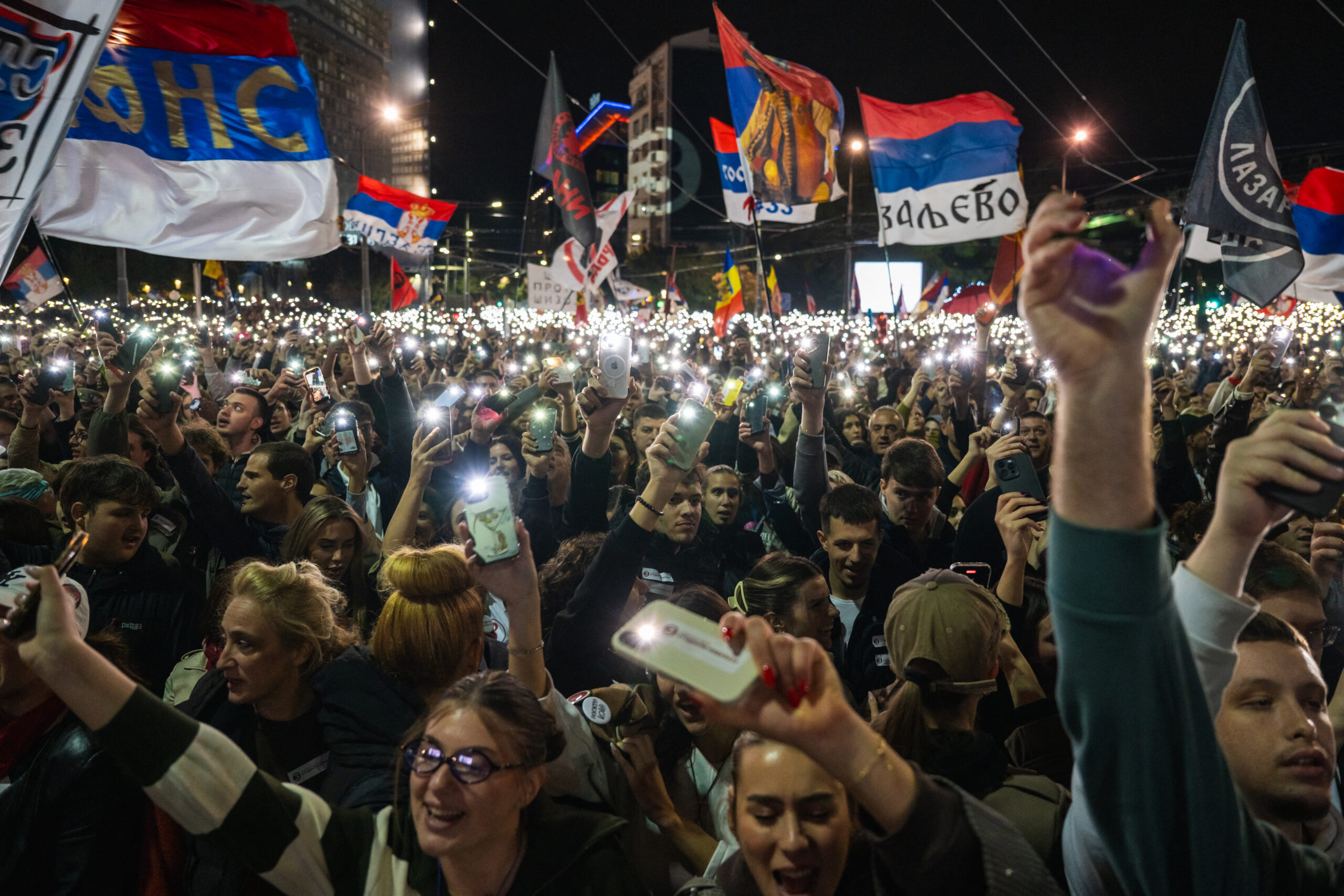
The first of November, 2024 will be remembered as one of the darkest days in Serbia’s modern history. That day, the recently renovated canopy of the railway station in Serbia’s second-largest city, Novi Sad, collapsed, killing sixteen people. Most citizens saw the tragedy as the direct result of corruption under the government of the time. Less than two years later, the movement born from the tragedy defeated that government at the ballot box without ever abandoning the principles of nonviolence.
I have been part of this movement since its first weeks: as a student in the Faculty of Political Sciences in Belgrade, as a participant in the faculty blockades, and as a member of the citizens’ assembly in my hometown of Užice. What follows is an account of how we organized, what it cost us, and what I think others can learn from our movement.
The public response to the collapse was immediate. On the day itself, people traveled to Novi Sad to donate blood for the injured, and protests began within days. At one of these protests in Belgrade, people acting on behalf of the ruling party attacked students and citizens who had gathered in front of the Faculty of Dramatic Arts to pay tribute to the victims. The students responded by blockading the university. By the end of the year, almost every higher-education institution in Serbia was under blockade, and a student movement had taken shape.
Like the youth-led movements that have shaken governments from Kenya to Nepal, Serbia’s movement mobilized people on a mass scale. What set it apart was its focus on a concrete demand, accountability for corruption, and its commitment to nonviolence throughout two years of protest.
How We Organized
From the first days, students built an unusual form of organization based on plenums and direct democracy. The plenum was its core: an assembly open to everyone taking part in a university’s blockade, where participants discussed, voted, and made decisions. The movement’s nonhierarchical structure, which gave everyone equal voice, drew in students who would never have joined a conventional organization.
Each university had its own plenum and its own working groups, covering areas such as media, strategy, relations with the faculty administration, and donations. Above them sat coordinating working groups, where delegates from the matching working groups of related universities met. A separate body of delegates had one task only: to count and consolidate the votes cast in individual university plenums.
Observers often called the movement “leaderless.” That is not accurate. There was no personalized central leadership, but the movement was never absent of leadership either. It is more precise to say that the movement had a broad collective leadership, built on delegates rather than traditional leaders and representatives.
The model had clear strengths. It protected us against infiltration: Even if people loyal to the regime got inside, there was no leadership position for them to subvert or take over, because none existed. The model also had clear costs. Communication with domestic and international organizations was slow and difficult, because delegates could only convey decisions already reached by a plenum or working group, never individually.
The tension sharpened when students began demanding early parliamentary elections. A degree of centralization followed: Dedicated working units were set up to handle electoral logistics and to turn the students’ program into practical activity. One debate kept returning: Should decisionmaking power remain with the plenums, which had greater legitimacy but were slow, or move to the new working units, which were far more efficient but less legitimate because they did not include all students? We never fully settled it. What I took from that debate is that legitimacy and efficiency pull against each other, and a movement must decide deliberately how much of one it is willing to give up for the other.
Walking to the People
The marches began as an answer to obstruction. Whenever a major student gathering was announced, intercity bus and train services to the host city were often canceled. Ahead of the March 15 protest in Belgrade, for example, passenger trains were suspended, officially because of bomb threats. Students responded by walking.
But the marches quickly became more than a way around the regime’s obstacles. They grew into a grassroots outreach campaign aimed at people the movement had not yet reached, especially in rural areas, where the ruling party enjoyed considerable support. The campaign sought to broaden public support for the student movement by raising awareness of its demands, engaging citizens in smaller towns and rural communities, and building connections with people beyond its existing support base. In the winter of 2025, the kept up the movement’s momentum and put students in direct contact with citizens across the country.
The scenes along the way were some of the most powerful I have witnessed. People came out onto their balconies to greet us, brought food, and showed their support. One of the warmest receptions came in Knić, where we stopped for the night on our way to Kragujevac. A column of several hundred students and citizens, led by tractors, entered the town to find that local residents had prepared a welcome with music, fireworks, and food for everyone who had made the journey on foot.
Each march led to a major protest. The first converged on Novi Sad on February 1; this became the largest demonstration the city had seen up to that point. The second went to Kragujevac on February 15. I walked it with other students from Užice: We organized ourselves, chose our routes, and set off together with students from Čačak, Gornji Milanovac, and other towns in western Serbia. The third went to Niš on March 1, with columns arriving from every part of the country. The fourth and last went to Belgrade.
The marches culminated in Belgrade on 15 March 2025, in the largest demonstration in Serbia’s history. The independent Archive of Public Gatherings estimated the crowd at between 275,000 and 325,000 people. I was there. During the fifteen minutes of silence held for the Novi Sad victims, a sudden, deafening sound swept through part of the crowd, causing people to panic and run. That evening, from media reports and friends, we learned that many people had heard something like an aircraft coming in to land over the city center and first heard the suggestion that some kind of acoustic weapon had been used against peaceful protesters. The government denied it, and Belgrade prosecutors later said no such device had been used. Many citizens nevertheless came forward with their accounts of that evening, and the independent research group Earshot concluded that protesters had “highly likely” been targeted with a directed acoustic device.
Living Under Repression
Living under constant pressure and repression is hard. What disturbs me most is how quickly people get used to it.
At first, repression took the form of smear campaigns: attacks on both the movement and its individual members broadcast on progovernment television stations, derogatory AI-generated videos targeting regime critics, and labels such as “foreign mercenaries,” “domestic traitors,” “enemies of Serbia,” and “Ustaše” — a reference to Croatia’s WWII fascist movement — applied to demonstrators.
Over time, the repression escalated. In Belgrade, organized groups of thugs turned up to block peaceful gatherings of Most ostaje (The Bridge Stays), an informal network of activists from across the city opposing the planned demolition of the Old Sava Bridge. The network’s first gathering took place on the evening of 31 October 2024, just hours before the canopy collapsed in Novi Sad, and until the spring of 2025 its members kept a camp at the entrance to the bridge that served as their base. Elsewhere, so-called random passers-by, supposedly in a hurry to get home, drove into peaceful demonstrators, assaulted them, and humiliated them.
The next stage brought covert filming of activists, followed by the arrests of students and activists in Novi Sad in mid-March 2025. Until then, arrests had been sporadic.
Repression and arrests peaked in the summer of 2025, after the mass protest at Slavija Square in Belgrade on June 28, the Vidovdan national holiday. A wave of decentralized protests followed across the country, and many citizens were arrested and beaten, either by groups of thugs or by the police themselves.
In those conditions, our only real protection was the solidarity of fellow activists and the work of independent media. The regime increasingly relied on what became known as “silent arrests,” carried out away from cameras. Many of them would have gone unnoticed had independent journalists and activists not brought them to public attention.
Mobilizing the Citizenry
In March 2025, the student movement called on citizens to form local assemblies known as zborovi. By April, assemblies had emerged across Serbia and become part of the wider uprising.
I was a member of the assembly in Užice. It was not a citizens’ assembly in the formal legal sense, but a platform that brought together activists, students, opposition councilors, and citizens who wanted to take part in the struggle for democracy. It ran on the same principles of plenary sessions and direct democracy as the student blockades. In practice, most of its work was concrete and logistical: deciding when protests would take place, choosing speakers, planning routes, and finding someone with sound equipment and a vehicle to move it.
After Vidovdan, protests became even more decentralized, and local groups like ours carried the movement through the summer. Historically, protests have often lost momentum during the summer months, as students return to their hometowns, people go on holiday, and warmer weather shifts public attention away from political engagement. In 2025, they did not.
At the end of June and in early July, we blocked the main road through Užice every day, which clearly worried the authorities. After several days, some of the country’s highest-ranking officials appeared on national television and warned that if the people of Užice took to the streets again, the police would disperse them by force. That very evening, the people of Užice took to the streets and blocked the roads. The police responded with extreme brutality.
The next morning, several of us were arrested, me among them. Our fellow citizens protested outside the prison every evening. On the seventh day after our arrests, the people of Užice called on citizens from across Serbia to come to the city and join a protest against our detention. The day after that protest, we were released to await trial. Those evenings outside the prison taught me more about the power of local organization than anything I had ever read.
From the Streets to the Ballot Box
Political parties are essential to representative democracy, in Serbia as anywhere else. In our case, however, something unusual happened: A list of candidates to represent the student movement in parliament emerged from a system built on direct democracy.
Some opposition parties chose to run in the elections; others stepped aside. I have always argued for unity among opposition actors, and that is what we saw. At the local level, parties and civic groups cooperated more than ever before, sharing experience and logistics, monitoring elections, and organizing protests together, particularly during the summer of 2025. Direct democracy combined with a broad civic front proved to be the most effective way to mobilize society against the regime.
The struggle had lasted many years, the last two of them especially intense. It ended on 25 October 2026, when the student list won an outright majority in early parliamentary elections and a ruling party that had held power for fourteen years was defeated. Many expected the authorities to refuse to accept defeat and to destabilize the country further. That did not happen: The ruling party conceded on election night.
The incoming government now faces the test that every victorious movement faces. It must stay committed to fighting corruption and restore media freedom, above all at the outlets that have been under the regime’s direct control and served as one of its main pillars. The new government must also depoliticize the public sector, another pillar of the old order, which was held in place through blackmail, pressure, and the appointment of loyalists.
Our experience shows that a disciplined, nonviolent movement can defeat a regime that controls the media, the police, and public institutions. But winning an election is not the end of the struggle. The lesson I would offer to movements elsewhere is this: Do not dissolve the structures that brought you victory. The citizens who organized in plenums and assemblies, who walked across the country and stood outside prisons, are now the best guarantee that power will be held to account, including the government they helped to elect.
Presented by

Copyright © 2026 JoD Productions
Next month: a new column from the Frontline.
Join our mailing list to receive each month’s essay as soon as it is published. The Frontline is always free to read and share.