
Serbia’s student movement just peacefully ousted the country’s corrupt leader by turning their protests into political power. They did it by marrying creativity to strategy, organization, and outreach.
October 2026
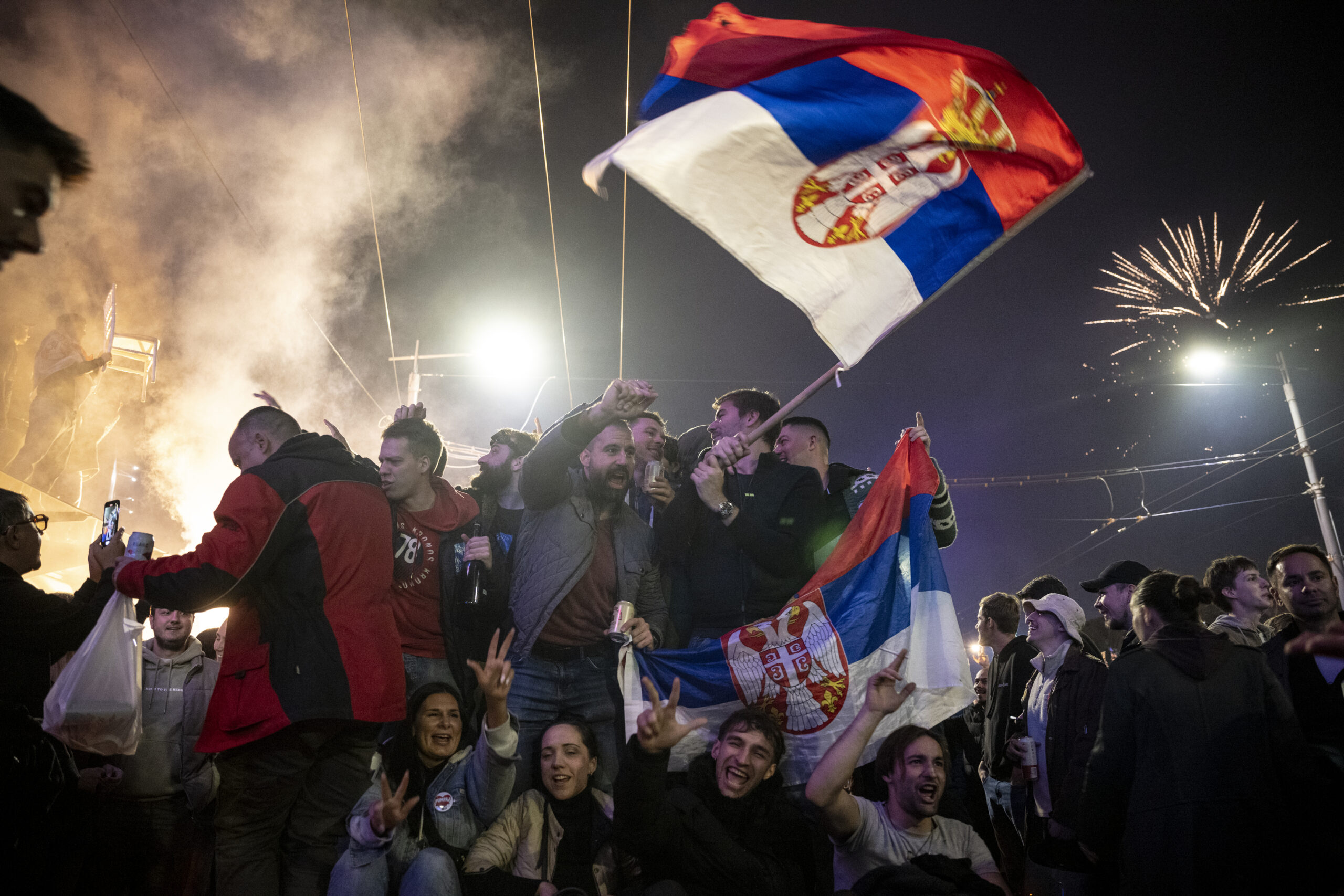
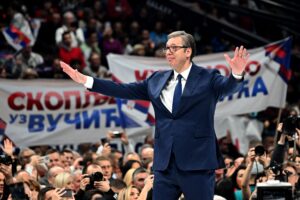
On the night of October 25, crowds filled the streets of Belgrade chanting two words: “Gotov je!” — “He’s finished!” I first heard that chant a quarter-century ago, when hundreds of thousands Serbs demanded that Slobodan Milošević accept his defeat at the ballot box. This time, the man who was finished was President Aleksandar Vučić — and many of those chanting were not yet born when we brought down Milošević. History may not repeat itself, but in Serbia it clearly keeps the same playlist.
I know what many of you are thinking, because I hear it everywhere. Protest is dead. Authoritarian populists keep winning, from Istanbul to Caracas, while the street answers with marches that change nothing. You watched Madagascar’s Gen Z rise up with breathtaking courage and chase a president into exile — and then watched a colonel ride their revolution into the palace. A year later, as one Malagasy activist from the capital, Antananarivo, admitted, “we had no program, no government ready, no consensus figure.” You watched France’s recent youth protests curdle from good intentions into looting and fires, handing the argument to the other side. And the data seem to agree: The success rate of nonviolent campaigns fell from 65 percent in the 1990s to under 34 percent a decade later, while participation rates were cut in half.
Then came Serbia. With nearly 70 percent turnout — the highest since the breakup of Yugoslavia — a student-led movement took 52.7 percent of the vote and roughly 140 of 250 parliamentary seats, wiping every traditional party off the electoral map. Vučić — who blamed independent media, unnamed European countries, and an “American deep state” for his defeat — conceded by 9:30 on election night. No leader. No party machine. No magic, either. Protest still works — but only when you couple enthusiasm with strategy, mobilization with organization, social media with boots on the ground. Miss any of the three, and you get Venezuela or Madagascar. Get all three, and you get Serbia.
Enthusiasm Plus Strategy
After the canopy at Novi Sad’s railway station collapsed in November 2024, killing sixteen people, the crowds kept growing — candlelit vigils, blocked universities, bridges, and roads — a whole winter of grief. On March 15 the following year, the movement held the largest single gathering in Serbian history: hundreds of thousands packing Slavija Square in Belgrade. Still, the government conceded nothing — not a single resignation, nor policy passed, nor prisoner freed. After the loudest day in Serbian history, that silence was the real turning point. The students got the message: Numbers buy attention, but attention alone buys nothing. So, they did the least romantic thing a movement can do. They decided to contest an election — to convert a year of moral legitimacy into a confrontation the regime could not avoid or referee. Strategy is not a document. It is the discipline to change direction when the music stops.
Organization Wins the Game
Publicly, the movement was deliberately decentralized and leaderless — no faces to arrest, no hierarchy to infiltrate. But leaderless never meant structureless. A strategic core of student leaders had spent months preparing for the election like engineers, not activists. They meticulously vetted a list of 250 candidates, looking for people who would offer a maximum of public trust and a minimum of opportunities for the regime to attack — a cardiologist at the top, along with professors, farmers, actors, and not a single career politician. They built a ground game of more than 35,000 poll watchers and mobile teams who monitor outside election sites, backed by communications and legal teams. Vučić, meanwhile, campaigned as he had for fourteen years — via state media, with his face on every screen — yet for the first time, he was campaigning on defense, answering a movement instead of directing one.
Virtual Is Nice. Boots on the Ground Are Essential.
To be fair, the students were brilliant online — the raised red hand signifying the regime’s bloody hands with slogans like “corruption kills,” dozens of highly effective memes and short videos designed by film and theater students — these were visuals engineered to travel, an Instagram game that made a local movement feel national, regional and even global. But hashtags don’t knock on doors in villages where the television says the government is always right. So the students knocked. Through “Student u svakom selu” — “a student in every village” — they visited more than 400 towns and settlements, tens of thousands of households, in pairs, with an app logging every porch conversation. And they biked, crisscrossing the country on the “Guardians of the Constitution” cycling tour, handing out copies of the constitution like pamphlets of a promise to thousands of voters in dozens of smaller towns and villages. And they marched, literally, into the deeply unfriendly, regime-affiliated territory that every normal campaign writes off as hopeless.
Here is the part I love most: The movement’s eleven-point platform was drafted from those porch conversations. The country’s villagers coauthored the program. This, too, was history updated once again — a lesson we learned in 2000, when Otpor’s local activists visited thousands of households nationwide, harvesting the elements of the “Contract with Serbia” — the coalition’s electoral platform that defeated Milošević.
These efforts exposed the regime’s familiar electoral repertoire — vote buying, pressuring public employees to vote for the ruling party, a tilted broadcast landscape, and the like. Yet none of it mattered, because the movement answered with the one thing a hybrid regime cannot survive: an electorate too large and too watchful to steal from.
Now the Hard Part
Vučić will not be leaving the keys under the doormat. After fourteen years of rule, the Student List is inheriting wreckage, not a state: institutions hollowed out and staffed for loyalty, gutted police departments, courts and prosecutors bent by years of corruption and nepotism, a public administration in which honest servants were punished and compromised ones promoted, a media landscape that is a branch office of the party — and, hardest of all, citizens divided into two countries that happen to share one territory.
The movement has spent two years proving it could bring the old machine down. It has never once practiced running the country that the machine leaves behind. When Breza Race Maksimović and I warned in these pages last summer that fear of what comes next was this movement’s greatest obstacle, that fear was never a question about their program. It was a premonition of what follows the morning after victory: the day the winners inherit the wreckage. December’s presidential election is the first checkpoint. The transition — professionals instead of loyalists, accountability without vengeance, one country instead of two — will decide whether October 25 becomes a national liberation or just a change of management.
To every movement watching from Antananarivo to Paris to wherever the next tragedy falls: Don’t take the wrong lesson from your failures. Your protests didn’t fail because “protest fails.” They failed because enthusiasm was asked to do strategy’s job. The Serbian students proved that the crowd still matters — when you weld it to organization and walk into every village and every polling station. The playlist, it turns out, still works. But only if you learn the whole song.
Srdja Popovic is founder of the Center for Applied Nonviolent Action and Strategies and lecturer at Colorado College and the University of Virginia. He is author of Blueprint for Revolution: How to Use Rice Pudding, Lego Men, and Other Nonviolent Techniques to Galvanize Communities, Overthrow Dictators, or Simply Change the World (2015). His Twitter handle is @SrdjaPopovic.
Copyright © 2026 JoD Productions Inc
Image Credit: Andrej Ivanov/Getty Images
|
FURTHER READING |
||
How Serbian Students Created the Largest Protest Movement in Decades
|
How Tragedy Sparked a Protest Movement
|
Why Aspiring Autocrats Are Watching Serbia
|