
October 2005, Volume 16, Issue 4
Babel in Democratization Studies
Recent works on regime types have led to confusion and a tendency to overstate the differences between established and newer democracies.
2995 Results
October 2005, Volume 16, Issue 4
Recent works on regime types have led to confusion and a tendency to overstate the differences between established and newer democracies.
October 2003, Volume 14, Issue 4
Europe faces a potentially dangerous “double bind”: The legitimacy of domestic democracy in the member states is waning, and citizens are increasingly unhappy with the EU’s lack of accountability—but the new draft Constitution fails to address the problem.

July 2015, Volume 26, Issue 3
A few years ago, Europe’s most important intergovernmental human-rights institution, the Council of Europe, crossed over to the dark side. Like Dorian Gray, the dandy in Oscar Wilde’s story of moral decay, it sold its soul. And as with Dorian Gray, who retained his good looks, the inner decay of the Council of Europe remains hidden from view.
October 2018, Volume 29, Issue 4
Democracy is enduring in Latin America, but it cannot be said to be prospering. Illiberalism and polarization are rising. Yet core democratic institutions remain firmly in place, and therein lies hope.
July 2016, Volume 27, Issue 3
As more and more African presidents attempt to remove or circumvent constitutional term limits, African populations increasingly are mobilizing en masse, at great risk, to defend their constitutions.
January 2013, Volume 24, Issue 1
Over the past decade, Chinese authorities have turned against many of the legal reforms they themselves had enacted in the late 20th century. Lawyers have come under increased pressure. Political campaigns warning against rule-of-law norms have rippled through the courts. And central authorities have massively increased funding for extralegal institutions aimed at curtailing and suppressing…
January 2013, Volume 24, Issue 1
In October 2012, Georgia’s government lost power in an election, and peacefully stepped aside. But can a country with Georgia’s troubled history capitalize on this surprising achievement?
April 2008, Volume 19, Issue 2
Long an extreme case of institutionalized instability, Ecuador now has a dynamic young president who is determined to remake its constitution, and eventually its society, in the name of "twenty-first-century socialism."
October 2022, Volume 33, Issue 4
We welcome the common ground. The challenge ahead is to protect democracies genuinely in peril, while not losing valuable time and resources chasing authoritarian ghosts.
October 2025, Volume 36, Issue 4
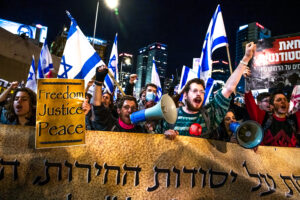
When Israel’s democratic safeguards came under attack, Israeli political scientists felt they had a duty to spread a shared, nonpartisan understanding of the dangers of democratic backsliding. Here is how they organized, built channels of communication, and reached the public.
October 2011, Volume 22, Issue 4
Though justly vaunted as the world’s largest democracy, India will in all likelihood remain reluctant to take on the mantle of “democracy promoter” for a mix of historical, ideological, and strategic reasons.
July 2004, Volume 15, Issue 3
Over the ten years since its first nonracial elections in 1994, South Africa has seen its democratic order become more firmly institutionalized, even as the electoral dominance of the ANC has continued to grow.
April 2023, Volume 34, Issue 2
Complaining about parties and politicians is common everywhere, but troubled Peru has devolved into a cautionary tale for what a democracy without established parties and professional politicians can look like.

July 2022, Volume 33, Issue 3
No state on the planet is more heavily targeted by authoritarians’ information warfare than the Republic of China on Taiwan. And no other state and free society are better at resisting the daily onslaught.
October 2021, Volume 32, Issue 4
A weakened mandate from voters and perennial state dysfunction are putting Mexico’s populist president in a bind. Will he further damage democracy to fulfill his promises for change?
October 2018, Volume 29, Issue 4
The question of succession is a tricky one for populist leaders. In Ecuador, it has produced a surprising reversal for Rafael Correa, who had thoroughly dominated the political scene for the past decade.
July 2017, Volume 28, Issue 3
The CCP regime has lost support among three groups it should normally be able to count on: street-level police, retired military officers, and state employees who are drafted into stifling dissent on the part of their own relatives.
July 2017, Volume 28, Issue 3
Read the full essay here. India’s Supreme Court has played the role of a countermajoritarian check but has also flirted with populism. This essay examines three aspects of India’s higher judiciary: the struggle between the judiciary and the other branches over “custody” of the Constitution; the question of judicial independence and who has the right…
July 2017, Volume 28, Issue 3
Read the full essay here. Seven decades after gaining its independence from the British Empire, India retains all the hallmarks of a functioning democracy: It holds reasonably free and fair elections, has a mostly independent judiciary plus a largely free press, and enjoys a robust and growing civil society. Yet thanks to India’s colonial inheritance…