
July 2016, Volume 27, Issue 3
Shadows in the Swiss Paradise
Long a standout example of consensus-based politics, prosperous Switzerland has now become a mixed democracy with a good deal of polarization and uncertain prospects.
1005 Results
July 2016, Volume 27, Issue 3
Long a standout example of consensus-based politics, prosperous Switzerland has now become a mixed democracy with a good deal of polarization and uncertain prospects.
January 2016, Volume 27, Issue 1
Ethiopia’s ruling party has long been tightening its grip, using antiterrorism laws and harsh restrictions on media and civil society to silence voices critical of the regime.
July 2015, Volume 26, Issue 3
How are trends in global democratization likely to be shaped by the distribution of such key structural factors as income, ethnic or religious diversity, and the quality of the state?
April 2015, Volume 26, Issue 2
In a year marked by escalating terrorism, the use of more brutal repression by authoritarian regimes, and Russia’s annexation of a neighboring country’s territory, the state of freedom worsened significantly in nearly every part of the world.
October 2014, Volume 25, Issue 4
More and more Latin American countries have sought to relax or even eliminate presidential term limits. What are the consequences for democracy?
April 2013, Volume 24, Issue 2
A particular pattern of institutional change—“serial replacement”—is dominant in Latin America and other developing countries with weak institutional contexts. This pattern is characterized by institutional change that is both frequent and radical.
April 2013, Volume 24, Issue 2
Latin America’s much-discussed political “left turn” has taken two very different forms. Why has the region’s commodities boom led some left-turn states to move toward “plebiscitarian superpresidentialism,” while others have resisted this temptation?
January 2013, Volume 24, Issue 1
In October 2012, Georgia’s government lost power in an election, and peacefully stepped aside. But can a country with Georgia’s troubled history capitalize on this surprising achievement?
April 2012, Volume 23, Issue 2
Vietnam and its smaller neighbors Laos and Cambodia remain bastions of illiberalism and one-party rule despite rapid economic growth and falling poverty. What will it take to reform their elitist political cultures and curtail the use of public office for private ends?
July 2010, Volume 21, Issue 3
A new look at the World Values Survey data reveals how the Muslim world’s religious context affects individual Muslims’ attitudes toward democracy.
January 2010, Volume 21, Issue 1
Read the full essay here. The recent history of Eastern Europe can best be understood as a transition to a new social contract between the postcommunist state that emerged from its communist predecessor and the postcommunist citizen who evolved from the communist subject. It is the relationship between state and society under communism that best…
July 2009, Volume 20, Issue 3
Evidence suggests that under some circumstances repeated elections, even if flawed, can lead to democratization.
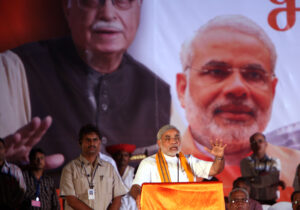
July 2024, Volume 35, Issue 3
While he did not achieve the sweeping victory many predicted, Narendra Modi led his ruling coalition to a third consecutive victory. In so doing, he is laying the foundation for a new political order in which India is simultaneously more democratic and more illiberal.
April 2008, Volume 19, Issue 2
Long an extreme case of institutionalized instability, Ecuador now has a dynamic young president who is determined to remake its constitution, and eventually its society, in the name of "twenty-first-century socialism."
April 2008, Volume 19, Issue 2
Democracy assistance has been a growing priority for the United States since the end of the Cold War. The record shows that its focus goes well beyond elections and other procedural dimensions of democracy.
January 2008, Volume 19, Issue 1
The history of twentieth-century European communist parties shows that extremists can be moderated by robust democratic institutions. Without them, however, the inclusion of extremist parties may undermine democracy.
April 2004, Volume 15, Issue 2
Constitution writers in ethnically or otherwise divided countries should focus on designing a system of power-sharing rules and institutions. Studies by political scientists point to a set of basic recommendations that should form a starting point for constitutional negotiations.
April 2004, Volume 15, Issue 2
Events last November confouned expectations set by the failure of democratization in Russia and other ex-Soviet republics, and should prompt new reflections on how fragile openings to democacy may be sustained and widened.

January 2025, Volume 36, Issue 1
The 2024 election led to a dramatic changing of the guard, ushering in new political leaders and ousting dynastic elites. Can a new president correct the corruption and misgovernance of the past?

January 2025, Volume 36, Issue 1
Nicolás Maduro brazenly stole Venezuela’s 2024 presidential election, despite a free, fair, and transparent ballot count that showed a clear opposition victory. Why would an autocrat want to maintain one of the world’s best voting systems?