

January 2020, Volume 31, Issue 1
The New Competitive Authoritarianism
In recent years competitive authoritarianism has emerged in some countries with relatively strong democratic traditions and institutions.
2855 Results
January 2020, Volume 31, Issue 1
In recent years competitive authoritarianism has emerged in some countries with relatively strong democratic traditions and institutions.

April 2025, Volume 36, Issue 2
Despite a brutal thirteen-year civil war, Syrians are not building from scratch. In fact, Syria has a long and rich history of state-building to guide them.
July 2025, Volume 36, Issue 3
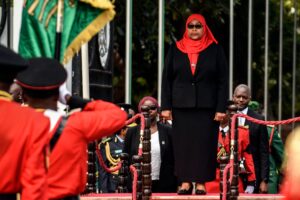
President Samia Suluhu Hassan came into office promising democratic reforms. Four years later, it is clear she is more of a performer than a reformer. Far from delivering on her promises to unwind Tanzania’s authoritarian machinery, she is relying on the repressive tools we know so well.

Forget his excuses. Russia’s autocrat doesn’t worry about NATO. What terrifies him is the prospect of a flourishing Ukrainian democracy.
October 2010, Volume 21, Issue 4
Reports on elections in Burundi, Colombia, Ethiopia, Guinea, Philippines, Poland, Rwanda, São Tomé and Príncipe, Slovakia, and the Solomon Islands.
April 2007, Volume 18, Issue 2
Reports on elections in Bahrain, Gabon, The Gambia, Lesotho, Madagascar, Mauritania, Saint Lucia, Senegal, Serbia, and Turkmenistan.

October 2013, Volume 24, Issue 4
Is democracy threatened by a “reverse wave”? Examining regional patterns and distinguishing between different types of democracy gives us a new basis for assessing this question. Listen to the podcast with authors Jørgen Møller and Svend-Erik Skaaning [mp3]
January 2011, Volume 22, Issue 1
Imprisoned Chinese dissident Liu Xiaobo, who was awarded the 2010 Nobel Peace Prize, is best known for his eloquent and incisive essays. Two of them are featured here: “Can It Be That the Chinese People Deserve Only ‘Party-Led Democracy’?” and “Changing the Regime by Changing Society.”
July 2010, Volume 21, Issue 3
Democratization is never easy, smooth, or linear, but as Indonesia’s experience in building a multiparty and multiethnic democracy shows, it can succeed even under difficult and initially unpromising conditions.
October 2005, Volume 16, Issue 4
Having drawn lessons from the downfall of some of his fellow autocrats, President Alyaksandr Lukashenka is preventing the emergence of an effective democratic movement in Belarus.
July 2022, Volume 33, Issue 3
A group of corrupt authoritarian powerholders has impoverished Sri Lanka and even brought starvation to the island. But behind their misrule lies the deeper and longer-term problem of unconstrained majority rule.
April 2009, Volume 20, Issue 2
A review of Conversations with Tocqueville: The Global Democratic Revolution in the Twenty-First Century edited by Aurelian Craiutu and Sheldon Gellar and Tocqueville et les frontières de la démocratie by Nestor Capdevila.
April 2008, Volume 19, Issue 2
A review of India After Gandhi: The History of the World's Largest Democracy by Ramachandra Guha and The Clash Within: Democracy, Religious Violence and India's Future by Martha C. Nussbaum.
January 2008, Volume 19, Issue 1
A review of The Occupation of Iraq: Winning the War, Losing the Peace by Ali A. Allawi.
October 2006, Volume 17, Issue 4
We should neither be too hasty to discount the prodemocratic political ferment in the Arab world, nor be fooled into thinking that Islamist groups will play a constructive part in democratic transitions.
April 2005, Volume 16, Issue 2
Recently reelected premier Thaksin Shinawatra and his "Thais Love Thais" party offer a fusion of populist rhetoric with policies that serve the interests of the Thai business class.
April 2005, Volume 16, Issue 2
A review of The Democratic Advantage: How Democracies Promote Prosperity and Peace by Morton H. Halperin, Joseph T. Siegle, and Michael M. Weinstein.
October 2004, Volume 15, Issue 4
A review of A Continent for the Taking: The Tragedy and Hope of Africa by Howard W. French.
July 2003, Volume 14, Issue 3
Democratic and ecnomic development will become sustainable in sub-Saharan Africa only with the emergence of coherent, legitimate and effective states.
January 2003, Volume 14, Issue 1
The vast obstacles to democratic reformism include basic provisions in the Constitution of the Islamic Republic itself.