

The JoD’s 10 Most-Read Essays
The Journal of Democracy strives to keep you up to date on the latest developments in global democracy and autocracy. Here are our ten most-read essays over the past month.
3273 Results
The Journal of Democracy strives to keep you up to date on the latest developments in global democracy and autocracy. Here are our ten most-read essays over the past month.
July 2014, Volume 25, Issue 3
Reports on elections in Afghanistan, Algeria, Colombia, Egypt, El Salvador, Guinea-Bissau, Hungary, India, Indonesia, Iraq, Kosovo, Libya, Lithuania, Macedonia, Malawi, Maldives, Mauritania, Panama, Serbia, Slovakia, South Africa, and Ukraine.
January 2004, Volume 15, Issue 1
Since the fall of the Berlin Wall, the involvement of NATO and the EU with their prospective new members has worked strongly in favor of democratic governance in Central and Eastern Europe.

July 2025, Volume 36, Issue 3
The most challenging type of diversity for democracy is religious diversity. This also helps explain why modern democracy first took root in Western Europe: Religiously homogenous populations went hand in hand with the early formation of parliaments.
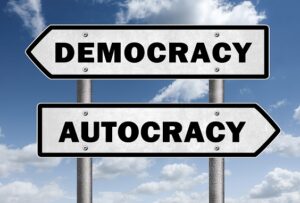
In the new issue of the Journal of Democracy, Kurt Weyland argues that democracy almost always triumphs over populism. In fact, while strongmen may strain democratic institutions, they rarely come out on top.
Winter 1990, Volume 1, Issue 1
Read the full essay here.
April 2011, Volume 22, Issue 2
Are laws guaranteeing citizens freedom of access to public information (FOI laws) among the most important democratic innovations of the last century?
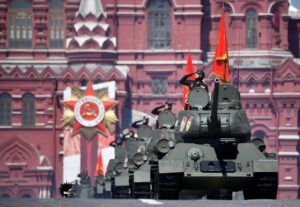
How does a Russian autocrat celebrate Victory Day while losing a war? Expect lies, myths, and propaganda.

January 2014, Volume 25, Issue 1
In recent years, Mexico has stumbled into an encounter with collective violence, this time in the form of the “drug war.” Among its many harms is the damage it is doing to Mexican democracy.
April 2008, Volume 19, Issue 2
Despite key improvements during Néstor Kirchner's presidency, Argentine democracy remains vulnerable to crisis. The near collapse of the party system and weakness of political and economic institutions continue to threaten stability.
January 2007, Volume 18, Issue 1
A crucial requirement of government by consent is the willingness of defeated candidates and parties to concede when the voters' verdict goes against them. Events in Mexico following its July 2006 presidential election have sorely tested that country's young democracy in this regard.
The Reagan-Fascell Democracy Fellows Program at the NED invites applications for fellowships in 2014–15.
October 8, 2013
October 2007, Volume 18, Issue 4
The failure of the elections has been partly mitigated by the hope of judicial review of electoral malfeasance, the stabilizing ingenuity of ethno-regional power-sharing, and renewed national discussions of electoral reforms.
April 2006, Volume 17, Issue 2
Iraq’s three elections in 2005 highlighted the role—but also the limits—of electoral-system design in managing potentially polarizing divisions.
October 2004, Volume 15, Issue 4
Democracy requires robust political equality, but the persistence of social, economic and cultural inequality complicates its realization.

In Bolivia’s presidential runoff on Sunday, center-right senator Rodrigo Paz Pereira defeated right-wing former interim president Jorge “Tuto” Quiroga.
April 2023, Volume 34, Issue 2
The global democratic decline of the last two decades is rarely discussed in the same breath with the 2003 decision by the United States and Britain to invade Iraq. But the roots of our present disorder can be traced to that disastrous and foolhardy war of choice.
July 2018, Volume 29, Issue 3
Bulgaria continues to enjoy free and fair elections, but over the last decade its politics has come to be dominated by Prime Minister Boyko Borisov, who practices a brand of discretionary rule that puts his own priorities above any commitment to legal or constitutional norms.