
April 2006, Volume 17, Issue 2
Electoral Systems Today: A Global Snapshot
A wide variety of electoral systems is used around the world, but in recent years the trend has been toward systems based upon greater proportionality.
2779 Results
April 2006, Volume 17, Issue 2
A wide variety of electoral systems is used around the world, but in recent years the trend has been toward systems based upon greater proportionality.
July 2005, Volume 16, Issue 3
If Iraq is to become the free and self-governing country that an overwhelming majority of its citizens want it to be, a "useable past" made accessible by historical memory will be vital.
July 2005, Volume 16, Issue 3
Many saw the election of Workers' Party leader Luiz Inácio "Lula" da Silva to the Brazilian presidency in October 2002 as the beginning of an era. Two years into his first term, Lula has yet to live up to that expectation.
January 2005, Volume 16, Issue 1
To everyone's surprise, the Congress party defeated the incumbent BJP in the April-May 2004 parliamentary elections. What caused this political turnaround, and what will be its effects?
January 2005, Volume 16, Issue 1
World events-recent, current, and almost certainly to come-drive home the truth that before there can be a democratic state, there must first be a functioning state, period. Creating workable states where they have been destroyed or have barely existed yields to none among the challenges of our time.
October 2004, Volume 15, Issue 4
Surveys show that Africans’ commitment to democracy fades over time, but also that their support can be refreshed by alternations in power via elections.
July 2004, Volume 15, Issue 3
Russia's liberal-democratic parties have failed. It is time for a new movement that can gain the trust of the Russian people by putting forward a full reform program based on liberal and democratic principles.
July 2004, Volume 15, Issue 3
Since the end of the Cold War, Central America has seen a regionwide diminution of military influence that bodes well for democratic governance and healthier civil-military relations.
January 2004, Volume 15, Issue 1
One of the most important events in post-Cold War international affairs, NATO enlargement is even more of a democratic milestone for the countries of Eastern Europe than is the expansion of the EU.
October 2003, Volume 14, Issue 4
The EU was founded partly for the purpose of strengthening democracy, but it has been created in a way that is intrinsically not democratic.
July 2003, Volume 14, Issue 3
New data covering most of the 1990s reveal that democracy, even when minimally defined, has a potent independent impact that tends to reduce infant mortality and promote overall social well-being.
January 2003, Volume 14, Issue 1
After a decade of partial liberalization begun by the late King Hussein, freedoms are now being rolled back by an anxious regime.
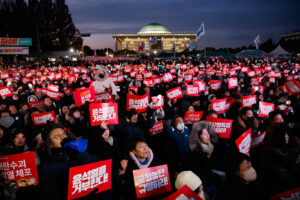
April 2025, Volume 36, Issue 2
When South Korea’s president declared martial law last December, he shocked the country and sparked a political crisis that laid bare deep-seated divisions. Can Korean democracy overcome the nationalist polarization that has always defined it?
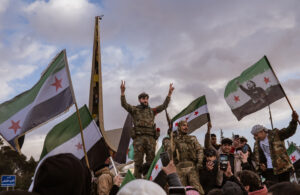
April 2025, Volume 36, Issue 2
Despite a brutal thirteen-year civil war, Syrians are not building from scratch. In fact, Syria has a long and rich history of state-building to guide them.
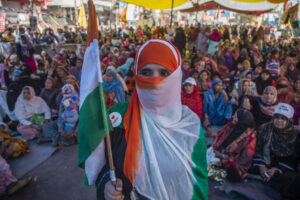
April 2025, Volume 36, Issue 2
The ruling BJP has long sought to sideline Indian Muslims. But even the opposition is opting to exclude them politically. Muslims’ chances at greater representation remain dim.
April 2019, Volume 30, Issue 2
It is imperative that artificial intelligence evolve in ways that respect human rights. Happily, standards found in landmark UN documents can help with the task of making AI serve rather than subjugate human beings.

October 2025, Volume 36, Issue 4
Latin America remains haunted by the specter of “strongman” rule. Term limits have been a way of guarding against this threat, but aspiring autocrats have now found a new avenue to bypass this barrier to power: courts of law.
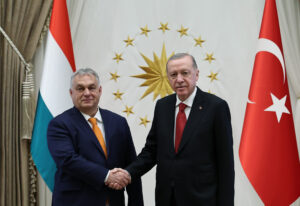
January 2016, Volume 27, Issue 1
Old-fashioned military coups and blatant election-day fraud are becoming mercifully rarer these days, but other, subtler forms of democratic regression are a growing problem that demands more attention.
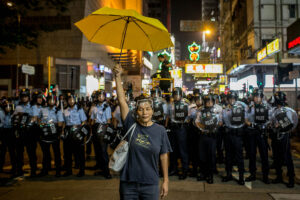
April 2015, Volume 26, Issue 2
The demonstrations of late 2014 captured the world’s attention with their scale, passion, and resourcefulness, but in the end were unable to move dug-in local and national authorities. Yet time is still on the side of the demonstrators.
January 2022, Volume 33, Issue 1
Excerpts from: Sviatlana Tsikhanouskaya’s Summit for Democracy speech; announcement by Women’s Tennis Association cancelling future tournaments in China; statement on sentencing of Tony Chung under Hong Kong’s National Security Law; Honduran president Xiomara Castro’s inauguration address; “Nigeria Unite” by DJ Switch.