
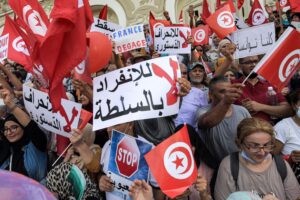

January 2022, Volume 33, Issue 1
Coup in Tunisia: Is Democracy Lost?
President Kais Saied’s power grab has crushed Tunisian democracy, returning the country to the old playbook of Arab dictators past and present.
898 Results
January 2022, Volume 33, Issue 1
President Kais Saied’s power grab has crushed Tunisian democracy, returning the country to the old playbook of Arab dictators past and present.
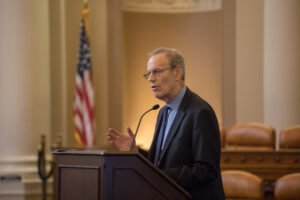
October 2021, Volume 32, Issue 4
The National Endowment for Democracy’s founding president made enormous contributions to the fight for freedom and human rights. Reflections on what his 37-year tenure meant for the democratic cause—and this journal.

July 2025, Volume 36, Issue 3
Capitalism is often blamed for democracy’s ills. But much of the blame is misplaced. It is not business capture of the state but rather state capture of business that poses the greatest danger to democracy.
Just a month after its introduction, ChatGPT, the generative artificial intelligence (AI) chatbot, hit 100-million monthly users, making it the fastest-growing application in history. For context, it took the video-streaming service Netflix, now a household name, three-and-a-half years to reach one-million monthly users. But unlike Netflix, the meteoric rise of ChatGPT and its potential for…
October 2023, Volume 34, Issue 4
Generative AI can flood the media, internet, and even personal correspondence, sowing confusion for voters and government officials alike. If we fail to act, mounting mistrust will polarize our societies and tear at our institutions.
July 1994, Volume 5, Issue 3
Excerpts from: South African President Nelson Mandela’s inaugural speech; Salvadoran president Armando Calderón Sol’s inaugural speech; a presentation speech by Yelena Bonner, the widow of Andrei D. Sakharov.
October 2023, Volume 34, Issue 4
An expansive underworld of hidden wealth lies beneath the everyday economy. This stealth network of tax havens, secret trusts, and offshore accounts is weakening democratic institutions and fueling our worst enemies.
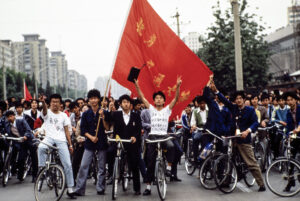
July 1999, Volume 10, Issue 3
The recognition of democracy as a universally relevant system is a major revolution in thinking, and one of the main contributions of the twentieth century. While not yet universally practiced, democracy is now being taken as generally right.
October 1995, Volume 6, Issue 4
Excerpts from: Burmese opposition leader Aung San Suu Kyi’s speech in Rangoon; human rights advocate Harry Wu’s remarks before the U.S. House of Representatives on China’s labor camps; “Our Global Neighborhood,” presented at the World Economic Forum.
July 2010, Volume 21, Issue 3
A review of China's Long March to Freedom: Grassroots Modernization by Kate Zhou.
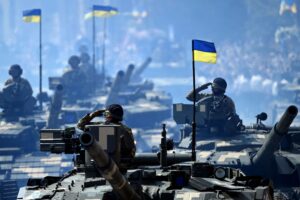
The country’s military is advancing on the battlefield. If Ukraine defeats Russia’s massive army, the ripple effects will be felt across the globe. | By Francis Fukuyama
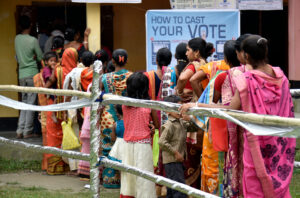
National politics is increasingly overshadowing everything else, even as local government does more and more. Here’s how to right the balance. | By Eguiar Lizundia and Utpal Misra
April 2007, Volume 18, Issue 2
The Putin regime is plunging Russia into a deepening crisis. It is time to end the fiction that today's Russia is a democracy.
October 2016, Volume 27, Issue 4
Liberal democracy in Europe today is under siege from a variety of political forces, but it is critical to recognize the distinctions among them.
April 2024, Volume 35, Issue 2
A liberal society must reckon the demands of the common good, while offering what we most crave—something worth sacrificing for.
April 2019, Volume 30, Issue 2
Spain’s system of Autonomous Communities had functioned fairly smoothly for decades following the country’s democratic transition, but events in Catalonia are putting it under unprecedented strain.
October 2017, Volume 28, Issue 4
“Democratic deconsolidation” on the level of attitudes and beliefs is real, and behind it lies a disturbing rise in tolerance for antisocial behavior, especially among the young.
April 2014, Volume 25, Issue 2
Long prone to coups, Pakistan now for the first time has seen a freely elected government duly serve out its full term and peacefully hand the reins of power to another.
January 2014, Volume 25, Issue 1
The changes that civil societies in Central and Eastern Europe have experienced since communism’s fall are real, but often misunderstood.
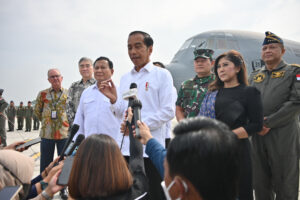
July 2024, Volume 35, Issue 3
What some elites in Indonesia, Malaysia, and Thailand portray as “unity” is nothing more than a corrupt bargain meant to cheat voters of their right to decide their country’s political future before a single ballot is cast.