
October 2020, Volume 31, Issue 4
Election Watch
Reports on elections in Burundi, Guyana, Mali, Poland, Serbia, Singapore, Sri Lanka, Suriname, and Vanuatu.
2116 Results
October 2020, Volume 31, Issue 4
Reports on elections in Burundi, Guyana, Mali, Poland, Serbia, Singapore, Sri Lanka, Suriname, and Vanuatu.
April 2011, Volume 22, Issue 2
In China, the Internet is not merely contested space between citizen and government. It is also a catalyst for social and political transformation, offering the possibility of better governance with greater citizen participation.
January 2019, Volume 30, Issue 1
Reports on elections in Afghanistan, Armenia, Bahrain, Bhutan, Bosnia-Herzegovina, Brazil, Cameroon, Democratic Republic of Congo, Fiji, Gabon, Georgia, Latvia, Madagascar, Maldives, São Tomé and Príncipe, Swaziland, and Togo.
October 2017, Volume 28, Issue 4
A tribute in remembrance of Liu Xiaobo (1955–2017).

The last Soviet leader brought down his regime and ended the Cold War. The free world owes him a debt of gratitude. | By Lucan Ahmad Way
The Council on Foreign Relations has included Steven Heydemann's JoD essay "Syria and the Future of Authoritarianism" on its list of "Must Reads."
October 22, 2013
January 2004, Volume 15, Issue 1
Excerpts from: a November 2003 interview with Iranian human rights activist Shirin Ebadi, winner of the 2003 Nobel Peace Prize; a September 2003 speech by Hossein Khomeni, grandson of the founder and Supreme Leader of the Islamic Republic of Iran; a September 2003 statement issued by Václav Havel, Arpád Göncz, and Lech Wałęsa, former presidents…
July 2009, Volume 20, Issue 3
A tribute in remembrance of Samuel P. Huntington (1927–2008).
January 2015, Volume 26, Issue 1
A review of An Uncanny Era: Conversations Between Václav Havel and Adam Michnik, translated and edited by Elzbieta Matynia.

January 2010, Volume 21, Issue 1
In recent years, scholars have begun to focus on the sources of "authoritarian resilience." But democracy has also shown surprising resilience, in part because the disorders to which it is prone tend to counteract each other.
January 2016, Volume 27, Issue 1
China’s government looks to Singapore, the only country in the region to modernize without liberalizing, in hopes of finding the key to combining authoritarian rule with economic progress and “good governance.”
July 2010, Volume 21, Issue 3
Although many Iraqi parties continue to be organized along religious or ethnic lines, both the tone and the results of the 2010 parliamentary election campaign show that most Iraqi voters prefer a broader national agenda over narrow sectarian appeals.
July 2004, Volume 15, Issue 3
President Vladimir Putin's lopsided election victory was assisted by an unlevel electoral playing field, but elections still matter in Russia and they will make more difficult the consolidation of authoritarianism.

Cuba’s dictatorship has kept student movements under its thumb for decades. But the regime’s repressive tactics have inadvertently breathed new life into a new generation of student activists. These young people are willing to fight for the island’s freedom.
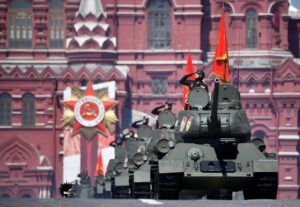
How does a Russian autocrat celebrate Victory Day while losing a war? Expect lies, myths, and propaganda.
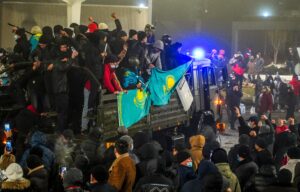
Thousands took to the streets to protest. While the regime promises to listen, its actions make clear: Dissent will not be tolerated.
October 2014, Volume 25, Issue 4
The protests that have been erupting around the world may signal the twilight of both the idea of revolution and the notion of political reformism.
July 2019, Volume 30, Issue 3
Three decades after sub-Saharan Africa joined the “third wave,” democracy’s ability to endure has been established in many countries, but its quality remains a grave concern.
October 2018, Volume 29, Issue 4
Public-opinion data from Pew Research Center show that global support for representative democracy is widespread, but often thin. Amid rising economic anxiety, cultural unease, and political frustration, citizens are increasingly open to alternative systems of government.
July 2015, Volume 26, Issue 3
Nonpartisan election monitoring has helped to foster democratization over the last thirty years, but now dictators are trying to sabotage it, often by spreading lies and confusion.