
Winter 1991, Volume 2, Issue 1
Documents on Democracy
Excerpts from: the Madrid Declaration; Popular Movement of Ukraine (Rukh) party president Ivan Drach’s speech to the Congress; the Charter of Paris.
2785 Results
Winter 1991, Volume 2, Issue 1
Excerpts from: the Madrid Declaration; Popular Movement of Ukraine (Rukh) party president Ivan Drach’s speech to the Congress; the Charter of Paris.

October 2008, Volume 19, Issue 4
A domestic political crisis began brewing in Georgia long before the current conflict with Russia. Since the Rose Revolution, the country has been troubled by flawed elections, a “superpresidency,” and a malleable constitution.
January 2017, Volume 28, Issue 1
Political scientists have long assumed that “democratic consolidation” is a one-way street, but survey evidence of declining support for democracy from across the established democracies suggests that deconsolidation is a genuine danger.
October 2016, Volume 27, Issue 4
Iraqis of all ethnic and sectarian stripes are fed up with the ineptitude and corruption of their political leaders, parties, and government institutions.
July 2020, Volume 31, Issue 3
The Islamic Republic is in a volatile, even prerevolutionary situation, hammered by foreign opposition and sanctions from the outside, and the disillusionment and discontent of its own people from within. But a catalyst needs to appear.
July 2017, Volume 28, Issue 3
Read the full essay here. India’s Supreme Court has played the role of a countermajoritarian check but has also flirted with populism. This essay examines three aspects of India’s higher judiciary: the struggle between the judiciary and the other branches over “custody” of the Constitution; the question of judicial independence and who has the right…
April 2017, Volume 28, Issue 2
This small West African country voted a longtime dictator out of the presidency. This victory for democracy was seemingly snatched away by his refusal to leave power—yet a breathtaking reversal lay in store.
July 2015, Volume 26, Issue 3
Europe in the Middle Ages was hardly democratic, but it did have law-based institutions that could and did stay the hands of kings, laying a crucial basis for future state-building and democracy-building alike.
January 2014, Volume 25, Issue 1
The changes that civil societies in Central and Eastern Europe have experienced since communism’s fall are real, but often misunderstood.
July 2013, Volume 24, Issue 3
Not only did the Algerian regime survive the “Arab Spring,” it hardly deviated from its normal methods of authoritarian governance—patronage, pseudodemocratization, and effective use of the security apparatus.
April 2011, Volume 22, Issue 2
Once dismissed as an “overcrowded barracoon,” this Indian Ocean island nation has more recently been hailed as one of Africa’s “emerging success stories,” but the truth is that some troublesome shadings haunt this rosy picture.
January 2009, Volume 20, Issue 1
For most of history, a closed social order has seemed the most “natural” way to manage the problem of controlling the use of force. The rise of modern democracy can be understood only in the context of the transition to open-access orders.
April 2007, Volume 18, Issue 2
By most theoretical accounts, Indian democracy should not even exist. Yet, despite serious challenges, it shows signs of enduring and even deepening.
April 2007, Volume 18, Issue 2
Pervasive corruption hampers India's democracy, yet anticorruption movements may be helping to improve governmental accountability.
January 2006, Volume 17, Issue 1
Data from Africa show that repeated elections, regardless of their relative freeness or fairness,appear to have a positive impact on the growth of civil liberties and democratic values.
January 2004, Volume 15, Issue 1
The fall of the Berlin Wall gave East Europeans a euphoric sense that they were about to give European democacy a new direction. But as many of their countries prepare to join the EU, little has worked out as expected in those heady days.
April 2003, Volume 14, Issue 2
The recent election of political outsider Lula da Silva as president is a sign of hope for the future of democracy in Brazil.
January 2003, Volume 14, Issue 1
Holding regular, free elections may not be enough to stop turbulence that threatens both the quality of democracy and the coherence of the state.
October 2024, Volume 35, Issue 4
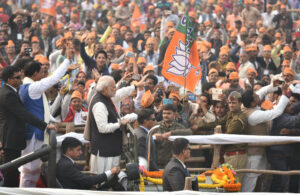
Majoritarian nationalism is a defining feature of our time. If we are to resist ethnonationalist leaders trying to recast our societies into imagined majorities, we must revise our conception of democracy and the exclusion inherent in majority rule.
January 1993, Volume 4, Issue 1
Excerpts from: Organization of American States resolutions on the “presidential coup” in Peru; the report of the Argentinian National Commission of Disappeared Persons.