
October 2015, Volume 26, Issue 4
After the Arab Spring: Do Muslims Vote Islamic Now?
Islamic political parties were not especially popular with voters in Muslim-majority countries before the Arab Spring. Has that changed?
3264 Results
October 2015, Volume 26, Issue 4
Islamic political parties were not especially popular with voters in Muslim-majority countries before the Arab Spring. Has that changed?
July 2013, Volume 24, Issue 3
Today’s Russian protest movement in many ways resembles past civil-rights and civil-resistance efforts in other parts of the world, from its commitment to nonviolence to its key demands—a vote that counts and equality under the law. Listen to the podcast.
January 2013, Volume 24, Issue 1
China is heading toward a tipping point, with two likely scenarios for how a political opening will come about. Most Chinese intellectuals think that only gradualism—“slow and steady,” step-by-step reform—can offer China a safe and feasible path toward liberal democracy. But they are wrong. Instead of “taking it slow,” China should shun gradualism and opt…
July 2012, Volume 23, Issue 3
Until recently, political scientists argued that democracy had poor chances of survival in a multiparty presidential regime. Latin America’s recent experience tells a different story.

July 2024, Volume 35, Issue 3
Claudia Sheinbaum won Mexico’s presidency in a landslide, but celebration of her election as the country’s first female president was blunted by a deeper concern: Mexico’s deteriorating democracy. In truth, the country’s democratic institutions are highly resilient, and there is reason to be optimistic about what lies ahead.
July 2024, Volume 35, Issue 3
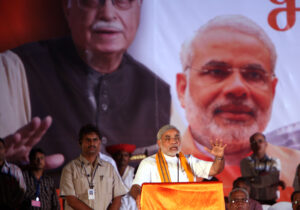
While he did not achieve the sweeping victory many predicted, Narendra Modi led his ruling coalition to a third consecutive victory. In so doing, he is laying the foundation for a new political order in which India is simultaneously more democratic and more illiberal.
October 2006, Volume 17, Issue 4
In reelecting President Alvaro Uribe by a landslide, Colombia's voters opted for continuity. But they chose continuity with an administration that has carried out a major series of policy innovations.
July 2005, Volume 16, Issue 3
The role of international factors varied greatly across the post-Cold War transitions to democracy, but the intensity and results of external democratizing pressure depended on two variables: linkage to the West and Western leverage.
July 2004, Volume 15, Issue 3
Today, Jews the world over are closely and correctly associated with liberal democracy. What are the wellsprings of Jewish tradition and commitment that feed this association?
April 2004, Volume 15, Issue 2
Historical and other evidence from around the world suggests that Protestantism has helped to create a web of mediating factors—from higher literacy to lower corruption to active civic groups—that encourage self-government.
April 2004, Volume 15, Issue 2
East Timor, which emerged from a tragic and bloody past to gain full independence in 2002, offers a factinating case of democratization in a small developing country with a shallow history of democracy.

April 2023, Volume 34, Issue 2
The staggering global popularity of soccer makes it a prime target for regimes that worry about the negative press they get for their undemocratic practices. The Gulf monarchies have led the way in getting into the wide world of sports as a means of cleaning their image.
October 2025, Volume 36, Issue 4
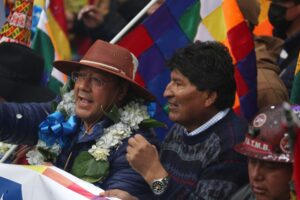
Evo Morales’s Movement Toward Socialism transformed Bolivian politics. But after almost two decades in power, the party is unraveling. No longer the country’s anchor, the MAS has become a major driver of instability and political decay.

July 2024, Volume 35, Issue 3
The Salvadoran president’s “iron fist” policies have become one of the most popular political brands in Latin America. But the very reasons that explain his success in El Salvador point to why his repressive approach will not succeed elsewhere.
April 2013, Volume 24, Issue 2
Evidence of the evil perpetrated in North Korea’s prison camps continues to emerge, as most vividly highlighted by Blaine Harden’s Escape from Camp 14: One Man’s Remarkable Odyssey from North Korea to Freedom in the West.
April 2019, Volume 30, Issue 2
Reports on elections in Bangladesh, Comoros, Democratic Republic of Congo, El Salvador, Estonia, Guinea-Bissau, Madagascar, Moldova, Nigeria, Senegal, and Togo.
July 1998, Volume 9, Issue 3
The early 1990s saw a wave of competitive multiparty elections in Africa. These contests can be described as "founding" elections in the sense that they marked for various countries a transition from an extended period of authoritarian rule to fledgling democratic government. By the middle of the 1990s, this wave had crested. Although founding elections…
October 2013, Volume 24, Issue 4
Excerpts from: Russian anticorruption crusader and Moscow mayoral candidate Alexei Navalny’s speech; presidential contender Nana Akufo-Addo’s speech conceding the race to John Dramani Mahama and Mahama’s address; remarks by jailed Chinese human-rights activist Xu Zhiyong and essay dedicated to him by lawyer and human-rights activist Teng Biao.
April 1993, Volume 4, Issue 2
Reports on elections in Cyprus, Djibouti, Ghana, Kenya, Lithuania, Madagascar, Niger, Senegal, South Korea, Taiwan, Yugoslavia.
July 1998, Volume 9, Issue 3
Reports on elections in Armenia, Colombia, the Dominican Republic, Ecuador, Hong Kong, Hungary, India, Moldova, Paraguay, Philippines, Senegal, Seychelles, Ukraine, Yugoslavia (Montenegro).