
July 1992, Volume 3, Issue 3
Election Watch
Reports on elections in Albania, Azerbaijan, the Czech and Slovak Federative Republic, Ecuador, Fiji, Gambia, Mali, Philippines, St. Lucia, South Korea, Thailand.
3081 Results
July 1992, Volume 3, Issue 3
Reports on elections in Albania, Azerbaijan, the Czech and Slovak Federative Republic, Ecuador, Fiji, Gambia, Mali, Philippines, St. Lucia, South Korea, Thailand.
April 2011, Volume 22, Issue 2
Chinese authoritarianism has deftly adapted to the Internet Age, employing various forms of technological controls. China’s brand of networked authoritarianism serves as a model for other regimes, such as those of Iran and Russia.
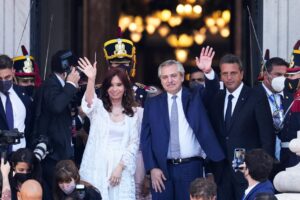
Online Exclusive by Casey Cagley | Across Latin America, former leaders are keeping a chokehold on their countries’ politics. It’s time their successors break free.
Spring 1990, Volume 1, Issue 2
Reports on elections in Brazil, Chile, Costa Rica, Grenada, Nicaragua, the Union of Soviet Socialist Republics, and Zimbabwe.
April 2000, Volume 11, Issue 2
Since its establishment in 1964, the Press Union of Liberia has championed the right of journalists to report freely on events in Liberia and abroad. Political setbacks continue to put it to the test.
October 2003, Volume 14, Issue 4
The rules that govern voting will always be of vital importance in any democracy. The beginning of wisdom is to turn from the usual focus on electoral systems in order to reflect on larger goals and the trade-offs among them that may be necessary.
January 1995, Volume 6, Issue 1
Reports on elections in Botswana, Brazil, Macedonia, Mozambique, Namibia, Nepal, São Tomé and Príncipe, Slovakia, Sri Lanka, Uruguay.
April 1997, Volume 8, Issue 2
Reports on elections in Chad, Gabon, Gambia, Madagascar, Pakistan, Russia (Chechen Republic), Singapore.
April 2011, Volume 22, Issue 2
In late 2010, not long before seismic political change was to erupt across the Middle East, Jordan held parliamentary elections. Officials were eager to present these as a fresh start, but a closer look tells a different tale.
Spring 1991, Volume 2, Issue 2
Reports on elections in Bangladesh, Barbados, Benin, Cape Verde, El Salvador, Guatemala, Haiti, São Tomé & Príncipe, and Yugoslavia.

April 2017, Volume 28, Issue 2
Rising populism in the U.S. and beyond is calling into question the liberal-democratic bargain that has defined the postwar era. What led to Americans’ present revolt against elites, and what are its implications?
October 2016, Volume 27, Issue 4
Reports on elections in Croatia, Gabon, Mongolia, São Tomé and Príncipe, Seychelles, and Zambia.
July 2022, Volume 33, Issue 3
More than window dressing, public-opinion surveys and elections provide a crucial insight into the Russian people’s relationship with their regime.
July 2018, Volume 29, Issue 3
The political turmoil following a journalist’s murder in Slovakia has revealed serious dangers to the country’s democratic institutions.
July 2007, Volume 18, Issue 3
Reports on elections in Algeria, Armenia, Bahamas, Benin, Burkina Faso, Estonia, Mali, Mauritania, Nigeria, and Timor-Leste.
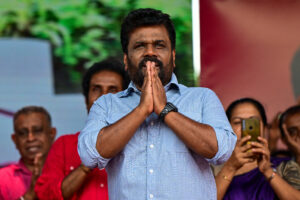
A few years ago Anura Kumara Dissanayake led a struggling political party with bleak prospects. Now he is Sri Lanka’s newly elected president. The hardest work may still lie ahead.
October 2017, Volume 28, Issue 4
Reports on elections in Albania, Angola, Congo (Brazzaville), Kenya, Mongolia, Papua New Guinea, Rwanda, Senegal, and Singapore.
January 2018, Volume 29, Issue 1
International Forum for Democratic Studies report on "Sharp Power: Rising Authoritarian Influence"; Emmerson Mnangagwa's inaugural address as interim president of Zimbabwe; letter from Zimbabwean civil society organizations; address by U.K. prime minister Theresa May; statement by former Soviet political prisoners and dissidents.
January 2004, Volume 15, Issue 1
Reports on elections in Azerbaijan, Croatia, Georgia, Grenada, Guatemala, Mauritania, Rwanda, and Serbia.
Will artificial intelligence end democracy? Plus: Why global democracy is proving to be far more resilient than people think; how African church leaders became unlikely defenders of democracy; and the ways in which vast networks of hidden wealth are eating away at our democratic institutions.