
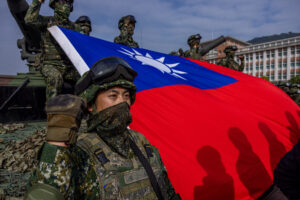
What It Takes to Win the New Cold War with China
Our struggle against the Soviet Union offers vital lessons for how to confront the aggressive totalitarian threat that Beijing now represents. | Carl Gershman
3081 Results
Our struggle against the Soviet Union offers vital lessons for how to confront the aggressive totalitarian threat that Beijing now represents. | Carl Gershman
The Journal of Democracy has partnered with the Review of Democracy podcast and the Democratic Dialogues podcast to share in-depth conversations with JoD authors on their latest essays. Listen, read, and learn!
April 2014, Volume 25, Issue 2
After four years of sharing power with the opposition, Zimbabwe’s longtime president Robert Mugabe and his party claimed a huge victory in the 2013 elections. What accounts for the opposition’s stunning electoral decline?

July 2025, Volume 36, Issue 3
The most challenging type of diversity for democracy is religious diversity. This also helps explain why modern democracy first took root in Western Europe: Religiously homogenous populations went hand in hand with the early formation of parliaments.
July 2013, Volume 24, Issue 3
Reports on elections in Bhutan, Bulgaria, Equatorial Guinea, Kenya, Malaysia, Montenegro, Pakistan, Paraguay, Philippines, and Venezuela.
January 2009, Volume 20, Issue 1
Reports on elections in Azerbaijan, Belarus, the Czech Republic, Guinea-Bissau, Lithuania, the Maldives, Romania, Rwanda, Slovenia, Swaziland, Vanuatu, and Zambia.
April 1993, Volume 4, Issue 2
Excerpts from: speeches from El Salvador’s National Reconciliation Day ceremonies; the Mozambique’s General Peace Accord; South Korean president Kim Young Sam’s inaugural address; Chakufwa Chihana’s speech accepting the 1992 Robert F. Kennedy Human Rights Award.
January 2006, Volume 17, Issue 1
Burundi's leaders are learning to embrace a culture of discussion and consensus that offers a way out of the abyss of civil war.

Cash is king, even if you are an activist leading a democratic movement against some of the world’s worst dictators. That’s why Bitcoin has quickly become the currency of choice for dissidents working everywhere.

Establishment parties are flagging. They should learn from political disruptors.
April 2023, Volume 34, Issue 2
The past year offered the brightest picture in almost two decades, as global improvements in freedom nearly equaled global declines. Is democracy poised for a comeback?

Want to distract the public? Little works better than family feuds ripped from soap opera plotlines. That’s how the Marcos and Duterte clans keep people glued to the drama while crowding out democratic reform.

The Russian autocrat forgot an age-old truth about working with common criminals and soldiers for hire. By Zoltan Barany June 2023 A wonderful gift for Ukraine. My first thought upon reading the news that Yevgeny Prigozhin, leader of the Wagner Group, had called for an armed rebellion was that this serious rupture within the Russian…

January 2019, Volume 30, Issue 1
Democracies must grapple not only with the proliferation of AI to authoritarian and illiberal regimes, but also with the temptation that AI poses for democratic governments themselves.
January 2012, Volume 23, Issue 1
The legitimacy and appeal of democracy in East Asia will depend on how democratic countries in the region stack up against China.
April 2004, Volume 15, Issue 2
A through, deliberat, and consultative constitution-making process, which takes account of key lessons learned in other countries, will be essential to the legitimacy of a new Iraqi constitution and to the future of democracy.
April 2011, Volume 22, Issue 2
Reports on recent elections in Belarus, Cape Verde, Central African Republic, Chad, Haiti, Kosovo, Niger, Samoa, and Uganda.

January 2017, Volume 28, Issue 1
Political scientists have long assumed that “democratic consolidation” is a one-way street, but survey evidence of declining support for democracy from across the established democracies suggests that deconsolidation is a genuine danger.
January 2010, Volume 21, Issue 1
The short-term political impact of the economic crisis has been less dramatic than initially expected, but it may have lasting effects on the “quality” of democracy, including the legitimacy of prevailing financial institutions.
January 2021, Volume 32, Issue 1
Around the world, polarizing political strategies are pushing societies into a vicious cycle of zero-sum politics and eroding democratic norms. If democracies are to escape this trap, wise choices and innovation by prodemocratic politicians will be needed.