
January 2018, Volume 29, Issue 1
The Rise of Kleptocracy: Does China Fit the Model?
China has seen a staggering number of official corruption cases in recent years. But does it merit the label of kleptocracy?
3081 Results
January 2018, Volume 29, Issue 1
China has seen a staggering number of official corruption cases in recent years. But does it merit the label of kleptocracy?
October 2012, Volume 23, Issue 4
The “Arab Spring” has been very hard on autocratic presidents but so far has left the Arab world’s monarchies intact. How and why have Arab royals been able to resist the tide of protest?
April 2000, Volume 11, Issue 2
A country's political regime, regardless of its level of development, affects its social performance. Fewer children die in democracies than in dictatorships.
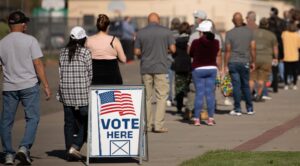

April 2021, Volume 32, Issue 2
The covid-19 pandemic nearly upended the U.S. election, but after a rocky primary season changes were made to save it. Alarmingly, however, a large portion of voters have rejected the result. The challenge of overcoming lies about a “rigged” election is great.
April 2019, Volume 30, Issue 2
It is imperative that artificial intelligence evolve in ways that respect human rights. Happily, standards found in landmark UN documents can help with the task of making AI serve rather than subjugate human beings.
July 2008, Volume 19, Issue 3
Read the full essay here. Political Islam is often cited as the key challenge to democratization in Muslim nations, but deep currents of authoritarianism may prove more of an obstacle. Traditions of monarchy, military rule, and weak civic institutions block the path of democratic transition throughout the Muslim world. Political Islam does of course present…
April 2003, Volume 14, Issue 2
There is an emerging current of enlightened thought in the Muslim world today, but it is all too often wrongly labeled and poorly understood.
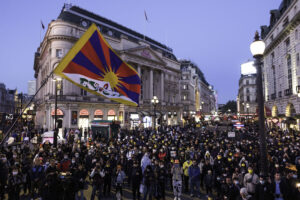
The CCP is engaged in a sprawling campaign to undermine democracy. Governments too often can be lumbering or weak in response. Look to civil society for the creativity and skill to keep the CCP on its heels.
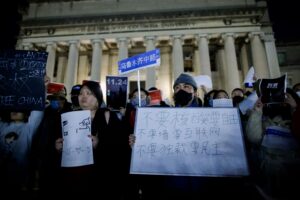
China’s recent protests marked a crucial milestone: The mainstream Chinese public, at home and abroad, finally spoke up for the Uyghurs and their plight. | Tenzin Dorjee
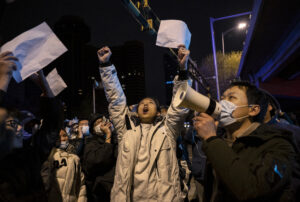
Chinese citizens from Urumqi to Shanghai took to the streets, blank sheets of white paper in hand, to denounce the CCP and call for change. Xi Jinping’s repression and zero-covid lockdowns have united the public in empathy and anger. | Guoguang Wu
January 2013, Volume 24, Issue 1
Given Southeast Asia’s relatively high level of socioeconomic development, we might expect it to be a showcase of democracy. Yet it is not. To grasp why, one must look to deeper factors of history and geography.
January 1998, Volume 9, Issue 1
Excerpts from: Chinese dissident Wei Jingsheng’s opening statement; Chinese president Jiang Zemin’s statement; Organization of American States Charter amendment; Iranian president Mohammad Khatami’s inaugural address; National Endowment for Democracy president Carl Gershman’s keynote conference speech.
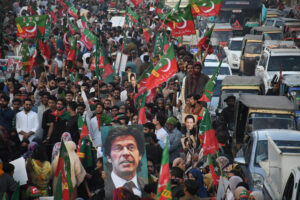
The break between the military and former prime minister Imran Khan marks a new era of instability. Is this the rise of an autocratic deep state or the fall of authoritarian populism? | Ayesha Jalal
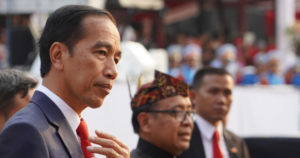
October 2019, Volume 30, Issue 4
For the second straight time, voters rejected a presidential candidate with ties to undemocratic Islamist forces, but victorious incumbent Joko Widodo felt compelled to tone down his support for liberalism.
April 2012, Volume 23, Issue 2
The upheavals that have been shaking the Arab-Muslim world are revolutions in discourse as well as in the streets. Arabs are using not only traditional and religious vocabularies, but also a new set of expressions that are modern and represent popular aspirations.
October 2021, Volume 32, Issue 4
A weakened mandate from voters and perennial state dysfunction are putting Mexico’s populist president in a bind. Will he further damage democracy to fulfill his promises for change?
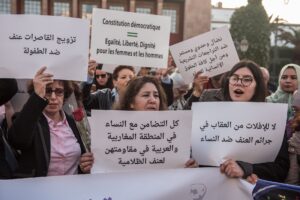
April 2022, Volume 33, Issue 2
Why are authoritarian regimes championing gender equality? Modern dictators want to appear progressive, liberal, and democratic, while distracting from their worst abuses.
January 2004, Volume 15, Issue 1
It has been claimed in the pages of this journal that a homogeneous society is an advantage when it comes to democratization. How might this suggestion be empirically tested, and with what (perhaps preliminary) results?