

The South Asian country is holding an election that will not only set it on a new political path but also reestablish its constitutional order. It’s intricate and carefully designed. But will it work?
January 2026
On 12 February 2026, Bangladesh will conduct one of the most institutionally consequential votes in its postauthoritarian transition. More than 127 million people are expected to enter polling stations carrying two distinct but interlocking forms of democratic authority in their hands. One ballot, printed on white paper, will determine parliamentary representation through the familiar mechanics of electoral competition. The other, on pink, will seek popular consent for the July National Charter (Constitutional Reform) Implementation Order 2025, a bundled referendum designed to authorize a sweeping reconfiguration of the constitutional order.
The simultaneity of these ballots is not merely an administrative convenience. It compresses constitutional refounding and the vote for parliamentary representation into a single day of political judgement. Voters are being asked not only to choose who will govern but also to authorize the institutional architecture within which governance will operate during the same democratic moment. Only after votes are cast will the depth and scope of that authorization become politically legible. This compression transforms the referendum from a procedural supplement into a systemic legitimacy stress test for Bangladesh’s democratic transition.
From Uprising to Charter
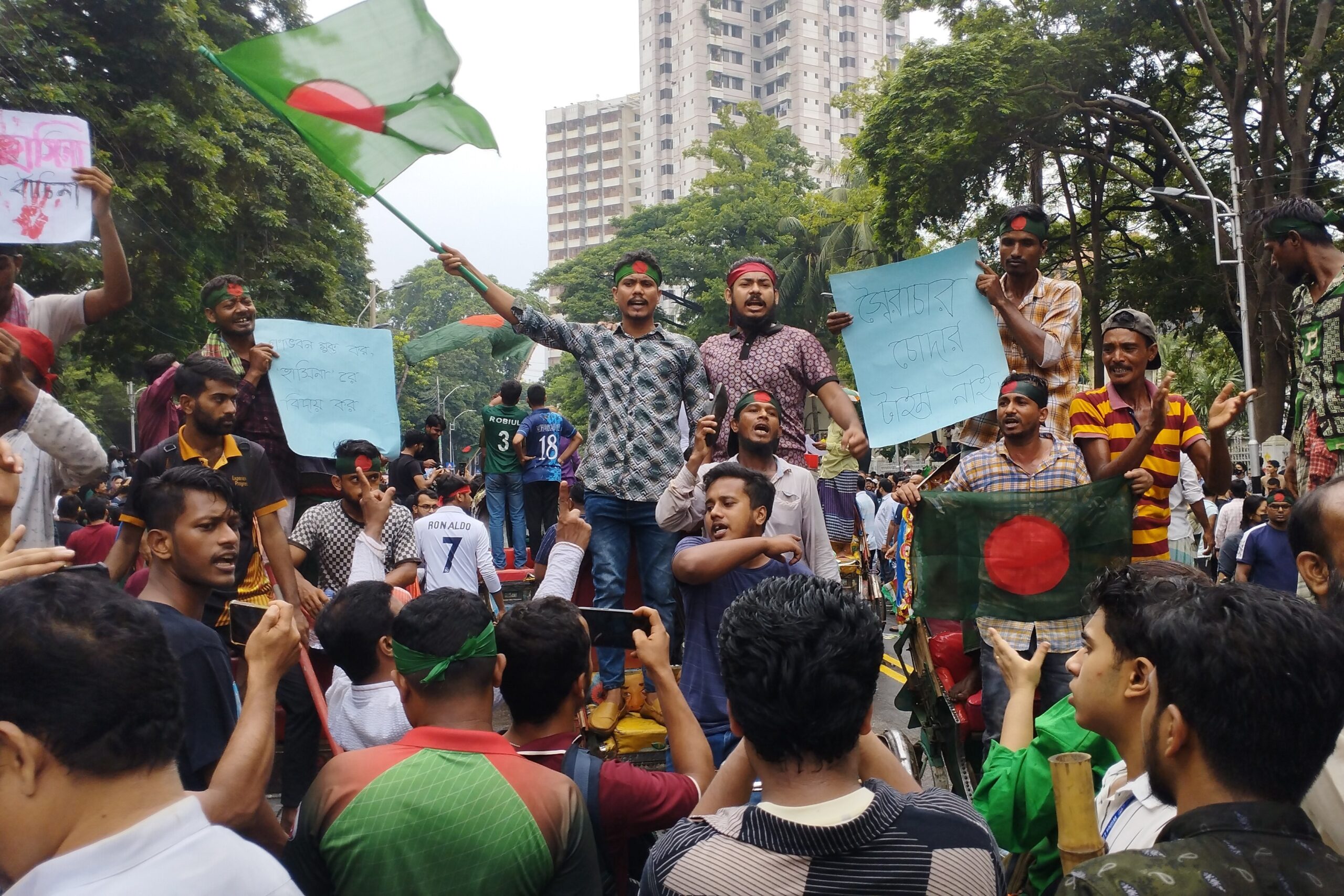
The July National Charter’s political genealogy lies in the student-led July–August 2024 mass uprising that culminated in the collapse of the incumbent regime headed by Sheikh Hasina of the Bangladesh Awami League. Like many transitional ruptures, the uprising generated what political theory describes as founding legitimacy, a moral claim that existing institutions had forfeited democratic credibility and required systemic redesign. Protest movements can delegitimize regimes, but they cannot themselves institutionalize constitutional order. Their authority must be translated into procedural form.
The interim government, led by Nobel Peace Prize laureate and economist Muhammad Yunus, pursued this translation through the National Consensus Commission, which Yunus chaired alongside vice-chair Ali Riaz, a political scientist. Throughout 2025, the Commission convened structured deliberations among 33 political parties and alliances with the aim of converting “uprising aspirations” into institutional blueprints. These negotiations sought to bridge street mobilization and constitutional design, producing a framework capable of transforming “revolutionary” legitimacy into juridical authority.
This process culminated in the July National Charter, which was signed by 25 political parties on 17 October 2025. The Charter contains 84 reform recommendations, including 48 constitutional amendments, addressing executive term limits, judicial independence, electoral governance, oversight institutions, and decentralization. To give the document legal force, Bangladeshi president Mohammed Shahabuddin of the Awami League issued the July Charter Implementation Order on 13 November 2025, mandating a referendum to obtain the “sovereign consent of the people.” The referendum thus represents the final procedural step in a legitimacy-translation chain that runs from uprising mandate to negotiated reform to constitutional authorization.
Institutional Architecture and Party Fractures
Despite its presentation as a consensus document, the Charter contains significant areas of structured dissent. These disagreements are not peripheral. They reflect competing constitutional philosophies about how democratic power should be distributed in a postauthoritarian state.
The most visible cleavage concerns the proposed bicameral legislature. The Islamist Jamaat-e-Islami party and the student-led National Citizen Party advocate the creation of a 100-member upper house selected through proportional representation based on the national vote share of each political party. The argument for this approach rests on representational pluralism. Proportional systems disperse legislative authority and reduce the distortions produced by majoritarian electoral rules.
The Bangladesh Nationalist Party (BNP), now the country’s de facto largest party, and which had alternated in power with the Awami League from 1991 to 2006, dissented from this model, proposing instead that upper-house composition be proportionately derived from the partisan seat distribution of the lower house. This alternative preserves governability coherence by aligning both chambers with parliamentary majorities. The disagreement therefore reflects a structural trade-off between representational diversity and legislative efficiency rather than a mere technical dispute.
A second fracture concerns the Charter’s proposal to prohibit the simultaneous holding of the offices of prime minister and party chief. Reform advocates view this separation as a safeguard against party-state fusion, arguing that unified leadership concentrates executive, legislative, and organizational power vertically. Opponents within the BNP caution that dividing party and executive leadership could fragment command structures, generating internal instability rather than democratic restraint.
Additional dissents extend to the composition of selection committees for independent commissions, the creation of a Judicial Secretariat under Supreme Court supervision, and the administrative reach of oversight bodies. Collectively, these disagreements reveal a deeper tension between advocates of systemic institutional overhaul and proponents of incremental parliamentary reform.
The Sidenote Doctrine and Structured Contestability
To accommodate dissent without derailing the reform process, the Charter institutionalized what may be described as a sidenote doctrine. Political parties were permitted to sign the Charter while formally recording objections to specific provisions. The framework further stipulates that any political party or alliance securing an electoral mandate on the basis of explicit manifesto commitments opposing particular reforms may pursue alternative institutional pathways once in office. Dissent, in other words, was not excluded from constitutional design but procedurally embedded within it.
This mechanism functions as a political pressure valve, enabling broad coalition participation in constitutional authorship without requiring ideological convergence on every reform domain. Yet that same mechanism also produces a legitimacy paradox. The Charter is presented to voters as a consensus framework even though key provisions remain electorally contestable after ratification. A “yes” vote therefore does not fully resolve constitutional disagreement; it defers elements of that disagreement to the next Parliament, where electoral mandates may collide with referendum authorization.
Contestability, however, is not evenly distributed across the reform architecture. The referendum framework differentiates between provisions that acquire binding constitutional force upon ratification and those that remain open to partisan reinterpretation. Core institutional arrangements — including the formation procedures for caretaker governments, the Election Commission, and the proportional composition of an upper house — are structured to take effect if approved, irrespective of recorded sidenotes. Other reform domains remain electorally negotiable, allowing parties to operationalize dissent through subsequent legislative pathways. The referendum thus authorizes a reform package whose internal contestability is itself institutionally prestructured.
This asymmetry introduces an additional layer of interpretive complexity. When citizens vote on reforms touching electoral-oversight bodies or legislative design, the object of consent is not purely substantive. Voters are not simply approving institutional arrangements in the abstract; they are endorsing reforms whose implementation pathways are already structured by dissent notes, override provisions, and manifesto-based revision pathways that allow elected parties to revisit specific reforms. Consent therefore attaches not only to institutional design but also to the procedural rules governing how disagreement over that design may unfold. In practical terms, some reforms acquire binding constitutional force upon ratification, while others remain open to renegotiation through subsequent electoral politics.
Moreover, by structuring approval of constitutional reforms through the legal architecture of the Implementation Order, the referendum embeds the reforms within a predefined framework of operationalization. To vote on a proposal carrying a recorded sidenote is therefore to authorize both the reform and the conditional framework governing its future contestation.
This design creates the possibility of postreferendum disagreement over what precisely has been authorized. Did voters endorse reforms as substantively framed in the Charter? Or did they endorse reforms as operationalized through an implementation framework that, in certain domains, overrides recorded dissent while preserving it in others? Tensions may sharpen where the Charter as a negotiated political blueprint diverges in interpretive emphasis from the Implementation Order as the juridical instrument structuring its binding force.
In this sense, the referendum does not simply register constitutional approval. It institutionalizes an interpretive horizon within which the meaning, scope, and binding force of that approval will continue to be contested. Authorization is secured at the ballot box, but its operational content remains politically and legislatively mediated.
Bundled Authorization and Consent Compression
If the sidenote doctrine structures how constitutional disagreement persists after ratification, the referendum ballot shapes how consent is generated before it.
Voters are presented with a single aggregated question encompassing dozens of constitutional reforms. Executive limitations, judicial restructuring, electoral redesign, and legislative engineering are folded into one approval vote. Institutional redesign is thus converted into a single, or unified, authorization moment rather than a sequence of discrete public choices.
This design narrows the space for differentiated consent. Voters who support executive term limits but oppose bicameral restructuring, for instance, cannot register that distinction. The ballot captures endorsement of the reform package in toto, leaving the scope of that mandate open to postreferendum interpretation. Legitimacy is therefore authorized collectively but specified politically, creating room for expansive institutional claims about the depth and breadth of public approval.
Such compression does not automatically invalidate democratic authorization. Bundled referendums are a recurrent feature of transitional constitutional moments, where institutional reforms are structurally interdependent rather than modular. Foundational redesign processes such as Kenya’s 2010 reform constitution and Chile’s 2022 constitutional referendum similarly aggregated executive, legislative, and judicial restructuring into unified authorization votes. In both cases, institutional transformation unfolded amid intense political polarization over the scope and direction of systemic change, reflecting the practical difficulty of sequencing foundational redesign through discrete plebiscites. Disaggregating such reforms into separate votes may fracture the coherence of the institutional architecture itself or expose individual components to strategic blockage capable of derailing the broader transition.
The democratic question, therefore, turns less on bundling itself than on the procedural environment within which consent is formed. Where voters perceive neutrality in framing, transparency in institutional implications, and equitable access to information, bundled authorization can still generate durable legitimacy even if its internal consent structure remains compressed.
The Legislative Clock and Transitional Leverage
The Implementation Order establishes a Constitutional Reform Council composed of newly elected members of Parliament. The Council is granted 180 working days to finalize constitutional amendments within an overall 270-day institutional lifespan.
The reform timetable compresses deliberation into a fixed constitutional window, structuring negotiation under conditions of procedural urgency rather than open-ended legislative reflection. In doing so, it privileges reform velocity over deliberative depth, accelerating institutional redesign while constraining the time available for parliamentary bargaining.
Time, in this arrangement, is not neutral; it redistributes bargaining power between transitional authorities and elected representatives. If the Council fails to secure supermajority agreement on the amendments within the designated period, the reform process risks stalling or being deferred, preserving transitional design expectations without guaranteeing constitutional incorporation. Delay, in this framework, does not merely slow reform. It sustains the shadow of transitional authorship over elected constitutional agency, allowing frameworks conceived under an interim mandate to retain structuring influence even in the absence of legislative ratification.
The ticking legislative clock thus generates structural leverage for transitional design over parliamentary deliberation. By embedding temporal pressure into constitutional negotiation, the framework raises a fundamental democratic question: whether electoral legitimacy can meaningfully revise reform architectures authored under a transitional mandate, or whether time itself operates to insulate transitional blueprints from substantive legislative re-authoring.
The institutional logic underlying this design presumes continuity between uprising legitimacy and electoral legitimacy. Yet that continuity may weaken once competitive party politics resumes and elected politicians assert independent constitutional authorship grounded in a fresh democratic mandate rather than “revolutionary” inheritance.
Simultaneity Revisited
Holding a referendum alongside a parliamentary election is not inherently democratically deficient. New Zealand’s binding 1993 electoral reform referendum and Uruguay’s constitutional plebiscites, for example, were conducted alongside general elections where voters simultaneously authorized political leadership and institutional change within a single electoral moment. In both cases, electoral and institutional authorization were temporally fused without being normatively disqualifying.
The concern in Bangladesh’s case lies not in the simultaneity itself but in the compression of multiple constitutional decisions into one act of consent.
That compression intensifies within a transitional institutional setting. The referendum intersects with bundled constitutional reform, transitional drafting authority retained by unelected bodies, externally imposed time constraints on amendment deliberation structured through the Implementation Order, and the exclusion of major political parties — most notably, the Awami League and the Jatiyo Party. Each element complicates democratic authorization on its own. In combination, they thicken interpretive complexity.
Voters are thus asked to authorize representatives and constitutional architecture under conditions of institutional flux. The electoral act becomes dual in function but unequal in deliberative depth. Candidate choice remains individualized and locally grounded, while constitutional consent is aggregated and systemic. This asymmetry complicates the thickness of consent that can realistically be generated within a single electoral encounter, making it difficult to determine whether referendum outcomes reflect considered constitutional endorsement or are instead shaped by concurrent electoral loyalties and campaign dynamics, even where procedural administration remains formally sound.
Verdict: Authorization Achieved, Consensus Deferred
The February 12 referendum is likely to succeed procedurally. A majority vote may authorize the Charter’s reform trajectory and provide the formal legal mandate required for constitutional change. Yet the acquisition of a mandate does not settle the question of legitimacy. Authorization may be secured at the ballot box even as agreement over institutional design remains politically unsettled. This deferred consensus is not merely a byproduct of political polarization but is partly structured by the Charter’s sidenote doctrine, whose conditional pathways for post-ratification contestation remain unevenly preserved within the Implementation Order, even in instances where referendum approval renders certain reforms constitutionally binding. In this sense, the referendum concentrates an unusually high degree of authorization density into a single electoral moment, asking constitutional consent to perform work that democratic deliberation typically unfolds over time.
The vote therefore functions not only as constitutional authorization but as an institutional wager. Bangladesh is, in effect, gambling that accelerated reform can generate durable legitimacy before political consensus fully matures. Institutional redesign and consensus formation are compressed into one act of political judgement, placing unusual interpretive weight on the referendum outcome itself.
Is the referendum, then, a sound and responsible democratic instrument? The answer is institutionally mixed. The intent to dismantle “autocratic concentration” of power is normatively compelling and historically anchored in the mass uprising that produced the reform agenda embodied in the Charter. However, the referendum’s design, as structured through the Implementation Order, introduces structural constraints on how consent is expressed. By selectively operationalizing the sidenote doctrine and by presenting constitutional transformation as a single aggregated choice, the process accelerates institutional authorization while limiting the space for differentiated political endorsement.
Questions of inclusion further shape the legitimacy horizon. The relative marginalization of the Awami League in the consensus process, shaped by the ban on its political activities imposed in the aftermath of its contested role while in power from 2009 to 2024 and the mass uprising, together with the limited visibility of actors aligned with its electoral base, narrows the participatory breadth of constitutional authorship. Constitutional orders achieve durability not only through ratification but through recognition across political divides. Where foundational design is perceived as politically partial, institutional acceptance may coexist with enduring contestation over the authority of the constitutional order itself.
The implications therefore extend beyond referendum day. Implementation legitimacy will depend on how the next Parliament manages embedded disagreements, interprets reform sequencing, and aligns transitional frameworks with electoral representation. Some of these embedded disagreements will not arise spontaneously from partisan competition but will flow directly from the Charter’s sidenote architecture and its uneven operationalization within the Implementation Order. Under such conditions, legislative conflict becomes an expected site of democratic negotiation rather than evidence of institutional breakdown. Contestation, in this sense, reflects the structured persistence of transitional legitimacy within what is formally framed as fully electoral constitutional ownership.
Bangladesh is thus not simply voting on reforms. It is testing whether its democratic refounding can proceed at transitional speed while still generating broad political ownership. What begins as a dual ballot of electoral choice and constitutional authorization converges into a single legitimacy judgement. That judgement unfolds within institutional frameworks partly shaped under the transitional mandate, rather than solely authored through electoral consent. The pink ballot, in this sense, is less a vote on institutional design than a test of how democracy reconstructs legitimacy after rupture.
Kazi A. S. M. Nurul Huda is associate professor of philosophy at the University of Dhaka and Zuzana Simoniova Cmelikova Visiting International Scholar in Leadership and Ethics at the University of Richmond’s Jepson School of Leadership Studies.
Copyright © 2026 National Endowment for Democracy
Image credit: Mamunur Rashid/NurPhoto via Getty Images
|
FURTHER READING |
||
The Return of Politics in Bangladesh
|

Did Muhammad Yunus Sign Up for Mission Impossible?
|
|