
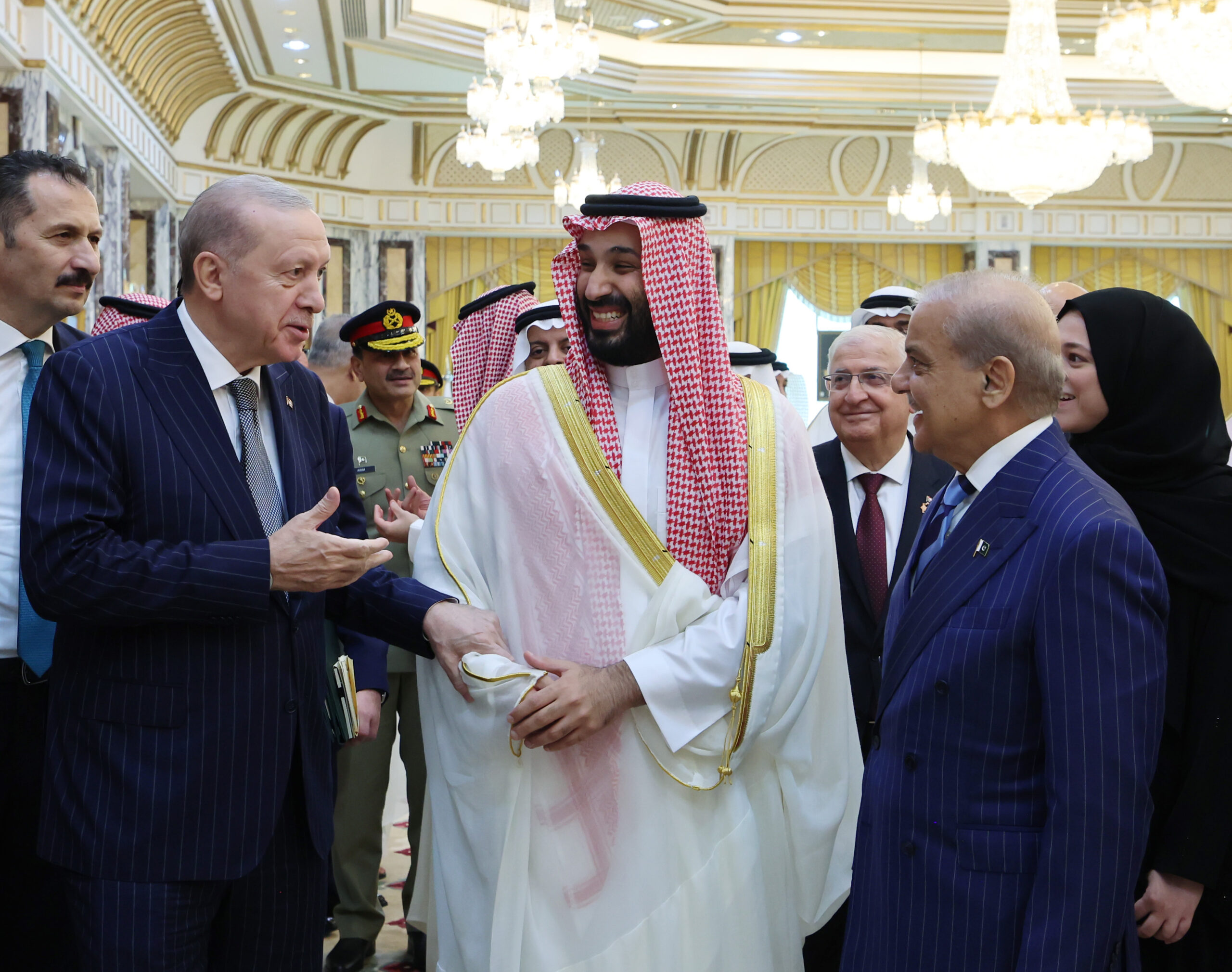
Autocratic middle powers are exploiting the rifts and divisions in the world order to reap newfound deals and influence.
August 2026
Middle powers are having a moment. Last month alone, the United Arab Emirates secured access to advanced American-made AI chips, Kazakhstan became the first country to join both Beijing’s and Washington’s flagship AI initiatives, and Turkey secured the removal of sanctions imposed by U.S. president Donald Trump’s administration.
Nine months after Canadian prime minister Mark Carney’s January 2026 speech in Davos, where he called on democratic middle powers to build a more cooperative world, the early beneficiaries of the “rupture” in the world order have been many of the world’s autocratic middle powers. Rather than trying to pursue self-reliance or build a new system, autocratic middle powers are seeking to extract concessions from an increasingly fragmented international order.
While middle powers are influential players in the international system, they lack the military or economic capabilities of a great power. Some leverage diplomatic capacities to achieve greater influence on the world stage; others punch above their weight because of a large storehouse of natural resources or strategic geography. The classification system is messy, but a growing divide among middle powers is along how they structure their governance: democratic or autocratic.
Today the leaders of democratic middle powers are struggling to chart a course distinct from a United States that increasingly exerts itself coercively. Their foreign policies remain built around alliances and institutions that served as the foundation of a rules-based international order, one that Washington willingly sidesteps in pursuit of ad hoc deals.
For many democratic middle powers, such as Australia, Canada, South Korea, and the United Kingdom, the post–World War II era saw the United Staes undertake a deliberate effort to build institutions that linked middle powers with America’s economic and security architectures. This strategy produced decades of unprecedented stability, peace, and prosperity, but it also created dependencies.
As a result, efforts by middle powers to break away from the United States are fraught with challenges. Despite Carney’s best efforts, the reality is that Canada’s economy has been built around a single customer, the United States, and economic diversification will take time. As Canada is learning, trying to renegotiate one’s relationship with the United States means weathering coercive actions and the threat of economically devastating tariffs. Canada’s situation is hardly unique. Many democratic middle powers remain deeply dependent on Washington for their trade partnerships and will find that attempts to unwind economic ties cannot be reversed quickly.
Self-reliance on defense matters will be even harder. Middle powers have recognized that the world is becoming more dangerous and have moved to meet the moment. Top Polish officials have raised the possibility of Poland “developing national nuclear capabilities,” and France has launched an initiative to expand Europe’s nuclear deterrent. But, for the many democratic middle powers that have tied their security to the United States, there exists no good alternative to the global network of democratic alliances underpinned by Washington. Despite the turmoil and unpredictability that President Trump has injected into the global system, Washington’s power and support remain indispensable to the security of many democratic middle powers.
In contrast, autocratic middle powers face a different set of incentives. Leaders of these nations are focused on regime survival, not electoral accountability. That permits them a wider set of options. Autocratic middle powers also had smaller roles in the post–World War II order. They did not enter the values-based international order the same way that democracies did. This imposed real limits on their behavior. For example, apartheid South Africa was subject to a UN arms embargo and the United States passed the Comprehensive Anti-Apartheid Act, which put the country under immense economic strain. Exclusion from the international order may have seemed like a limiting factor at the time, but today it seems to be an advantage.
The comparative advantage manifests in two ways. The first is via hedging. Autocratic middle powers have increasingly pursued flexible partnerships allowing them to extract concessions from great powers. Angola sought a $4.8 billion loan from Beijing for a major refinery, while also receiving a more than $500 million plus from Washington for the refurbishment of a railway. Djibouti hosts military bases for China, the United States, and others, receiving millions of dollars in payment in return. These states have sought to balance ties between China and the United States, with Vietnam’s leader explicitly saying “We do not pick sides.” They’ve also leveraged ties with regional powers. Egypt has been able to successfully navigate balancing ties with both the UAE and Saudi Arabia, securing vital financial partnerships from both.
Second, autocratic regimes have used their personal ties to gain influence, exploiting behavior that U.S. leaders would once have never engaged in. Kazakhstan agreed to give a small American company access to Kazakhstan’s reserves of tungsten, with the final deal directly benefiting the children of both President Trump and Commerce Secretary Howard Lutnick. Qatar made one of the boldest plays for Trump’s attention, donating a Boeing 747 to the Defense Department to be used as an Air Force One at the start of his second term. Like others, Doha wagers that appealing to Trump directly is an effective means of advancing its own national interests.
Personal ties may produce short-term windfalls, but they rarely generate the durable strategic relationships that institutions do. Autocratic nations must also navigate an increasingly erratic Washington and Beijing that have shown a willingness to use coercive measures to achieve their own goals. Autocracies change leaders, too. As a result, autocratic middle powers will still find themselves bowing to pressure from hegemons. The recent conflict with Iran illustrates these limits. Despite years cultivating personalist ties with the Trump administration, Gulf states were caught by surprise and found themselves exposed to Iranian retaliation.
Ultimately, Carney’s assertion that the only durable answer to an increasingly fragmented world is stronger institutions and deeper cooperation may prove right. But building a new international order is a slow and painful process, and today’s international system rewards governments that employ transactional and more personalized diplomatic approaches. Washington’s transactionalist nature does not discriminate between autocracies and democracies, but as long as it continues to privilege personal relationships over institutional ones, autocratic middle powers will retain a distinct advantage.
Imran Bayoumi is deputy director and resident fellow with the GeoStrategy Initiative at the Atlantic Council’s Scowcroft Center. He previously served as a policy advisor at the U.S. Department of Defense. His work has appeared in the Washington Post, Foreign Policy, the Globe and Mail, and the New Statesman.
Copyright © 2026 JoD Productions
Image Credit: TUR Presidency /Murat Cetinmuhurdar/Anadolu via Getty Images
|
FURTHER READING |
||
The Rise of Authoritarian Middle Powers |

The Golden Age of Transnational Repression |

Dictators Are Buying into Western Media
|